
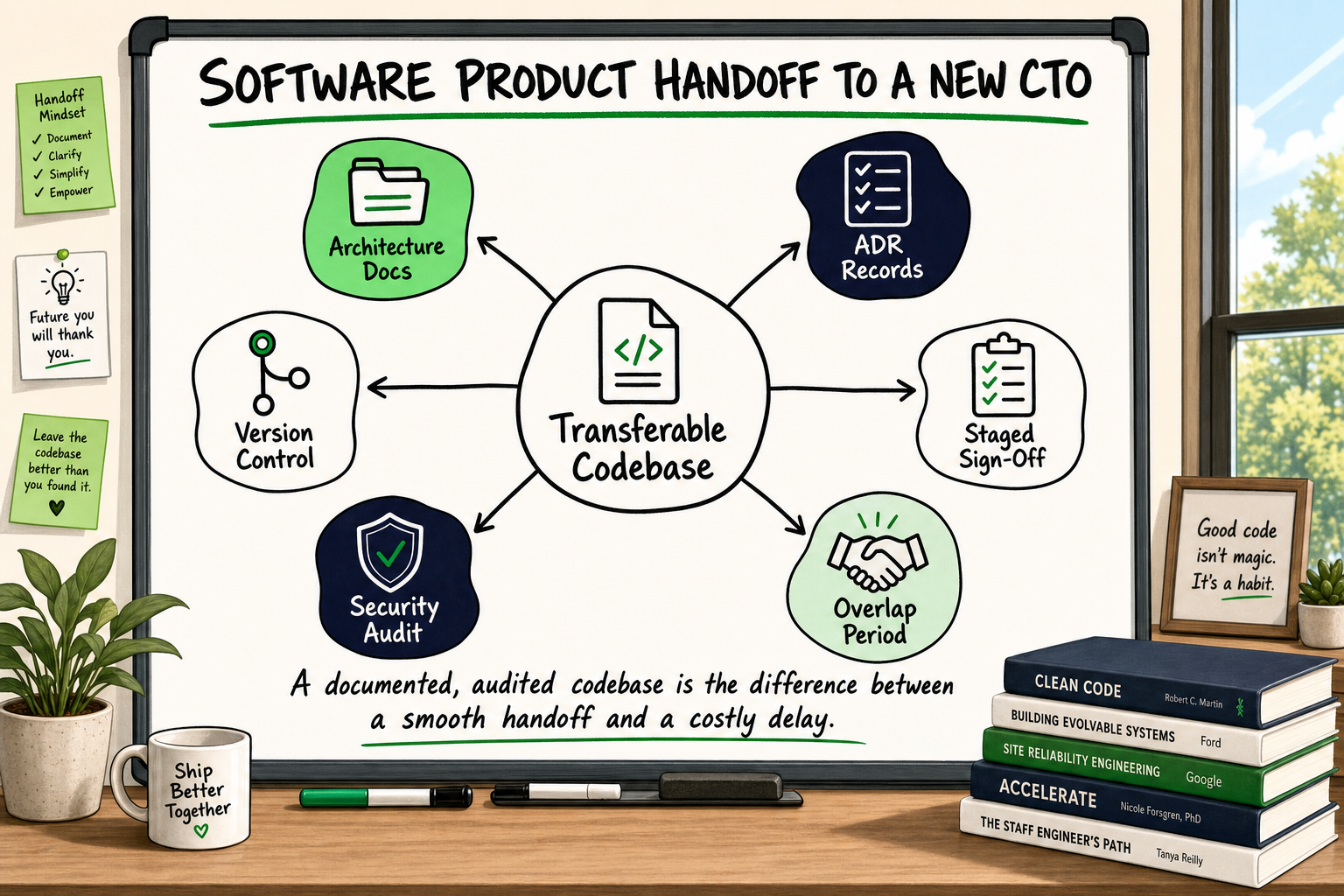
A software product handoff to a new CTO is one of the highest-stakes moments in a startup's lifecycle. Done well, it accelerates your next phase of growth. Done poorly, it costs months of re-work, erodes trust with your incoming hire, and can derail an acquisition at the worst possible moment.
This guide covers exactly what documentation and architecture standards make a codebase transferable — and gives you a step-by-step plan to prepare before the transition begins.
Why Software Handoffs Go Wrong
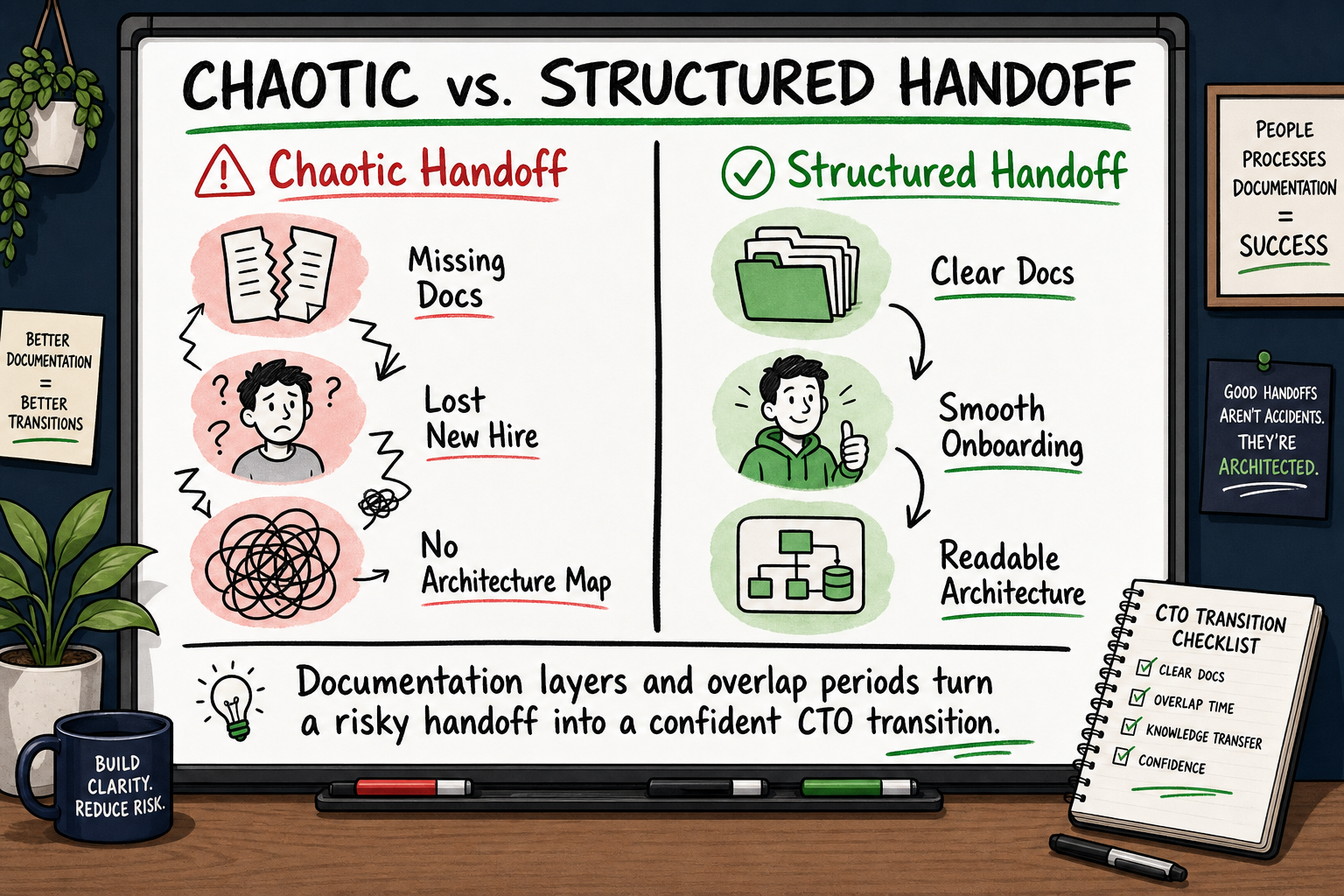
Most handoff failures are not caused by bad code. They are caused by missing context. The outgoing team carries years of decisions in their heads — decisions that never made it into a document, a comment, or a diagram. When they leave, that context leaves with them.
The Hidden Cost of Tribal Knowledge
Tribal knowledge is any technical decision, convention, or operational workaround that exists only in the memory of the people who built the system. Examples include:
- Why the team chose PostgreSQL over MongoDB for a particular service
- Why a seemingly redundant API call exists (removing it breaks a downstream webhook)
- Which environment variables are required but absent from the example
.envfile - The manual step that must happen after every deployment
Our team has audited codebases inherited mid-project where a single undocumented deployment step caused three days of environment failures for the incoming engineers. The fix was a single line in a README. The cost was a full sprint of lost velocity.
Tribal knowledge compounds over time. A two-year-old codebase with no documentation is not just hard to hand off — it is dangerous to modify.
Three Warning Signs Your Codebase Is Not Ready to Hand Off
- No one can set up a local development environment using only what is in the repository. If setup requires a Slack message to the original developer, the knowledge is not in the codebase.
- Technical decisions have no written rationale. A new engineer can read what was built but cannot understand why — and will either repeat the research or, worse, reverse a decision that was made for good reasons.
- There is no runbook for production incidents. If your incoming CTO cannot restart a failed service or roll back a bad deployment without calling someone, the operational risk is unacceptable.
What Is Clean Architecture in Software? Founder's Guide
The Five Layers of a Transferable Codebase
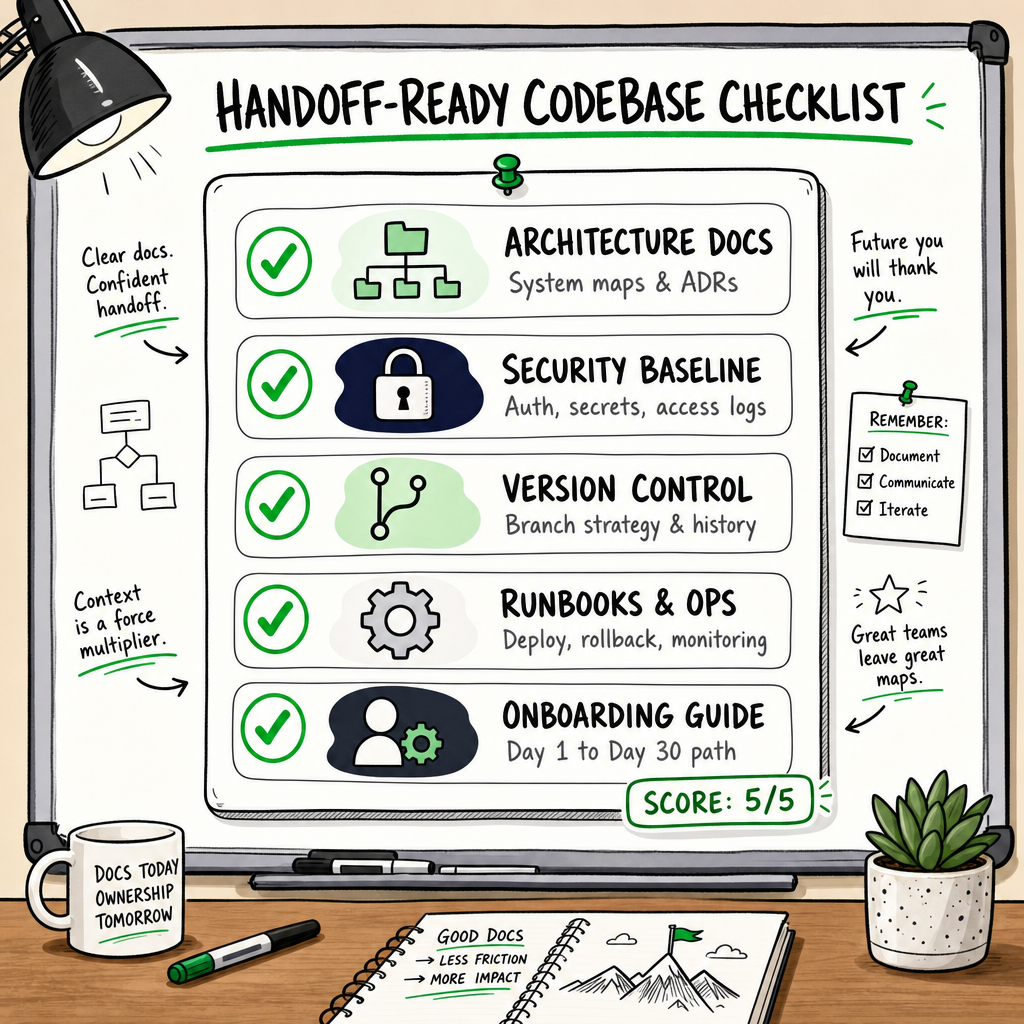
A codebase that can be handed off cleanly has five documentation layers. Think of these as floors in a building — each one supports the floors above it. Missing even one creates a gap that costs real time during a transition.
Layer 1 — Architecture Decision Records (ADRs)
ADRs are short documents that capture why a technical decision was made. They answer the question every new engineer eventually asks: "Why is it built this way?" We cover ADRs in detail in the next section.
Layer 2 — Environment and Infrastructure Documentation
This covers every dependency the system has on the outside world: cloud providers, third-party APIs, environment variables, infrastructure configuration, and deployment pipeline setup. The standard to aim for is infrastructure as code — where the infrastructure itself is version-controlled — supplemented by written documentation explaining the design.
At minimum, document:
- All environment variables and where to obtain their values
- Cloud or hosting provider setup (regions, instance types, scaling rules)
- CI/CD pipeline configuration and what triggers a deployment
- DNS, CDN, and domain management
Layer 3 — Data Model and API Contracts
A new CTO will need to understand your data model quickly. This means:
- An entity-relationship diagram (ERD) for your database schema, kept current
- API documentation for all internal and external endpoints (OpenAPI/Swagger is the standard [VERIFY])
- A changelog for any breaking API changes made after the initial release
Layer 4 — Runbooks and Operational Playbooks
A runbook is a step-by-step guide for performing a specific operational task: deploying a release, rolling back a bad deployment, rotating API keys, handling a database migration, or responding to a production incident.
Runbooks do not need to be long. A bulleted list of steps with expected outputs at each stage is enough. Their value is that a new engineer can follow them without supervision.
Layer 5 — Test Coverage and Quality Gates
An incoming CTO cannot trust a codebase they cannot verify. A test suite with meaningful coverage — and a CI pipeline that enforces it — gives confidence that changes will not silently break existing behaviour. Document:
- Current test coverage percentage and which areas are excluded
- How to run the test suite locally
- Which quality gates are enforced in the CI pipeline (linting, type checking, coverage thresholds)
What Is a Product Backlog? Quality, Grooming & Velocity
Architecture Decision Records: The Single Highest-Value Document You Are Not Writing
Of all the documentation a codebase can have, ADRs deliver the most value per hour invested — and they are the document most teams skip entirely.
Code tells you what the system does. ADRs tell you why. Without ADRs, every incoming engineer re-litigates decisions that were already made, often arriving at a worse answer because they lack the original context.
What an ADR Looks Like in Practice
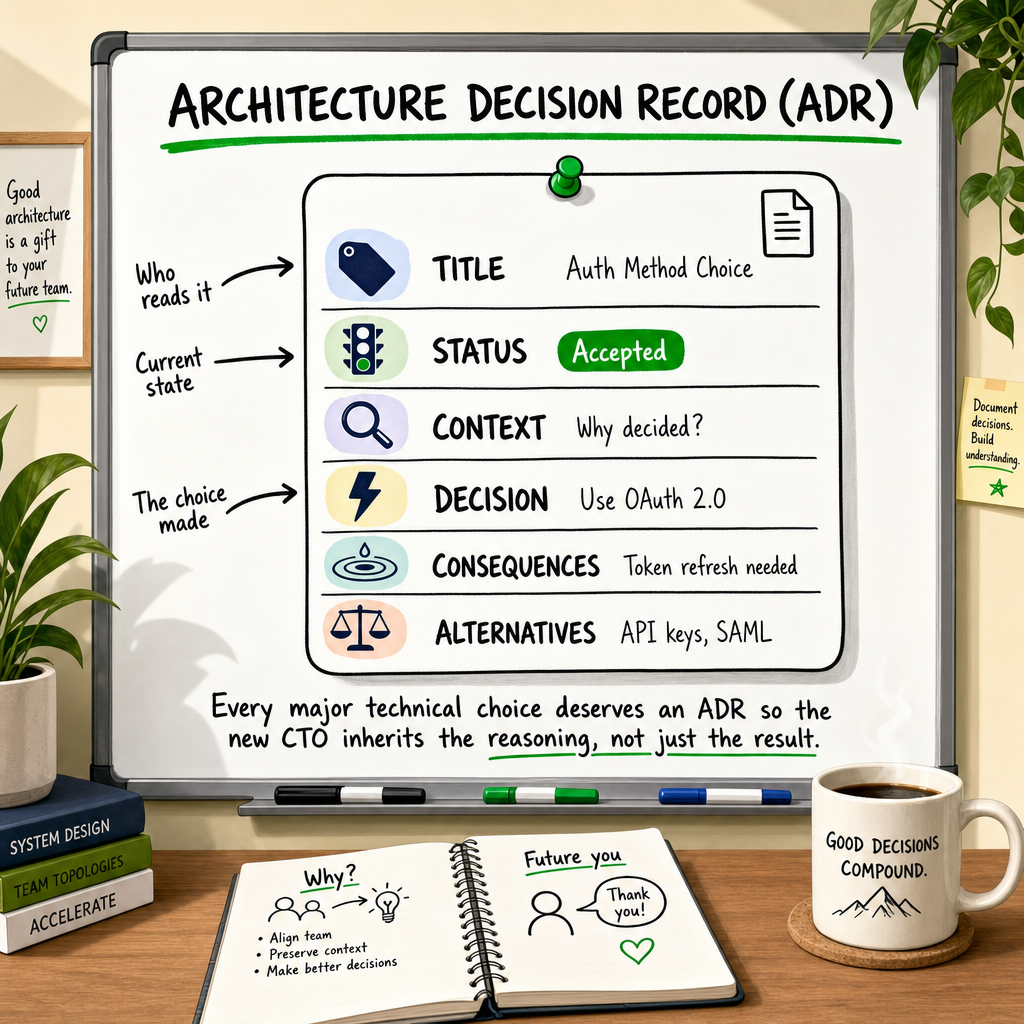
An ADR is typically a short Markdown file stored in a /docs/decisions/ folder in your repository. A minimal ADR contains:
| Field | Description | |---|---| | Title | A short, numbered description: "ADR-004: Use PostgreSQL as the primary datastore" | | Status | Proposed / Accepted / Deprecated / Superseded | | Context | What was the problem or requirement that prompted this decision? | | Decision | What was decided? | | Consequences | What are the trade-offs? What becomes easier and harder as a result? | | Alternatives considered | What else was evaluated and why was it rejected? |
The Alternatives considered field is the most important. It shows the incoming CTO that the decision was made thoughtfully, not arbitrarily — and prevents them from spending a sprint evaluating an option that was already ruled out.
How to Write an ADR Retrospectively (For Existing Codebases)
If your codebase has no ADRs, start by identifying the five to ten most consequential technical decisions made so far. Common examples:
- Choice of primary database
- Monolith vs microservices architecture
- Authentication and authorisation approach
- Choice of cloud provider and deployment model
- Any major third-party integrations baked into the core system
Write a retrospective ADR for each. Even if you cannot fully reconstruct the original context, documenting the decision and its consequences is far better than nothing.
Storing and Versioning ADRs Alongside Code
ADRs should live in the same repository as the code they document. This keeps them version-controlled, searchable, and directly linked to the decisions they describe. A dedicated /docs/adr/ directory with a numbered naming convention (e.g. 0001-use-postgresql.md) is the standard approach.
What Is Clean Architecture in Software? Founder's Guide
Preparing for Technical Due Diligence Before an Acquisition
If you are preparing for an acquisition rather than a CTO hire, the documentation standard is higher — and the consequences of gaps are more severe. Acquirers pay teams of engineers to find problems. They will find yours.
What a Technical Due Diligence Audit Covers
A typical technical due diligence process examines:
- Architecture and scalability — Can the system handle 10× current load? Are there single points of failure?
- Code quality — Is there meaningful test coverage? Is the codebase consistent and maintainable?
- Security posture — Has the OWASP Top Ten been addressed? Are there known vulnerabilities in dependencies? [Source: OWASP]
- Dependency health — Are third-party libraries up to date? Are there licences that create IP complications?
- Operational maturity — Is there monitoring and alerting? Can the team deploy and roll back reliably?
- Documentation completeness — The five layers described above
Dependency Hygiene and Licence Compliance
Outdated or unlicensed dependencies are a common reason acquisitions stall at due diligence. Run a dependency audit before entering any acquisition process:
- Use tools like
npm audit,pip-audit, orbundler-auditdepending on your stack [VERIFY tool names for current availability] - Check that all open-source licences are compatible with commercial distribution (GPL licences, in particular, can complicate asset sales)
- Document any known vulnerabilities with a remediation plan
Security Posture Documentation (OWASP Baseline)
Acquirers and incoming CTOs expect to see that common vulnerabilities have been considered. The OWASP Top Ten is the industry-standard reference [Source: OWASP]. For each item on the list, document whether it applies to your system and what controls are in place. Even a simple spreadsheet showing "considered / addressed / not applicable" is enough to signal maturity.
How to Evaluate a Software Development Partner: 9 Criteria
The Handoff Playbook: A Step-by-Step Transition Plan
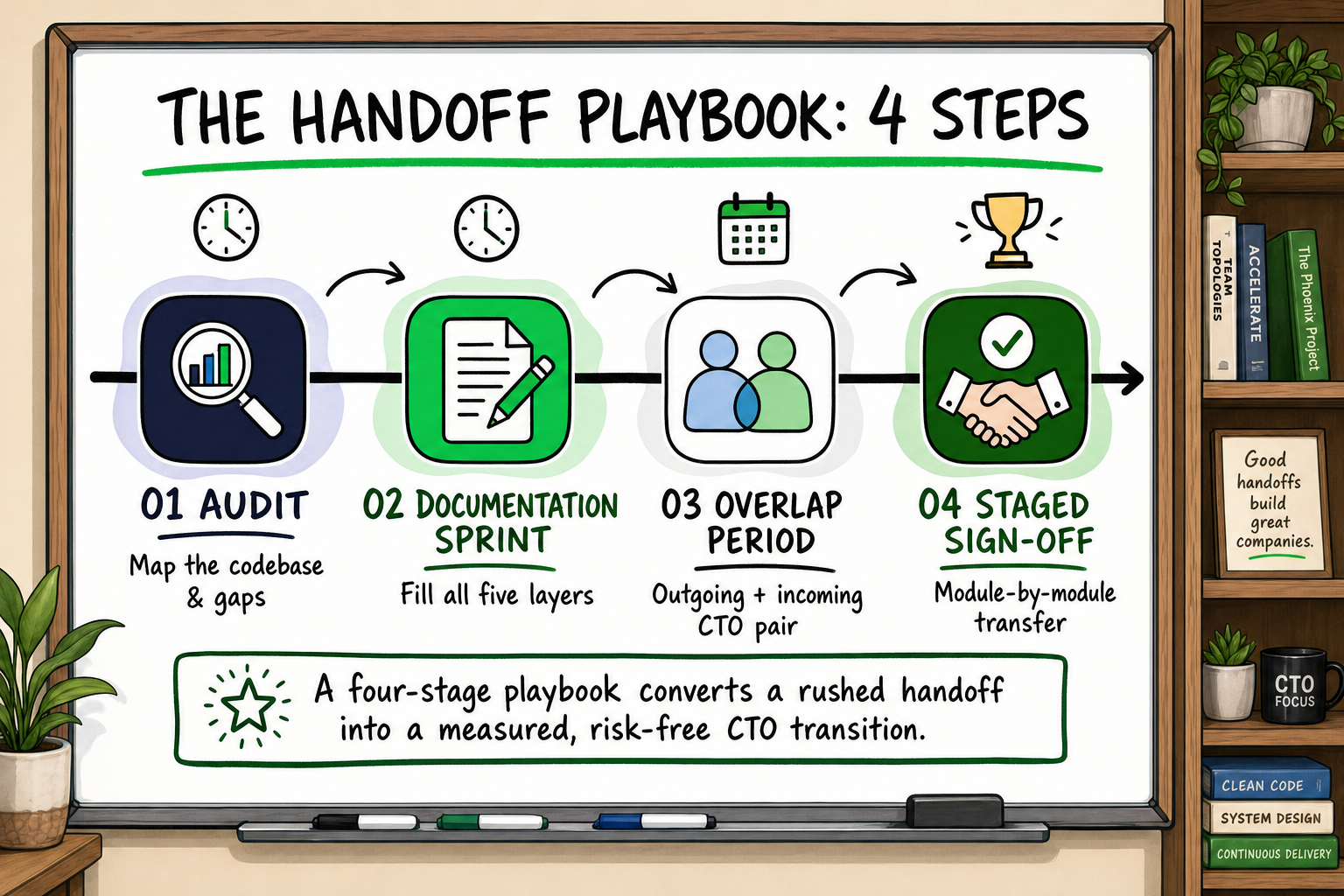
Documentation alone does not guarantee a smooth handoff. You also need a structured process for transferring knowledge and authority from the outgoing team to the incoming one.
Step 1 — Audit and Gap Analysis (Weeks 1–2)
Before the incoming CTO or team arrives, conduct a documentation audit against the five-layer framework above. For each layer, rate completeness honestly: complete, partial, or missing. This gap analysis becomes the input to the documentation sprint.
Prioritise gaps by risk: missing runbooks for production operations are higher priority than incomplete API documentation for internal endpoints that rarely change.
Step 2 — Documentation Sprint (Weeks 2–4)
Allocate dedicated time for the outgoing team to close the highest-priority gaps. This is not optional and it is not free — it takes real engineering hours. Budget 1–2 weeks of focused documentation work for a medium-complexity codebase.
Do not let the outgoing team document in isolation. Pair them with someone who will represent the incoming team's perspective (a senior engineer from your next hire cohort, or an external technical advisor) to ensure the documentation answers real questions rather than the ones the author already knows.
Step 3 — Overlap and Shadowing Period
If at all possible, arrange for a period where outgoing and incoming engineers work in parallel. Even two weeks of overlap — where the new CTO can ask questions directly and observe live operations — is worth more than any document.
During this period:
- Walk through every runbook and verify it works
- Conduct a live deployment together
- Review the ADRs and allow the incoming CTO to challenge or clarify each one
- Hand over access credentials in a structured, audited way
Step 4 — Staged Handover with Defined Sign-Off Criteria
Avoid a cliff-edge handover where responsibility transfers all at once. Instead, define clear sign-off criteria for each domain:
- Codebase access and tooling: sign off when the new CTO can deploy independently
- Operational responsibility: sign off when the new CTO has handled at least one incident end-to-end
- Architecture ownership: sign off after the ADR review session is complete and any open questions are resolved
Document the sign-off in writing. This protects both parties and creates a clean record of when responsibility transferred.
Automation Stack Design: Map Processes Before You Build
What a New CTO Will Actually Look for on Day One
Understanding what an incoming CTO checks first helps you prioritise your preparation. These are the quick-win areas that create immediate confidence — or immediate alarm.
The README Test
The README is the front door of your codebase. A new CTO will open it first. It should cover:
- What the product does (one paragraph)
- How to set up a local development environment from scratch
- How to run the test suite
- How to deploy
- Where to find deeper documentation (link to ADRs, runbooks, ERD)
- A list of all environment variables with descriptions
If the README does not allow a competent senior engineer to be productive within a day, it needs work before the handoff.
Deployment and Rollback Confidence
An incoming CTO needs to be able to deploy a change and roll it back without calling anyone. This requires:
- A documented and automated deployment pipeline
- A tested rollback procedure (not just a theoretical one)
- Clear documentation of what a "good" deployment looks like at each stage
If your deployment process involves manual steps, document every one of them in a runbook — and then work on automating them as part of the documentation sprint.
Monitoring, Alerting, and Observability Baseline
An incoming CTO inheriting a system with no monitoring is inheriting a blindfold. Before handoff, ensure:
- Application error tracking is in place (e.g. Sentry or equivalent)
- Infrastructure metrics are being collected (CPU, memory, request latency)
- Alerts exist for critical failure conditions
- Logs are accessible and searchable
Document the observability setup as part of the infrastructure documentation layer.
Event Tracking Analytics: A Founder's Guide
Frequently Asked Questions
How long does a software product handoff to a new CTO typically take?
A well-documented codebase can transition in two to six weeks with a structured overlap period. A poorly documented one can take three to six months, with significant re-work risk as the incoming team discovers undocumented decisions. The time you invest in documentation before the handoff is recovered many times over during the transition itself.
What is an architecture decision record (ADR) and why does it matter for a handoff?
An ADR is a short document that captures the reasoning behind a specific technical decision — the context, what was decided, the consequences, and what alternatives were considered. Without ADRs, incoming engineers re-litigate decisions that were already made carefully, often at significant cost. ADRs are the single document type most teams skip and most regret skipping during a handoff.
Can you hand off a codebase that has significant technical debt?
Yes — but transparency is essential. Include a tech debt register in the handoff pack: a documented list of known shortcuts, deferred work, and known risks. An incoming CTO who discovers technical debt that was not disclosed will lose trust immediately. One who receives an honest register can plan around it and make informed decisions.
What should be in a README for a handoff?
At minimum: project purpose, local setup instructions, a full environment variable list, third-party service dependencies, deployment process, rollback procedure, and an index of links to deeper documentation (ADRs, runbooks, ERD). A new engineer should be able to get the system running locally using only the README.
How do acquirers assess technical due diligence differently from a new CTO hire?
Acquirers focus on risk — licence compliance, security vulnerabilities, scalability ceiling, and dependency staleness. They bring external engineers specifically to find problems. A new CTO hire focuses on velocity and understandability. Both need the same documentation foundation, but an acquisition requires higher rigour on security posture (OWASP baseline) and dependency hygiene. Preparing for acquisition due diligence is the higher standard and covers both scenarios.
How Decyb Technology LLP Builds for Handoff from Day One
Everything described in this guide — ADRs, runbooks, environment documentation, test coverage, operational playbooks — requires discipline at the point of build, not a frantic catch-up weeks before a transition. That is where many development relationships fall short.
Founders who have worked with freelancers or junior agencies often discover, at exactly the wrong moment, that the product they paid to build cannot be handed to a new team without months of archaeology. The codebase exists. The documentation does not. The decisions live in someone's memory — and that someone has moved on.
Architecture Documentation as a Deliverable, Not an Afterthought
Decyb Technology LLP treats architecture documentation as a first-class deliverable on every engagement. ADRs are written during sprints, not retrospectively. Runbooks are part of the definition of done for any operational feature. Environment documentation is version-controlled alongside the code.
This is not a nice-to-have. It is the difference between a product you own and a product you are dependent on someone else to maintain.
For founders preparing for a technical hire or an acquisition, we also offer a standalone architecture documentation engagement: an audit of your existing codebase against the five-layer framework, a gap analysis, and a documentation sprint to close the highest-priority gaps — delivered with the same fixed-price, defined-scope model we use across all our engagements.
Proof: FieldFolio and Multiverse Architecture Documentation
When we built FieldFolio — a B2B wholesale marketplace now serving 40,000+ retailers across Australia and New Zealand — the architecture documentation was delivered as part of the project: multi-tenant design rationale, retailer onboarding flow, supplier catalogue sync architecture, and order management decisions, all documented in a format a future CTO or acquirer could review without needing to speak to the original team.
The same standard applied to Multiverse, a multi-tenant restaurant management system covering POS, inventory, online ordering, and back-office operations built on React, Node.js, and Express. The architecture diagrams, integration flows, and data model documentation were delivered alongside the software — because software without documentation is an incomplete product.
These are not portfolio embellishments. Our ★ 5.0 delivery record across 12+ years of client engagements — including a client relationship maintained across 10+ years in multiple technical capacities — reflects a consistent standard of delivery, not a one-off result. [INTERNAL LINK: How to Verify a Software Agency's Case Studies]
The Right Starting Point
If you are preparing for a CTO hire, a team transition, or an acquisition — and you are not confident your codebase would pass the README test described above — the right starting point is a direct, honest conversation about what you have and what you need.
Decyb offers a free 24-hour custom technology strategy call with a senior partner. No sales deck. No obligation. A genuine assessment of where your codebase stands against the standards described in this guide, and a clear picture of what it would take to get it handoff-ready.
Book your free strategy call — get a plan in 24 hours
All project timelines and delivery estimates are indicative and subject to scope confirmation. Third-party service costs are billed separately at cost. Decyb Technology LLP is registered in India; engagements are subject to terms of service available at decyb.com/terms.