
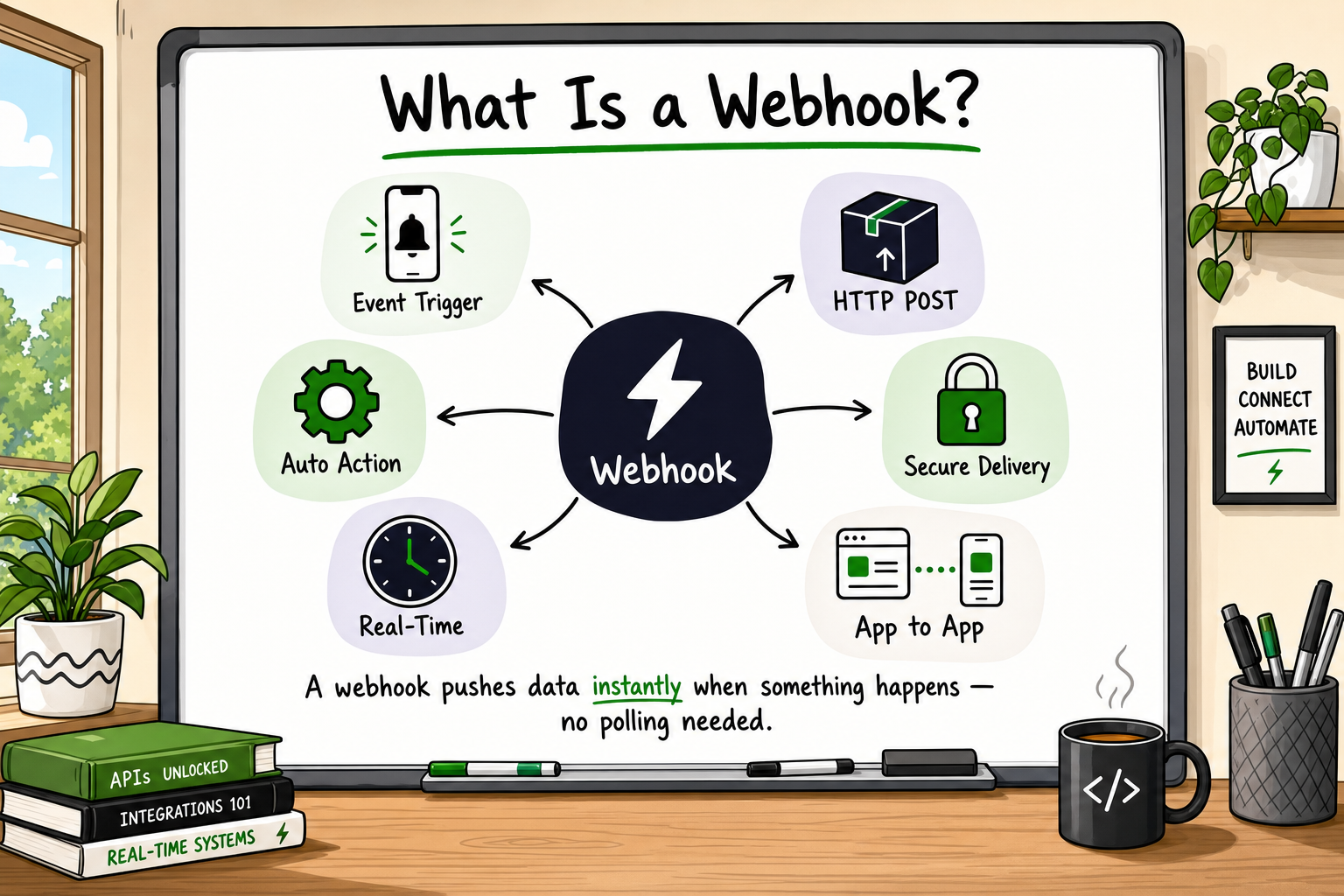
If you have ever connected two apps — say, Stripe to your CRM, or a form builder to your email platform — a webhook was almost certainly doing the heavy lifting behind the scenes. Yet the term itself trips up most non-technical founders. This guide explains what a webhook is, how it works, and where it fits in your product stack, with no assumed coding knowledge and no jargon you cannot act on.
The one-sentence definition you actually need
Webhooks in plain English
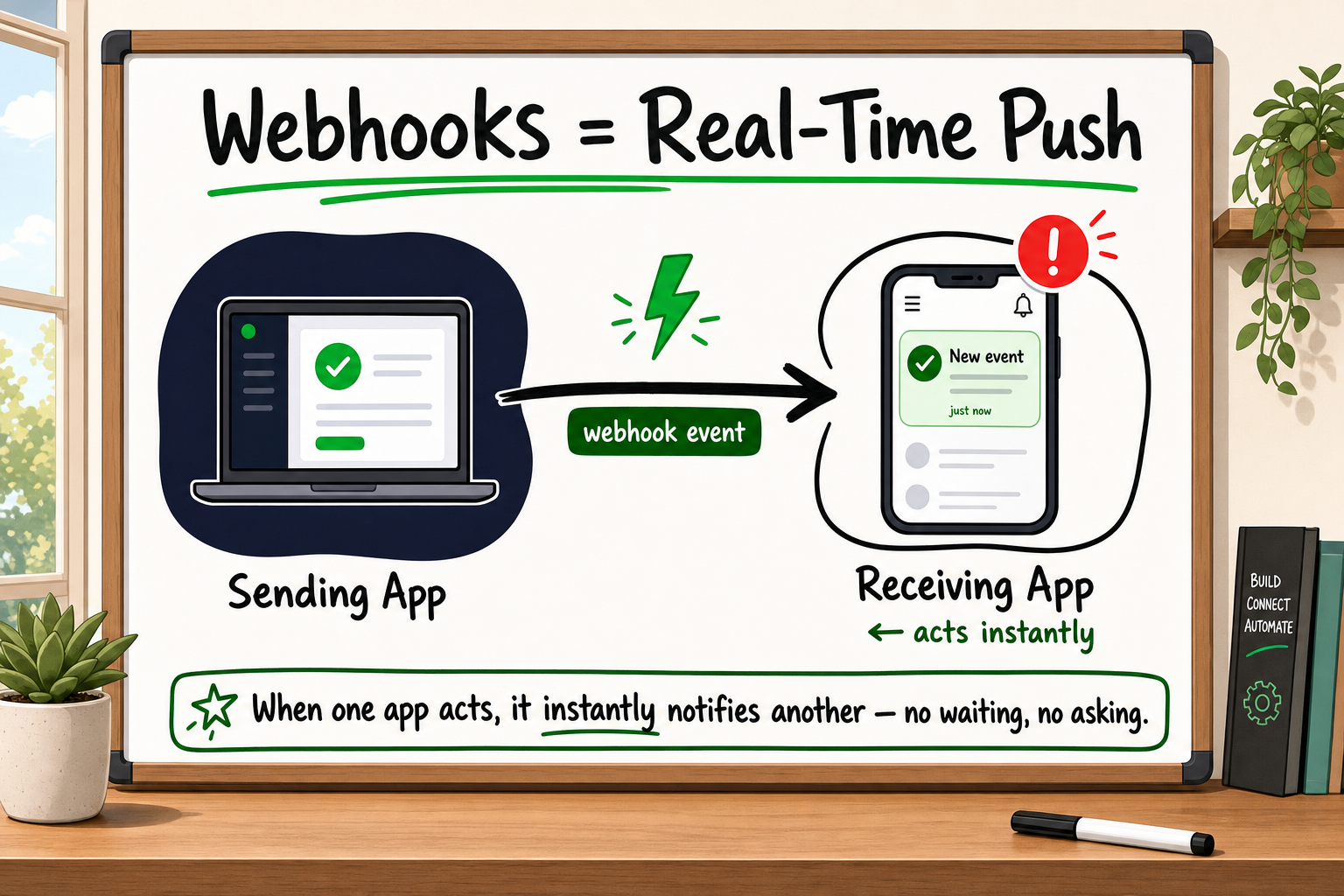
A webhook is an automatic message that one piece of software sends to another the moment a specific event happens.
That is it. No polling. No manual checking. One system does something — a customer pays, a form is submitted, an order ships — and it immediately tells another system about it.
The technical crowd sometimes calls this an "HTTP callback" or a "reverse API", but those labels obscure the simplicity. Think of it as a digital push notification between two pieces of software.
A quick analogy to make it stick
Imagine ordering a parcel online. You have two options for knowing when it arrives:
- Call the courier every hour to ask if it has been delivered yet.
- Ask the courier to text you the moment it is at your door.
Option 1 is how a traditional API poll works. Option 2 is a webhook. The courier (System A) proactively tells you (System B) that something happened, rather than waiting for you to ask.
This distinction has real consequences for your product's speed, cost, and reliability — which is why it is worth understanding before you start making integration decisions.
How a webhook actually works, step by step
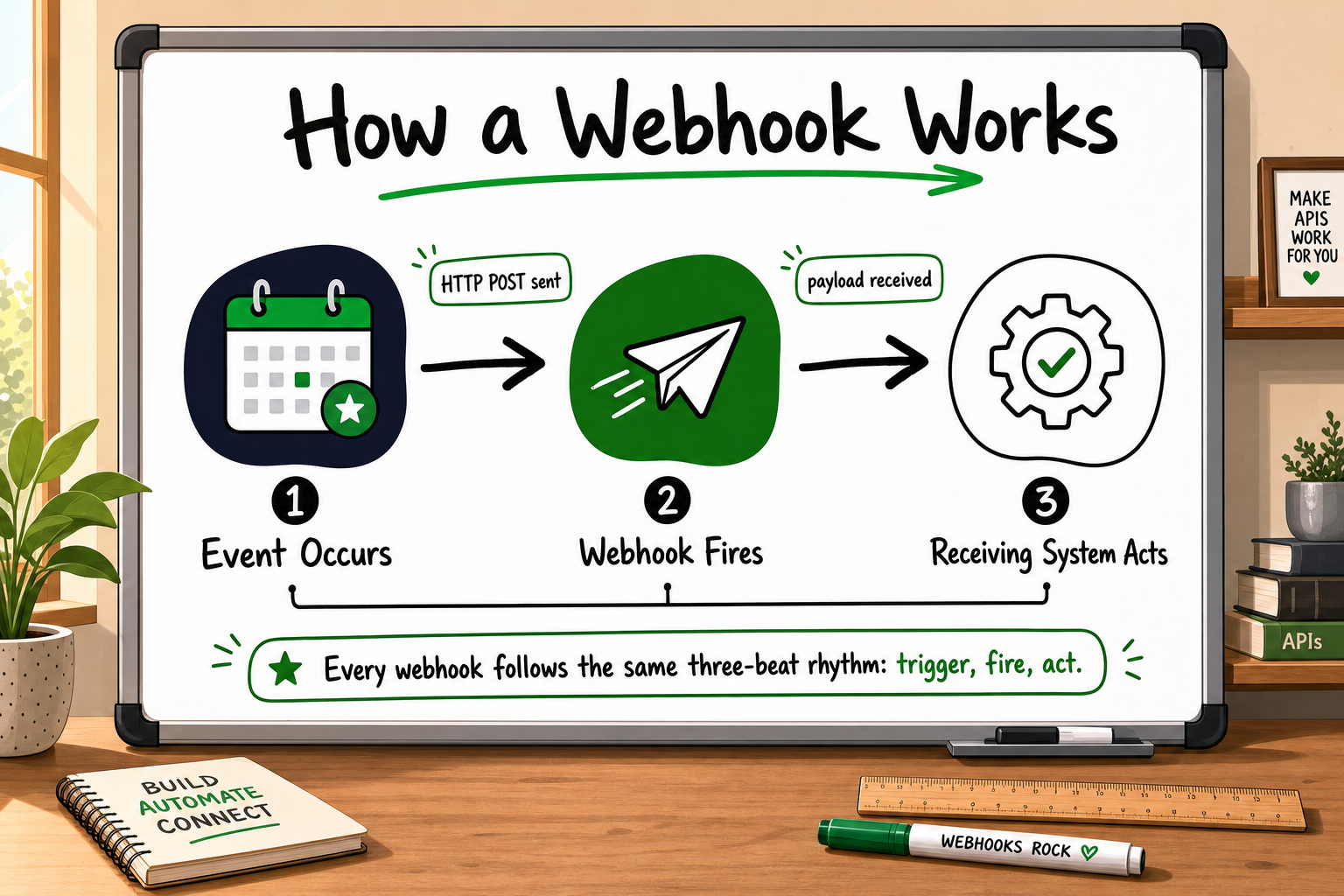
You do not need to read a single line of code to follow this. Here is what happens under the hood every time a webhook fires.
Step 1: An event happens in System A
Every webhook starts with a trigger event — something that happened in the originating system. Examples:
- A customer completes a payment in Stripe.
- A user submits a contact form on your website.
- A new subscriber joins your email list.
- An order status changes in your fulfilment system.
The originating system is configured to watch for that specific event. When it occurs, the system does not just record it internally — it prepares a message to send outward.
Step 2: System A sends a webhook
The message — called a payload — is typically a small JSON package containing everything relevant about the event. For a payment, that might include the customer's ID, the amount charged, the timestamp, and the transaction status.
System A sends that payload as an HTTP POST request to a URL you specify in advance. That URL is your webhook endpoint — essentially a dedicated address your system has opened to receive incoming messages.
Step 3: Your system receives and acts on the payload
Your endpoint receives the payload, verifies it came from a trusted source (more on that shortly), and then does whatever you have told it to do: create a CRM contact, send a welcome email, update a database record, fire a Slack notification.
The whole sequence — event to action — typically completes in under a second.
Concrete example: A new customer completes checkout on your website. Stripe fires a webhook to your CRM URL. The CRM instantly creates a contact record, tags the customer as a paying user, and queues a welcome email sequence. No human touched anything. No delay. No manual import.
Webhooks vs APIs: what is actually different
This is the question we hear most often from founders who have a basic grasp of APIs. The comparison is worth spending a moment on because choosing the wrong approach can create performance and cost problems later.
APIs: you ask, they answer
A traditional API is a request-response mechanism. Your system sends a question — "What are the orders placed in the last hour?" — and the API answers. If you want up-to-date information, your system has to keep asking on a schedule. This is called polling.
Polling is reliable and straightforward, but it has costs:
- Latency: You only know about a new event the next time you ask.
- Unnecessary requests: Most of the time, nothing has changed — but you are still making the API call.
- Rate limits: APIs cap the number of requests per minute or day. Heavy polling burns through your allowance fast.
Webhooks: they tell you when something happens
A webhook flips the model. Instead of your system asking for updates, the other system pushes an update to you the moment something relevant occurs. You receive only the data you need, exactly when it happens.
This is the event-driven architecture pattern — and it is how most modern product integrations are built.
Which one does your product need?
A useful rule of thumb:
| Situation | Better fit | |---|---| | You need data on demand (e.g. fetch a user's profile) | API | | You need to react instantly when something happens | Webhook | | You are syncing state between two systems in real time | Webhook | | You are querying historical records | API | | You need a two-way conversation with the external system | API |
Many products use both. An API call fetches data; a webhook notifies you when that data changes.
Real business scenarios where webhooks matter
Enough theory. Here is where webhooks show up in actual founder problems.
Payment confirmations and failed-charge alerts
Every major payment processor — Stripe, PayPal, Razorpay — uses webhooks to tell your system what happened after a transaction. A successful charge fires a webhook that provisions the customer's account. A failed charge fires a webhook that triggers a dunning email. Without webhooks, you would have no reliable real-time mechanism to respond to either event.
CRM and lead routing automation
When a lead fills in a form, a webhook can fire instantly to your CRM, route the lead to the right sales rep based on geography or deal size, and trigger an automated follow-up sequence — all before the lead has even closed the browser tab. Platforms like GoHighLevel and Zapier use webhook triggers extensively to wire these flows together without custom code.
E-commerce order and fulfilment sync
In high-volume e-commerce, keeping your storefront, warehouse, and carrier in sync manually is not an option. Webhooks carry order events — placed, packed, dispatched, delivered, returned — between systems in real time. Our team built event-driven integrations of this type for the FieldFolio B2B wholesale marketplace, handling order events across more than 40,000 retailers in Australia and New Zealand. The architecture had to be reliable at volume, which meant proper retry logic and idempotent processing from day one.
Notification and messaging triggers
Webhooks also power real-time messaging. A user reaches a milestone in your app — a webhook fires to Twilio, which sends an SMS. A support ticket is marked urgent — a webhook fires to Slack, which pings the on-call engineer. These are not sophisticated integrations to set up conceptually, but they require the plumbing to be done correctly.
What can go wrong with webhooks — and how to protect against it
Webhooks are powerful, but they have failure modes that non-technical founders should understand before signing off on an integration design.
Missed or failed deliveries
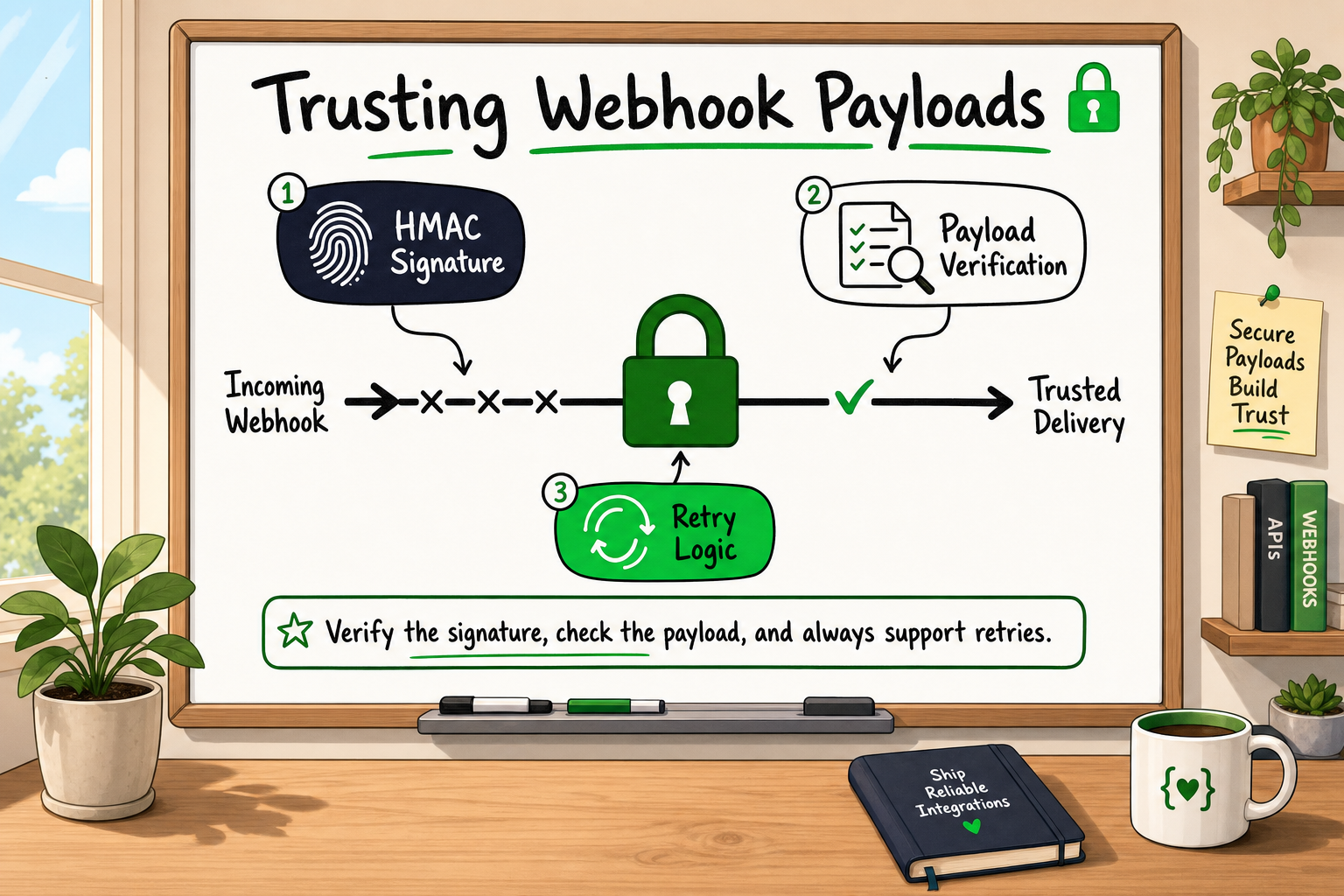
Your endpoint might be temporarily unavailable — a server restart, a deployment, a timeout. The sending system fires the webhook, receives no acknowledgement, and the event is lost. Most reputable platforms handle this with automatic retries on a backoff schedule (e.g. retry after 5 minutes, then 30 minutes, then 2 hours). Your system needs to be designed to handle those retries correctly.
Replay attacks and payload verification
Anyone who knows your webhook endpoint URL could, in theory, send fake payloads to it. A poorly secured endpoint might process fraudulent events — provisioning accounts that were never paid for, for example.
The standard defence is payload verification using a shared secret and an HMAC signature. The sending system includes a cryptographic signature in the webhook header; your endpoint checks that signature before doing anything with the data. The OWASP Top Ten [Source: OWASP] flags injection and broken authentication as leading causes of API and webhook security failures — signature verification directly addresses both risks.
Retry logic and idempotency
Because webhooks can be delivered more than once (due to retries), your receiving endpoint must be idempotent — meaning processing the same event twice produces the same outcome, not a duplicate action. A customer should not be charged twice or welcomed twice simply because the webhook was retried.
This is one of the areas where experienced engineering matters. Idempotency is easy to describe and easy to get wrong under pressure.
How to Evaluate a Software Development Partner: 9 Criteria
Webhooks without a developer: what is realistic
One of the most common questions from founders in early-stage companies is whether they can set up webhooks themselves, without engineering help.
What Zapier and Make handle for you
For common SaaS-to-SaaS connections, yes — tools like Zapier and Make (formerly Integromat) abstract the webhook plumbing almost entirely. You choose a trigger ("when a Stripe payment succeeds"), choose an action ("create a HubSpot contact"), and the platform wires the webhook under the hood. No code required.
This works well for straightforward flows with supported apps and moderate volume.
Where you still need a developer
The no-code path has genuine limits:
- Custom business logic: If the action your webhook needs to trigger requires branching logic, data transformation, or interaction with a proprietary database, no-code tools hit a ceiling quickly.
- Security validation: Zapier handles common integrations safely, but if you are building a custom endpoint to receive webhooks from an external partner, you need proper HMAC verification — and that requires code.
- High-volume reliability: At tens of thousands of events per hour, you need infrastructure designed to process webhooks at scale without dropped events or bottlenecks.
- Debugging and observability: When something breaks at 2am, a properly built system has logs and alerting. A Zapier task history is not the same thing.
Knowing when to ask for help
A useful signal: if your webhook integration involves money, sensitive user data, or a failure that would directly harm a customer — get a developer involved. The cost of getting it wrong is almost always higher than the cost of doing it right from the start.
Frequently asked questions about webhooks
What is a webhook in simple terms? A webhook is an automatic message one system sends to another the moment a specific event happens — no manual checking or repeated requests required.
What is the difference between a webhook and an API? An API requires your system to ask for data on a schedule (polling). A webhook pushes data to your system the instant an event occurs, making it faster and more efficient for real-time use cases.
Are webhooks secure? They can be, when implemented correctly. The receiving endpoint should always verify the payload using a shared secret or HMAC signature to confirm the request came from a legitimate sender [Source: OWASP].
What happens if a webhook delivery fails? Most platforms retry failed webhooks on a schedule. Your receiving endpoint should be idempotent — processing the same event twice should produce the same result — so that retries do not cause duplicate actions.
Can I use webhooks without writing any code? Tools like Zapier and Make let you receive and act on webhooks for common SaaS tools without coding. Custom business logic, security validation, and high-volume reliability still benefit from a developer building a proper endpoint.
What is a webhook payload? The payload is the data package sent with the webhook — typically a JSON object describing what happened, who it involved, and any relevant attributes such as an order ID, amount, or status.
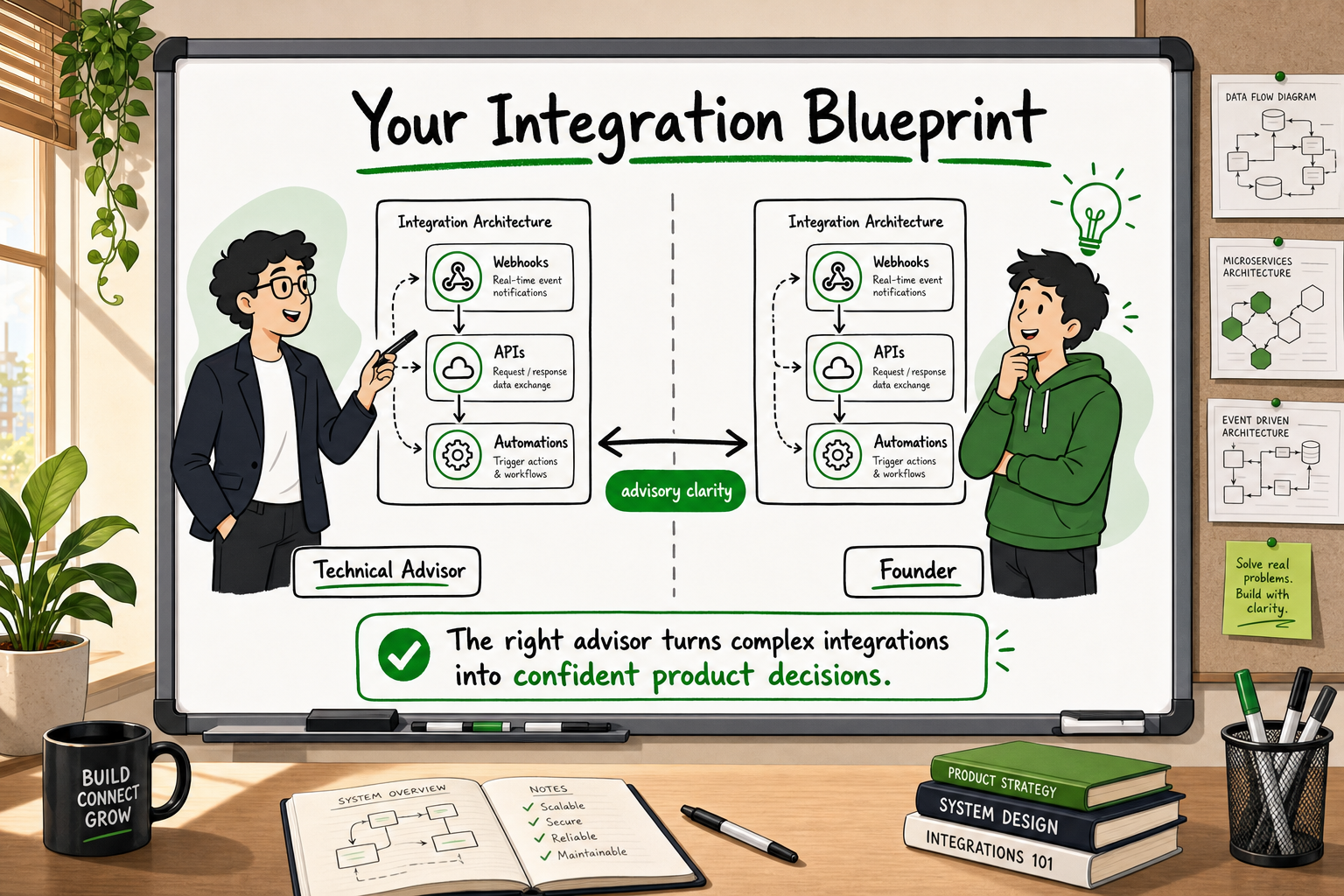
How Decyb Technology LLP approaches webhook and integration architecture
Understanding what a webhook is gives you the vocabulary to have better conversations with developers, evaluate integration proposals, and spot gaps in your product's data flow. But knowing the concept and building it reliably at scale are different problems.
Our team at Decyb Technology LLP has been designing and shipping event-driven integrations across SaaS, fintech, healthcare, and e-commerce products for over 16 years. A few examples of what that looks like in practice:
FieldFolio B2B wholesale marketplace. We built the order event architecture for a marketplace serving more than 40,000 retailers across Australia and New Zealand. Order placement, catalogue sync, and fulfilment updates all run through event-driven integrations designed for reliability under sustained volume — with retry logic, idempotency, and observability built in from the start.
GoHighLevel and automation workflows. Our automation engagements use webhook triggers as the connective tissue between CRM, messaging, and campaign systems. Clients have rated these engagements ★ 5.0, specifically noting clear communication and on-schedule delivery — the things that matter when you are trusting a vendor with operational workflows your revenue depends on.
Server-side event pipelines. Our Meta Conversions API implementation work — where webhook-style server-side event delivery replaced broken client-side tracking — was delivered ahead of schedule with full event deduplication. The same rigour we apply to marketing data pipelines applies to product integrations.
We work with non-technical founders regularly. Part of our job is making architectural decisions legible — explaining why a webhook is the right tool here, why a polling API is correct there, and what the trade-offs of each choice look like six months from now when your volume doubles.
If you are at the stage where you are evaluating how to connect your product's moving parts — or you have inherited an integration that keeps breaking — a short technical conversation can save months of rework.
Ready to talk through your integration architecture? Book your free 24-hour strategy call — no obligation, no sales pitch, just a straight answer from a senior technical partner on the best path forward for your product.
All project timelines and delivery estimates are indicative and subject to scope confirmation. Third-party service costs (hosting, domains, SaaS tools) are billed separately at cost. Decyb Technology LLP is registered in India; engagements are subject to terms of service available at decyb.com/terms.