
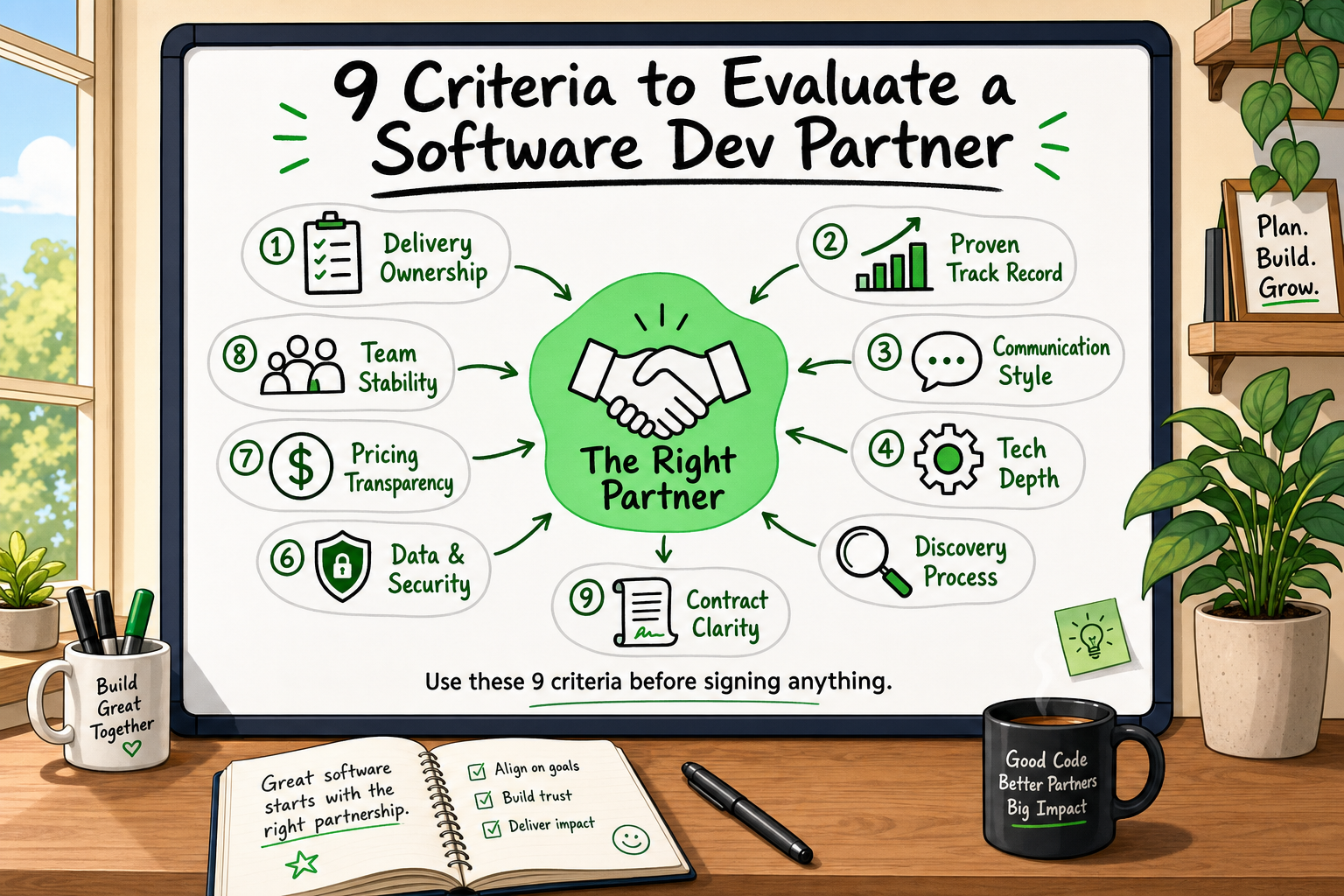
Finding a software development partner is straightforward. Finding one who actually owns the outcome — and is still answering your calls six months after launch — is considerably harder. If you are actively comparing agencies right now, you have probably already learned that a polished website and a long client list tell you almost nothing about what it is like to work with a team under pressure.
This guide gives you nine concrete criteria to apply to any vendor conversation, including the one you are already in. Each criterion comes with plain-English questions you can ask in a discovery call, and red flags that signal a team is better at selling than delivering. By the end, you will have a working checklist you can use before you sign anything.
Why Most Vendor Evaluations Fail Before They Start
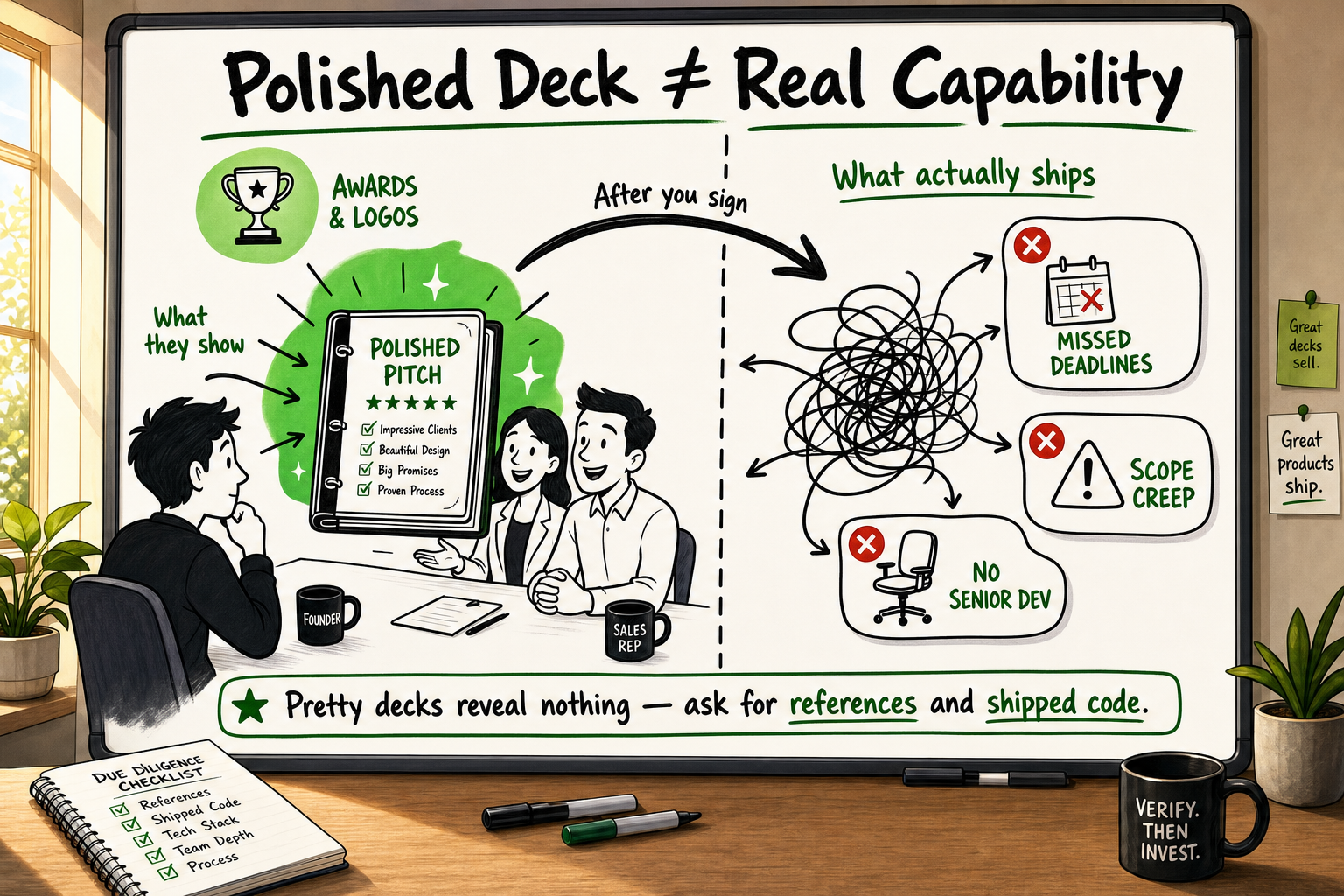
Most founders evaluate agencies on three things: the portfolio, the price, and the size of the team. These are reasonable starting points. They are also poor predictors of whether a project will ship on time, at quality, and without becoming a management burden.
The three signals founders over-index on
Portfolio aesthetics. Screenshots of finished products look identical whether the build took three months or three years, whether the code is clean or held together with string, and whether the client relationship ended warmly or in a dispute.
Hourly rate. A low rate from a team with weak discovery discipline will cost more than a higher rate from a team that scopes accurately and communicates proactively. Rate tells you about margin, not about value.
Team headcount. A 200-person agency with a rotating cast of juniors assigned to your project will move slower and communicate less clearly than a senior pod of four who treat your product as their primary responsibility.
What a reliable evaluation actually measures
A useful evaluation framework measures delivery accountability, decision-making quality, communication structure, and long-term alignment — all things you can probe in a 45-minute call before you spend a penny.
Over 16 years of software delivery across SaaS, fintech, healthcare, and eCommerce, I have watched more projects fail at the intake stage than at the build stage. The misalignments that cause expensive disappointments are almost always visible in the sales conversation — if you know what to look for.
Criterion 1 — Ownership of Delivery, Not Just Execution
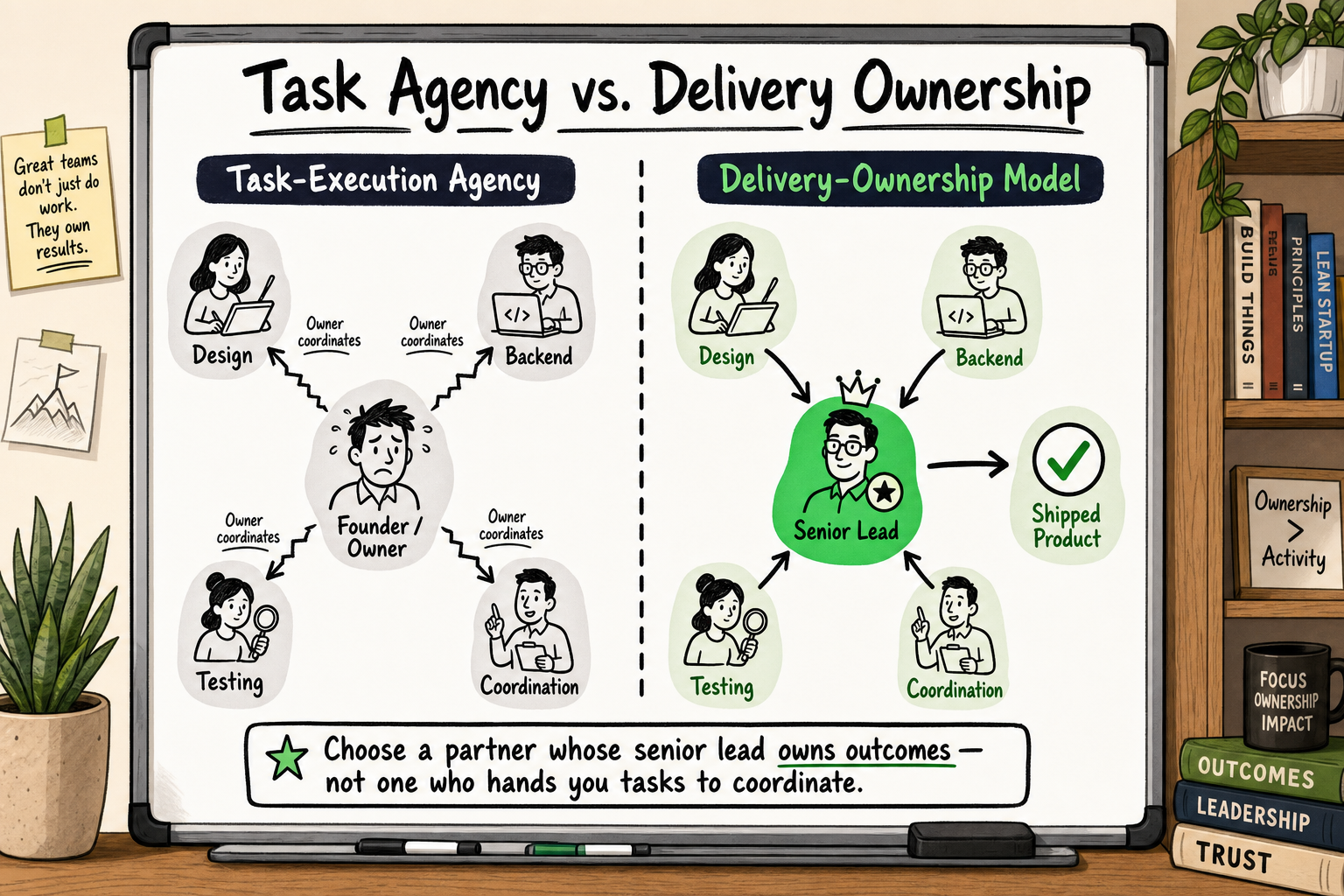
There is a meaningful difference between a team that executes tasks and a partner that owns delivery. Execution means the agency builds what you specify and stops when the brief runs out. Ownership means a named senior person takes responsibility for the outcome — flagging risks before they become crises, documenting decisions, and ensuring the final product matches the business goal rather than just the feature list.
What delivery ownership looks like in practice
- A named senior lead attends every significant decision point — not a project manager passing messages between you and an anonymous technical team
- Risk is flagged proactively, in writing, before it becomes a blocker
- The team can explain why a decision was made, not just what was built
- Handoff documentation exists as a matter of course, not as a special request
Questions to ask: does the agency own outcomes or just hours?
- "Who is the named person accountable for delivery on our project — and will they be present in our calls?"
- "Can you walk me through a decision you made on a recent project that the client did not ask for — and why you made it?"
- "What happens if your team discovers a risk two weeks into build that was not in the original scope?"
An agency that deflects the first question toward a process document rather than a person is signalling a structure built for scale, not for accountability.
Criterion 2 — Architecture Decision-Making and Documentation
How a team makes technology decisions matters more than which technology they choose. A React front end built with documented reasoning and clear trade-off analysis will age better than a perfectly fashionable stack chosen because it was familiar to the available developers.
What an ADR is and why it protects you
An Architecture Decision Record (ADR) is a short document that captures a technology decision, the options considered, the trade-offs evaluated, and the reasoning behind the final choice. Teams that produce ADRs routinely are teams that have thought through consequences before committing to a direction.
Why does this matter to you as a buyer? Because when you need to hand the product to a new CTO, raise a funding round, or onboard a second development team, documented architecture decisions are worth more than the code itself. They explain the why behind every significant choice.
Red flags in how agencies talk about technology choices
- "We use [framework] for everything" — a sign of convenience, not considered decision-making
- Inability to name a trade-off they consciously accepted on a recent project
- No mention of documentation when describing their delivery process
- Technology choices framed in terms of team familiarity rather than client business outcomes
On the FieldFolio engagement — a B2B wholesale marketplace built for 40,000+ retailers across Australia and New Zealand — an architecture decision document covering multi-tenant design, retailer onboarding flow, supplier catalogue sync, and order management was produced as a standard deliverable. It was not something the client requested mid-project. It was part of what delivery means.
Custom software development — /services/custom-software-development
Criterion 3 — How They Handle Scope Change
Every real project encounters scope change. The question is not whether your chosen agency has a process for handling it — it is whether they will show you that process before you sign.
Fixed-price vs. time-and-materials: what each model signals
Fixed-price development works well when discovery is thorough and scope is documented in enough detail that both parties agree on what "done" means. It protects your runway and creates a shared incentive to scope accurately. The risk is a team that locks in a price without rigorous discovery and then under-delivers to protect margin.
Time-and-materials shifts risk to the buyer and rewards slow delivery. It can be appropriate for exploratory or research-heavy phases, but it removes the incentive for the agency to scope efficiently.
Neither model is inherently better. What matters is whether the team's discovery process is rigorous enough to produce a scope document you would be comfortable signing — and whether their change-order process is transparent enough that you understand exactly what happens when requirements shift.
The change order questions every founder should ask upfront
- "Can you show me a sample change order from a previous project?"
- "At what point does a new requirement trigger a change order vs. being absorbed into the existing scope?"
- "How do you handle it when something in the original brief turns out to be technically unfeasible?"
A team confident in its scoping process will answer these questions readily and often volunteer the information before you ask. Teams that deflect or over-promise — "don't worry, we're flexible" — are signalling weak discovery discipline. That flexibility will cost you later.
Criterion 4 — Technical Debt Posture and Code Quality Gates
You do not need to read code to evaluate a team's attitude toward code quality. The questions you ask — and the answers you get — are sufficient.
How to ask about code quality without being a developer
Start here: "What percentage of your codebase is covered by automated tests on a typical project?" A credible answer names a number and explains what types of tests are involved (unit, integration, end-to-end). An evasive answer — "it depends on the project" without further qualification — is a signal.
Follow up with: "Walk me through your code review process." A team with genuine quality gates will describe who reviews what, at what frequency, and what the standard is for merging changes. A team without a meaningful process will describe something aspirational rather than operational.
What SOLID principles mean for your future scalability
SOLID is a set of five design principles that, when followed, produce code that is easier to extend, test, and hand off to a new team [VERIFY]. In plain English:
- S — each piece of code does one job
- O — you can add new functionality without rewriting existing code
- L — components can be swapped out without breaking the system
- I — no component is forced to depend on things it does not use
- D — high-level logic does not depend on low-level implementation details
You do not need to memorise these. You need to ask: "How do you ensure the codebase remains extensible as the product grows?" A team that can answer this in plain English — without resorting to jargon — understands the principles well enough to apply them.
For security, the OWASP Top Ten is a credible baseline [Source: OWASP]. Ask any agency you are considering: "Which OWASP risks are most relevant to our product, and how does your process address them?" Teams that cannot answer are not thinking about security as a build-time concern.
Criterion 5 — Data and Analytics Readiness from Day One
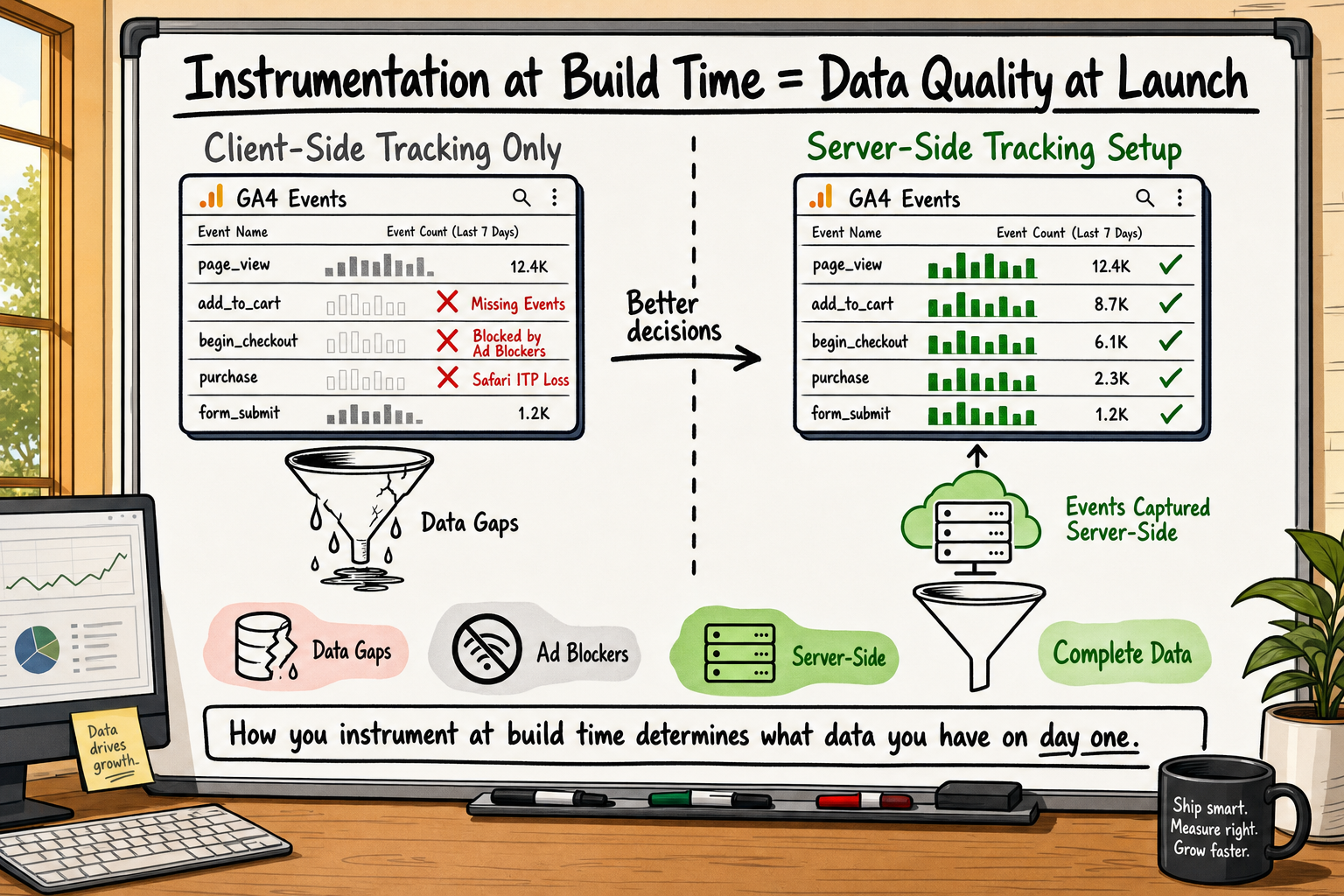
Analytics instrumentation is a build decision, not a marketing decision. Founders who treat it as an afterthought — "we'll add tracking after launch" — discover six months later that their GA4 is missing 40–60% of conversion events due to ad blockers and iOS privacy changes [VERIFY], and that retrofitting accurate tracking into a live product is significantly more expensive than building it correctly from the start.
Why analytics setup is a build decision, not a marketing decision
Client-side tracking — the standard Google Tag Manager setup that most agencies deliver — is increasingly unreliable. iOS privacy changes, browser-level ad blocking, and third-party cookie restrictions all reduce the fidelity of client-side event data. The result is a dashboard that looks populated but systematically undercounts the events that matter most: purchases, sign-ups, and form completions.
Server-side tracking solves this by sending event data directly from your server to platforms like GA4 and Meta's Conversions API, bypassing client-side interception entirely [Source: Google Analytics] [Source: Meta for Developers]. For any product running paid acquisition, this is not optional — it is the difference between growth decisions based on real data and growth decisions based on noise.
Server-side tracking and why it matters at MVP stage
Ask any agency you are evaluating: "How do you handle analytics instrumentation during the build, and do you set up server-side tracking as standard?" The answer tells you whether they think of analytics as a technical concern (correct) or a post-launch marketing concern (a problem).
Also ask: "How do you handle event deduplication between client-side and server-side signals?" Deduplication prevents the same conversion from being counted twice — a common error when both client and server are firing events simultaneously. A team that has solved this problem before will know exactly what you are asking.
Criterion 6 — Verifying Case Studies and Proof Points
A portfolio proves that a team has delivered finished products. It does not prove that those products were delivered on time, at the promised scope, with the quality the client expected, or that the relationship survived the process.
The three questions that expose a padded portfolio
- "Can I speak to a reference from this specific project?" Not a generic reference — a specific client on the case study you are looking at. A team with genuine delivery depth will arrange this without hesitation.
- "Walk me through three architectural decisions you made on this project and why." Generic answers — "we used React because it's fast" — indicate shallow involvement. Specific answers — describing a trade-off between a monolith and a microservices architecture at a particular scale threshold [Source: Martin Fowler] — indicate genuine ownership.
- "What went wrong on this project and how did you handle it?" Every real project has problems. A team that cannot name one is either being dishonest or was not close enough to the delivery to know.
How to request verifiable proof without damaging the relationship
Frame these questions as due diligence, not interrogation: "We take partnerships seriously and we have been burned before — so we do proper due diligence on everyone we consider. Is that something you are comfortable with?" Any agency that is uncomfortable with this question has answered it.
Criterion 7 — Communication Cadence and Escalation Paths
Communication structure predicts project health more reliably than technical skill alone. A brilliant team with no defined communication cadence will frustrate you within two sprints. A less technically brilliant team with a clear async update rhythm, a defined escalation path, and a weekly review process will keep you informed and in control throughout.
What a healthy sprint cadence looks like
- A weekly (or bi-weekly) sprint review where you see working software, not just status updates
- Async updates in writing — not just verbal promises in calls that produce no record
- A defined format for raising blockers, so they surface early rather than being absorbed and discovered late
- Clear ownership of who communicates what, and when
How to stress-test an agency's escalation process before you sign
Ask: "What happens if we disagree about whether a delivered feature meets the acceptance criteria?" A mature team will describe a documented process: written acceptance criteria defined before development, a structured review period, and a clear path from disagreement to resolution. An immature team will tell you "that hasn't really come up" — which means it will come up, and there is no process waiting for it.
The GoHighLevel integrations delivered for amoti — completed on schedule with clear communication throughout — earned a ★ 5.0 review specifically because the client experienced consistent async updates and no surprises. That outcome is a function of process, not luck.
Criterion 8 — Post-Launch Commitment and Growth Continuity
Launch day is the beginning of a product's life, not the end of an agency's obligation. Products that do not iterate after launch lose ground to competitors who do. Features that are not continuously refined in response to user behaviour represent a compounding opportunity cost.
Why launch is the beginning, not the end
Ask any agency you evaluate: "What does your engagement look like after launch?" A project shop will hand you documentation and close the ticket. A genuine partner will describe a structured post-launch phase covering feature iteration, infrastructure scaling, analytics review, and SEO — and will have a team in place to deliver it.
The risk of choosing a project shop is that the institutional knowledge of your product — the architectural decisions, the edge cases, the history — leaves with the team on day one after launch. Onboarding a replacement team costs time, money, and the accumulated context of the build.
Questions to ask about post-launch support and iteration
- "Do you offer an ongoing engagement model after launch, and what does it include?"
- "How do you handle infrastructure scaling if our user volume grows 10x in six months?"
- "Can you describe how you approached feature iteration on a product that has been live for more than 12 months?"
The most reliable signal is retention: how long do clients stay? Jatinder Kumar has been retained by a single client across 10+ years in multiple technical capacities — an outcome that does not happen with teams that treat launch as an exit event. [★ 5.0 long-term review]
Criterion 9 — Cultural Fit and Alignment on Business Outcomes
The final criterion is the hardest to measure and the most consequential. A technically excellent team that does not understand your market, your urgency, or your business model will build the wrong thing — efficiently and on time.
Why a technically brilliant team can still be the wrong choice
Cultural alignment is not about personality. It is about whether the team's instincts — the decisions they make without checking — are aligned with your business goals. A team that thinks in features will build what you specify. A team that thinks in outcomes will challenge you when your feature specification does not serve your business model.
The intake conversation that reveals business-outcome alignment
The most reliable signal I have found across 16 years of client engagements is the first 15 minutes of a discovery call. Teams focused on outcomes ask: "What does success look like for your business in 12 months, and how does this product contribute to it?" Teams focused on delivery ask: "What features do you need in your MVP?"
Both questions are reasonable. Only one of them reveals a partner who will make good decisions when you are not in the room.
Your 9-Criterion Evaluation Checklist
Use this in your next vendor call. A confident hire scores 8–9 out of 9. A cautious proceed scores 6–7 with clear explanations for the gaps. Fewer than 6 means keep looking.
| # | Criterion | What to Ask | Green Signal | Red Flag | |---|-----------|-------------|--------------|----------| | 1 | Delivery ownership | Who is named as accountable? | Named senior lead, present in calls | "The team" handles it | | 2 | Architecture documentation | Do you produce ADRs? | Yes, shown as standard deliverable | "We document as needed" | | 3 | Scope-change process | Show me a sample change order | Clear process, shown proactively | "We're flexible" with no detail | | 4 | Code quality gates | What % test coverage? What's your review process? | Specific numbers and named process | "It depends" | | 5 | Analytics readiness | Do you set up server-side tracking? | Yes, with deduplication handled | "We add tracking post-launch" | | 6 | Case study verification | Can I speak to a reference on this project? | Immediate yes, specific client | Hesitation or redirection | | 7 | Communication cadence | How do escalations work? | Written process, described clearly | "That hasn't come up" | | 8 | Post-launch commitment | What does the engagement look like after launch? | Defined iteration model | Project ends at handoff | | 9 | Business-outcome alignment | What does your discovery call focus on? | Business model before feature list | Feature list first |
How to use this checklist in a vendor call
Do not run through it as a questionnaire — that turns a conversation into an interview and rarely produces honest answers. Instead, weave these questions into a natural discovery conversation and score afterward. The pattern of answers matters more than any single response.
Scoring: what a confident hire looks like vs. a cautious proceed
A team that scores 8–9 has answered specifically, proactively, and with evidence. A team that scores 6–7 may be genuinely strong in delivery but early in building their documentation and communication infrastructure — worth proceeding with caution and a clearly scoped pilot. A team that scores below 6 is either misrepresenting its capabilities or is not the right fit for a product that needs to survive and scale past launch day.
Frequently Asked Questions
How do you evaluate a software development company if you're not technical? Focus on communication clarity, documentation habits, and willingness to arrange reference calls. Ask the team to explain their architecture decisions in plain English — this is a reliable proxy for technical quality that does not require you to read code. If they cannot explain a technology choice without jargon, they either do not understand it well enough or are not used to working with non-technical stakeholders. Either is a problem.
What are the biggest red flags when vetting a dev agency? Vague case studies with no named clients or verifiable references; inability to describe specific architectural decisions on a named project; no clear change-order process; and a discovery call that focuses on your feature list rather than your business model. A portfolio of impressive screenshots with no reference contacts behind it is the most common signal of a team whose delivery depth does not match its marketing.
Is fixed-price software development actually better for startups? Fixed-price works well when discovery is thorough and scope is documented with enough precision that both parties agree on what "done" means. It protects your runway and creates a shared incentive to scope accurately. The risk is an agency that locks in a price without rigorous discovery and then under-delivers to protect margin. Ask to see how they handle change orders — and ask for a sample — before committing to any pricing model.
How do I verify that an agency's case studies are real? Request a reference call with the named client on the specific project you are looking at. Ask the agency to describe three concrete architectural decisions made during that engagement. Verify technology stack claims against public information where possible (the company's engineering blog, LinkedIn job postings, or GitHub if repositories are public). A team with genuine delivery depth will welcome this process.
What should a post-launch partnership with a dev agency include? At minimum: a structured feature iteration process tied to user feedback and analytics data; infrastructure scaling support as traffic grows; ongoing SEO and analytics review; and a documented handoff plan if the relationship ends. A credible agency will have a defined process for all of these before launch day — not as an optional add-on, but as a natural continuation of the build engagement.
How Decyb Technology LLP Approaches Partner Evaluation — From Both Sides of the Table
Every criterion in this guide is one we apply to ourselves. When a founder considers Decyb as a development partner, we expect them to use this checklist — and we have built our process to pass it.
Here is what that looks like in practice.
On delivery ownership: Jatinder Kumar leads every engagement directly, from architecture through to post-launch growth. There is no account manager between you and the person making technical decisions. Every significant decision is documented, explained in plain English, and tied to a measurable business outcome. Our delivery record reflects this: consistent ★ 5.0 ratings across 12+ years of client engagements, from 2014 to 2025, across international freelance platforms.
On architecture documentation: The FieldFolio engagement — a multi-tenant B2B wholesale marketplace serving 40,000+ retailers across Australia and New Zealand — produced an architecture decision document as a standard deliverable. The Multiverse restaurant management system (covering POS, inventory, online orders, and back-office operations on React/Node.js/Express) produced the same. These documents are not marketing collateral — they are what we mean by handoff readiness.
On scope and pricing: We offer fixed-price custom web application development (React/Next.js + Node.js/Express) scoped end-to-end. Our discovery process is rigorous enough that we can commit to a price — and our change-order process is documented and shown to clients before they sign. We are also direct about what falls outside scope. Clarity at intake protects both sides.
On analytics readiness: Our Meta Conversions API implementation for a recent client was delivered ahead of schedule with full event deduplication and server-side optimisation — earning a ★ 5.0 review. Server-side tracking setup (Meta CAPI, GA4, GTM) is a named service, not an afterthought, because we know that growth decisions made on incomplete data compound into expensive mistakes.
On post-launch commitment: Jatinder has been retained by a single client across 10+ years in multiple technical capacities — a ★ 5.0 long-term review that reflects what genuine partnership looks like over time. Our ongoing growth partnerships cover SEO, analytics, new features, and scaling infrastructure, because launch day is the beginning of a product's life, not the end of our responsibility.
On cultural fit: We ask about your revenue model before your feature list. Our free 24-hour custom technology strategy call is a working session, not a sales pitch. You will leave it with a documented view of your options, the trade-offs involved, and a clear picture of whether Decyb is the right fit — regardless of whether you choose to work with us.
If you are close to a hiring decision and want to put this checklist to work on a real conversation, book your free strategy call. You will speak directly with a senior partner, get a technology plan within 24 hours, and have everything you need to make a confident choice — in either direction.
Book your free strategy call — get a plan in 24 hours →
All project timelines and delivery estimates are indicative and subject to scope confirmation. Third-party service costs (hosting, domains, SaaS tools) are billed separately at cost. Decyb Technology LLP is registered in India; engagements are subject to terms of service available at decyb.com/terms.