
If you have ever sat in a sprint review and nodded along while engineers debated "separation of concerns" or "dependency inversion," you are not alone. Clean architecture in software is one of those phrases that sounds intimidating but describes something surprisingly straightforward — and something that affects your runway, your fundraising, and your ability to hire a CTO without handing them a disaster.
This guide translates the concept into plain English. By the end, you will understand what clean architecture means, why it matters for your business (not just your engineers), and how to spot the difference between a well-built codebase and one that is quietly accumulating problems.
What Clean Architecture Actually Means (Without the Jargon)
The simple analogy: building a house vs. stacking furniture
Imagine two ways to create a living space. The first: you pour a proper foundation, frame the walls, run the plumbing, and then furnish the rooms. The second: you stack furniture in an open field and hope the arrangement holds. The first approach lets you repaint walls, replace a boiler, or add a room without tearing everything down. The second collapses the moment anything needs to change.
Software works the same way. Clean architecture is the discipline of building the foundation first — structuring code so that the core business rules sit in the centre, untouched by whatever database, framework, or user interface surrounds them.
The four layers every clean codebase shares
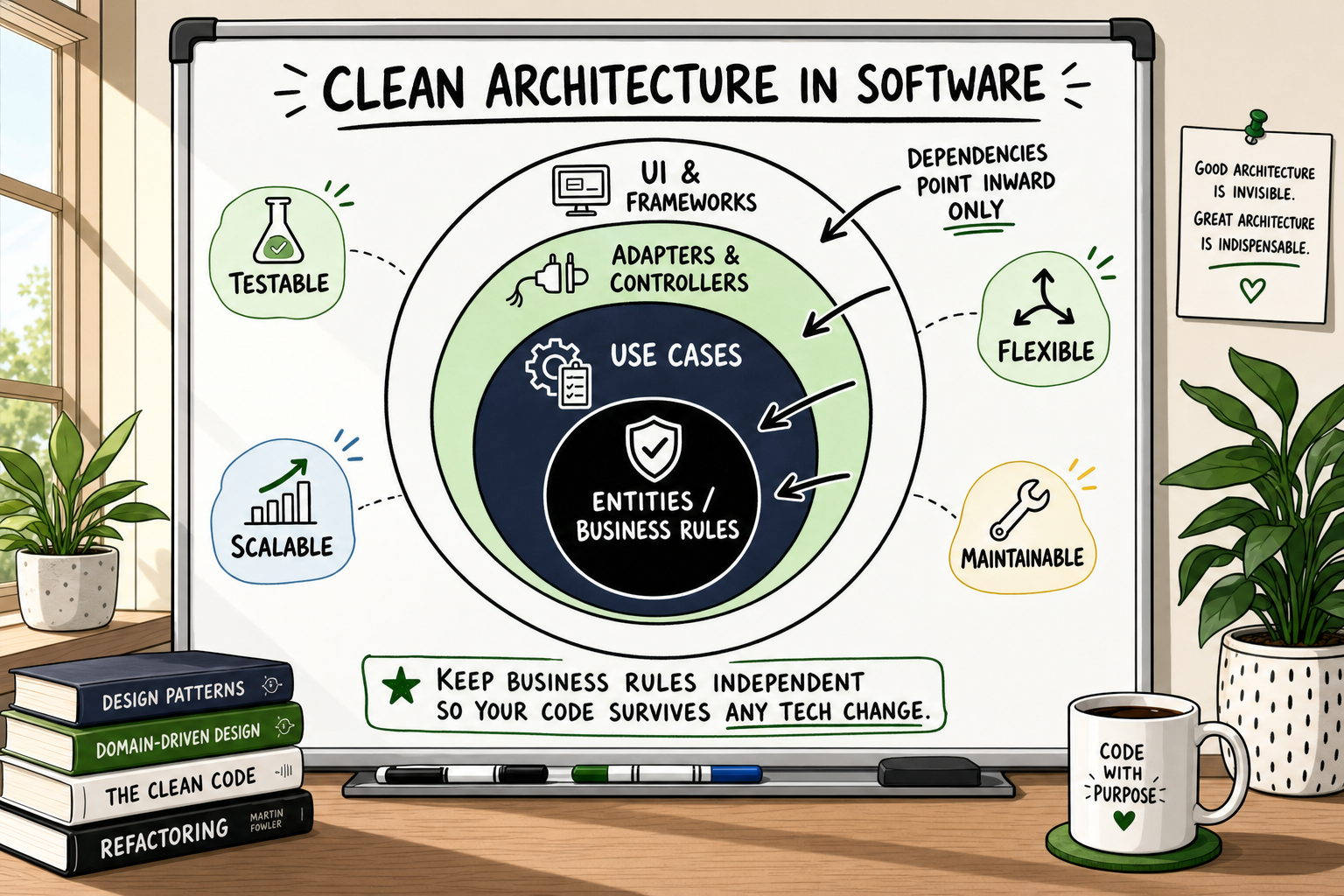
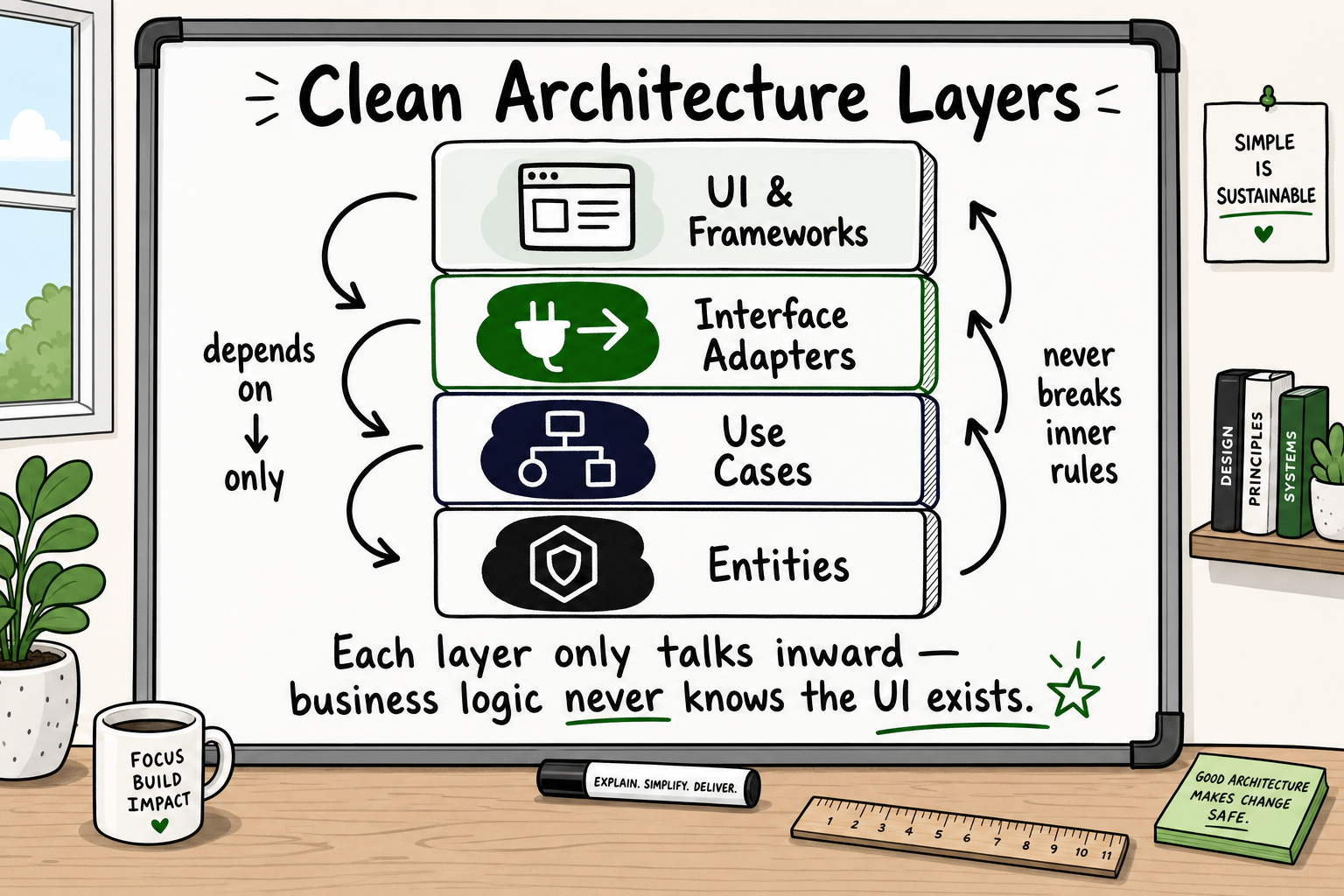
Most clean architecture diagrams draw four concentric circles:
- Entities — the core business rules. In a payroll app, an entity might be the rule that an employee cannot be paid below minimum wage. This logic belongs to your business, not to any software framework.
- Use cases — the actions your product can perform. "Process a payroll run" or "onboard a new contractor" are use cases. They orchestrate the entities but do not care how data reaches them.
- Interface adapters — the translators. These convert data from the format your database uses into the format your use cases expect, and vice versa. They are the middlemen.
- Frameworks and drivers — everything external: the web framework, the database, the payment gateway, the UI. These sit on the outermost ring.
The critical rule is that dependencies only point inward. Outer layers can call inner layers; inner layers know nothing about outer layers.
Why the order of those layers matters
When dependencies point inward, swapping any outer component — say, migrating from MySQL to PostgreSQL, or replacing a React front end with a mobile app — does not require touching your business logic. You change one layer, test it, and deploy. When dependencies point in every direction (the typical outcome of rushed MVP development), changing anything breaks everything.
What Is Multi-Tenant Architecture? Plain-English Guide
Technical Debt: The Hidden Cost of Skipping Architecture
How shortcuts in an MVP turn into expensive problems later
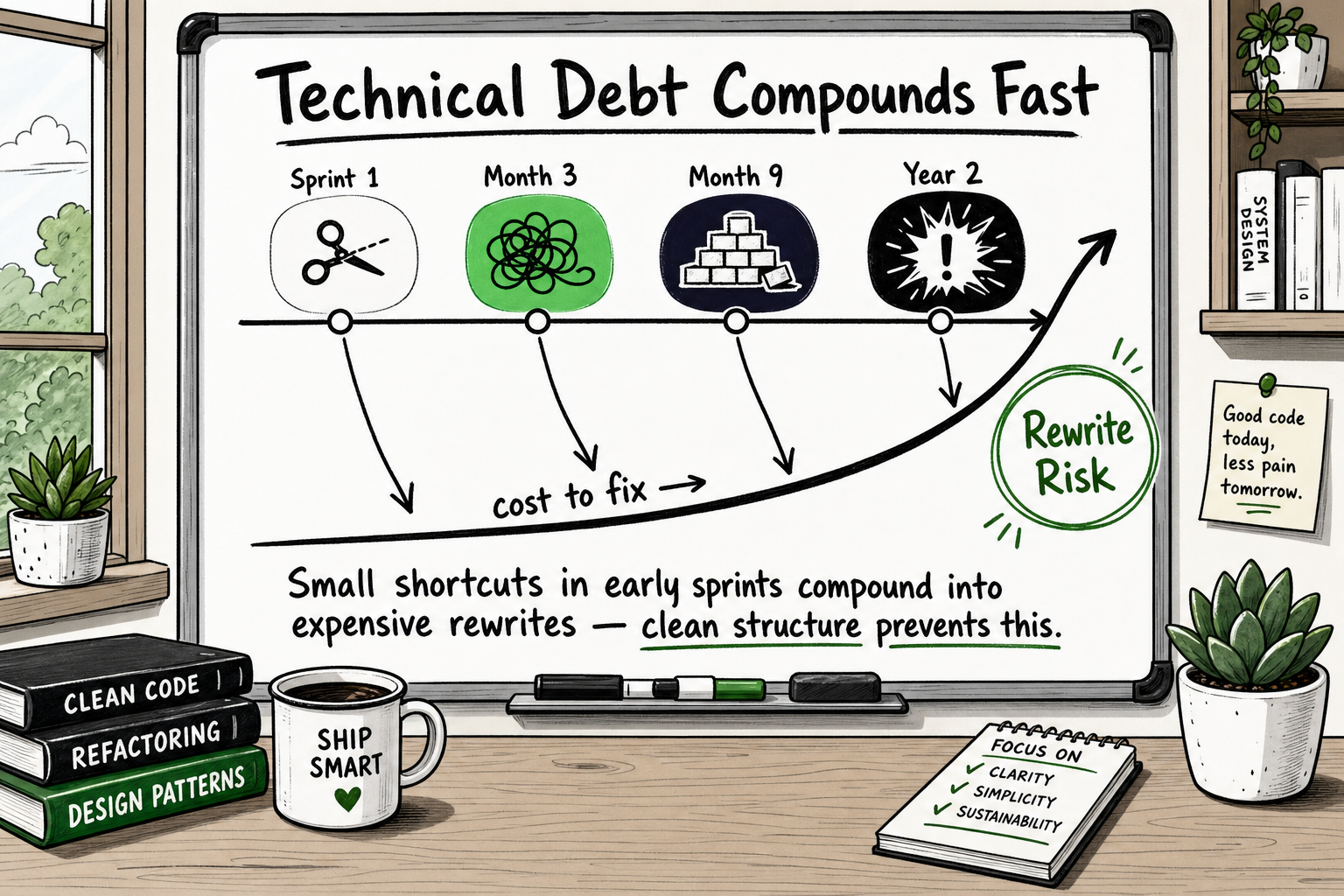
Every founding team feels the pressure to ship fast. That pressure is legitimate — speed is a competitive advantage. The trap is confusing going fast with skipping structure. When engineers hardcode database queries directly into user interface components, or write business rules inside API route handlers "just for now," they are borrowing time from the future.
Technical debt is that borrowed time, with interest. [VERIFY: industry estimates that fixing a defect post-release costs 5–10× more than fixing it during design — cite OWASP or equivalent [Source: OWASP Top Ten https://owasp.org/www-project-top-ten/]]
The compounding effect: why debt grows faster than your product
Every new feature built on top of messy code inherits the messiness. Engineers spend more time understanding the existing system than writing new functionality. Bug fixes introduce new bugs because the codebase is tightly coupled — changing one part breaks three others unexpectedly.
The result is a velocity curve that bends in the wrong direction. Six months after launch, your team is shipping fewer features per sprint than they were in week two. You hire more engineers to compensate, which increases burn without proportionally increasing output.
Three warning signs your codebase is already in trouble
- Every bug fix takes longer than it should. If a one-line change requires testing half the application, the code is too tightly coupled.
- New engineers take weeks to become productive. A well-structured codebase is self-documenting; a poor one requires tribal knowledge to navigate.
- Your team dreads the word "refactor." When engineers use refactoring as a euphemism for "we need to rebuild this from scratch," the debt has already compounded beyond easy repair.
What Is a Product Backlog? Quality, Grooming & Velocity
The Business Case for Clean Architecture
Shipping faster: how clean code accelerates every future sprint
Counter-intuitively, investing time in architecture upfront makes you faster — not slower — over any meaningful horizon. When each layer of the codebase has a single, clearly defined responsibility, engineers can work on multiple features in parallel without stepping on each other. Testing is faster because units of code are isolated. Deployments are safer because changes are contained.
A team shipping on a clean codebase compounds their velocity. A team shipping on debt erodes it.
Investor and acquirer due diligence: what they actually look for in a codebase
At Series A and beyond, technical due diligence is standard. Investors and acquirers bring in senior engineers to evaluate the codebase before completing a deal. The questions they ask are architectural: Is the business logic portable? Is there test coverage? Are there documented architecture decision records? Can the system scale without a rewrite?
A codebase that answers "yes" to those questions is an asset. One that answers "no" is a liability that can reduce valuation, extend deal timelines, or kill transactions entirely. [SOURCE: technical due diligence frameworks from institutional investors]
Handing off to a new CTO without a horror story
At some point, most founder-led technical teams bring in a CTO. That CTO will form their opinion of your company within the first week of reading the code. Clean architecture with documented decisions signals professionalism and foresight. Spaghetti code signals a rewrite — and a rewrite means months of no visible progress while burn continues.
How to Evaluate a Software Development Partner: 9 Criteria
SOLID Principles: The Rules That Keep a Codebase Healthy
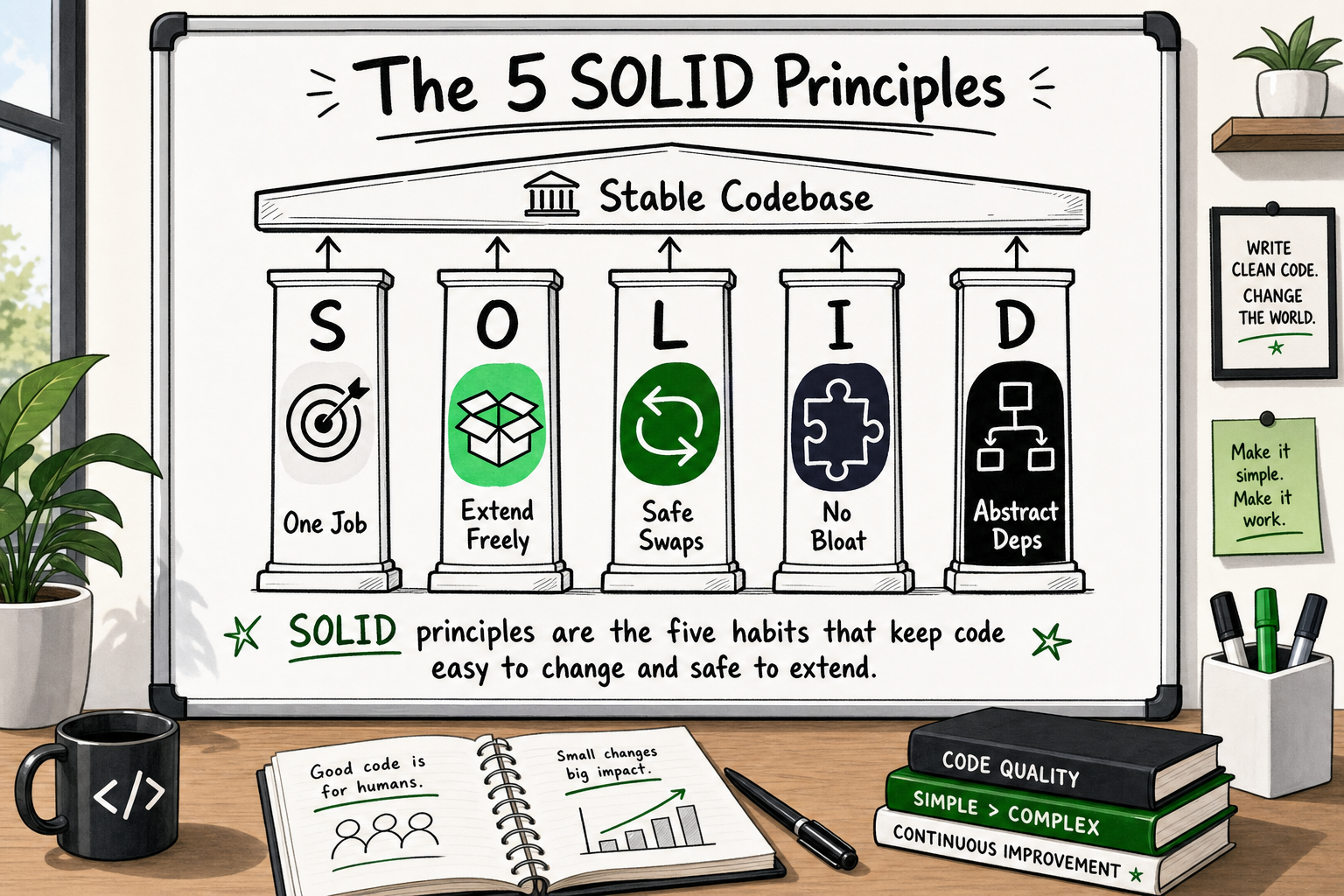
SOLID is an acronym for five software design principles introduced to help engineers write code that is easier to maintain and extend. Here is what each one means in business terms.
Single Responsibility: one job per module
The principle: Every module or class should have exactly one reason to change.
The business translation: Your payment processing module should only change when payment logic changes — not when you update your email templates. When modules do one job, a change in one part of the system does not accidentally break an unrelated part.
Open/Closed: extend without breaking
The principle: Software should be open for extension but closed for modification.
The business translation: Adding a new payment method should not require rewriting the checkout flow. A well-designed system lets you add capabilities without touching working code — which means lower regression risk and faster launches.
Liskov, Interface, and Dependency: the three that keep systems flexible
- Liskov Substitution — components that do the same job should be interchangeable. You should be able to swap your SMS provider without changing the notification logic that calls it.
- Interface Segregation — do not force a module to depend on methods it does not use. Lean, focused interfaces make systems easier to test and replace.
- Dependency Inversion — high-level business logic should not depend on low-level implementation details. Your order management system should not be hardwired to a specific database driver; it should depend on an abstraction that any database can satisfy.
Together, these five principles are the practical toolkit engineers use to build clean architecture. When someone on your team says the code follows SOLID principles, these are the rules they mean. [Source: Martin Fowler https://martinfowler.com/articles/microservices.html]
How to Spot Clean (and Unclean) Architecture as a Non-Technical Founder
Questions to ask your engineering team or agency
You do not need to read code to evaluate architectural quality. You need to ask the right questions:
- "Can we change the database without rewriting the business logic?" A clean codebase answers yes. A coupled one cannot.
- "Do we have architecture decision records?" ADRs are documents that explain why a technical decision was made, not just what was decided. Their presence signals a disciplined team.
- "How long does it take a new engineer to make their first meaningful contribution?" Under a week is a good benchmark. Months is a red flag.
- "What does the test coverage look like, and what does it actually test?" High test coverage on well-isolated units is valuable. High coverage on tightly coupled code gives false confidence.
Red flags that signal architectural shortcuts
- Engineers cannot estimate features confidently because "it depends on what else we'd need to touch."
- Bug fixes consistently introduce new bugs in unrelated areas.
- The team describes the codebase as "legacy" despite it being less than two years old.
- There is no documentation beyond inline comments.
What good documentation looks like
A well-architected system has three layers of documentation: a high-level architecture diagram showing how major components interact; architecture decision records explaining key choices; and clear module-level documentation explaining what each component does and what it does not do. If you ask for these and they do not exist, that tells you something important.
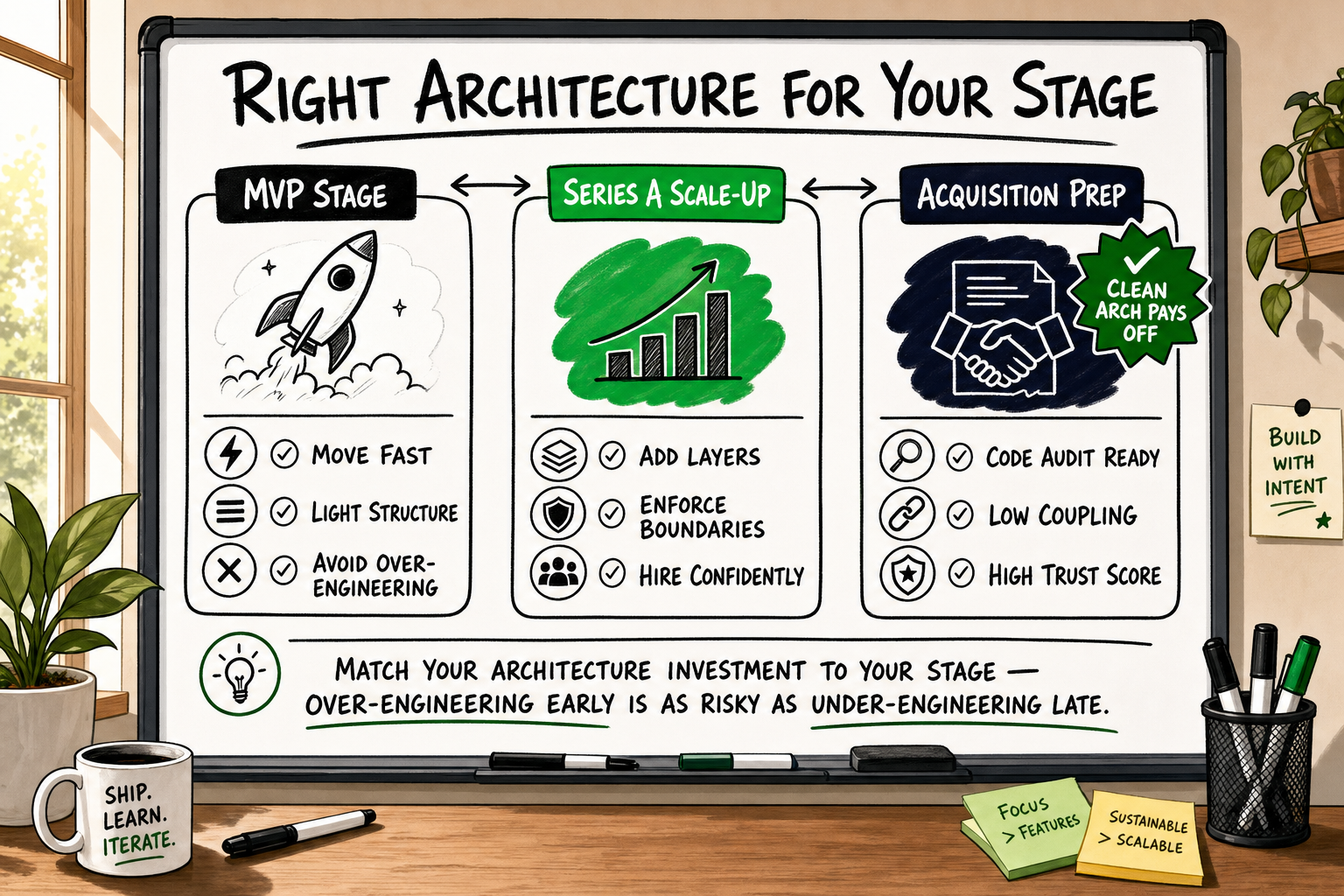
Clean Architecture in Practice: Real-World Startup Scenarios
Scenario 1: Building your first MVP the right way
The most common mistake at the pre-seed stage is treating architecture as something to worry about "when we grow." In reality, the decisions made in the first sprint follow the product for years. Choosing a layered structure from day one does not take significantly longer — the difference is a few hours of upfront design — but it means every subsequent sprint builds on a stable base rather than a shaky one.
The goal is not perfection; it is intentionality. Knowing why you made each technical decision, and documenting it, is what separates a buildable product from an expensive prototype.
Scenario 2: Scaling after your Series A without a rewrite
This is where architectural debt becomes a cash problem. Teams that reach Series A on a poorly structured codebase often find that the engineering capacity their funding was supposed to unlock is consumed by stabilisation instead of feature development. Investors expect to see the roadmap executed; instead, the team is wrestling with the foundations.
A clean architecture means you can add engineering capacity — new hires, contractors, a white-label partner — without a months-long knowledge transfer period. The codebase explains itself.
Scenario 3: Preparing your codebase for a CTO hire or acquisition
A documented, defensible architecture is an asset in any data room. It tells acquirers and new executive hires that the business was built with intention. It shortens due diligence, reduces negotiation friction, and signals that the founding team understood technology as a strategic lever rather than a cost centre.
The Multiverse restaurant management system is an example of this done right: a multi-tenant POS, inventory, and back-office platform built on React, Node.js, and Express with architecture decisions documented from the start — meaning any new technical stakeholder could understand the system's structure without an extended handholding period.
Frequently Asked Questions
What is clean architecture in software?
Clean architecture is a way of organising code into independent layers so that business logic — the rules that make your product valuable — stays separate from databases, frameworks, and user interfaces. Each layer can change independently without breaking the others. The concept was popularised by software engineer Robert C. Martin and is widely adopted in professional software development.
Is clean architecture only relevant for large codebases?
No — it is most valuable at the MVP stage. Shortcuts taken early in a codebase compound into expensive rewrites later. Applying clean architecture principles from the first sprint costs relatively little extra time but prevents the technical debt that slows teams down post-launch.
What is the difference between clean architecture and microservices?
They operate at different levels. Clean architecture describes how code is organised within a service — the internal layer structure. Microservices describes how separate services communicate with each other across a system. A microservices system can have terrible internal architecture; a monolith can be beautifully clean. They are complementary approaches, not alternatives.
How does technical debt relate to clean architecture?
Technical debt is what accumulates when clean architecture principles are skipped. Every shortcut — a hardcoded dependency, a module doing five jobs, a business rule buried inside a database query — is a piece of borrowed time that must eventually be repaid, usually at a higher cost than the original shortcut saved.
How can a non-technical founder evaluate whether their codebase is well-architected?
Ask your engineering team these questions: Can you change the database without rewriting business logic? Do you have architecture decision records? How long does it take a new engineer to ship their first feature? If the answers are uncertain or evasive, it is worth commissioning an independent architectural review.
How Decyb Technology LLP Approaches Clean Architecture
Everything in this guide — layered design, documented decisions, SOLID principles, the link between code quality and business outcomes — reflects how Decyb Technology LLP builds software from the first conversation with a client.
The founding problem most teams bring to us is not a technology problem. It is a confidence problem: they are not sure whether the code they have (or are about to commission) will hold up under real-world conditions. That uncertainty is expensive. It makes every hiring decision harder, every investor conversation more anxious, and every scaling sprint less predictable.
Architecture decisions documented from day one
On every project — from a seed-stage MVP to a production platform serving tens of thousands of users — our team documents architecture decisions as they are made. Not retrospectively. Not as an afterthought for the data room. From day one. The FieldFolio B2B wholesale marketplace, built for 40,000+ retailers across Australia and New Zealand, was designed with a multi-tenant architecture that allowed new retailer types and supplier integrations to be added without touching the core order management logic. That kind of structural thinking is not a luxury reserved for enterprise projects; it is the baseline standard we apply regardless of budget.
Delivery without the overhead
One of the most consistent frustrations we hear from founders is that they become the de-facto project manager for their own agency — chasing updates, resolving conflicts between contractors, and covering accountability gaps. Our model is built around senior partners who own delivery end-to-end. Across 12+ years of client engagements, we have maintained a consistent 5.0 rating precisely because the team that scopes the work is the team that ships it. There is no handoff to a junior execution layer after the proposal is signed.
Our internal benchmark shows delivery completing approximately 20% faster than average agency timelines across 50+ completed projects [VERIFY]. That speed does not come from cutting corners on architecture — it comes from not having to redo work that was structured poorly the first time.
What working with Decyb looks like in practice
For a non-technical founder, the first step is a free 24-hour technology strategy call with a senior partner. No junior account managers, no templated discovery questionnaires. You explain the business problem; we map the appropriate technical approach, flag the decisions that will matter most, and give you a clear view of what clean architecture looks like for your specific product.
If you are building a first product, scaling after funding, or trying to understand why your current codebase is slowing your team down, that conversation is the fastest way to get clarity.
Book your free strategy call — get a plan in 24 hours → Contact
All project timelines and delivery estimates are indicative and subject to scope confirmation. Third-party service costs (hosting, domains, SaaS tools) are billed separately at cost. Decyb Technology LLP is registered in India; engagements are subject to terms of service available at decyb.com/terms.