
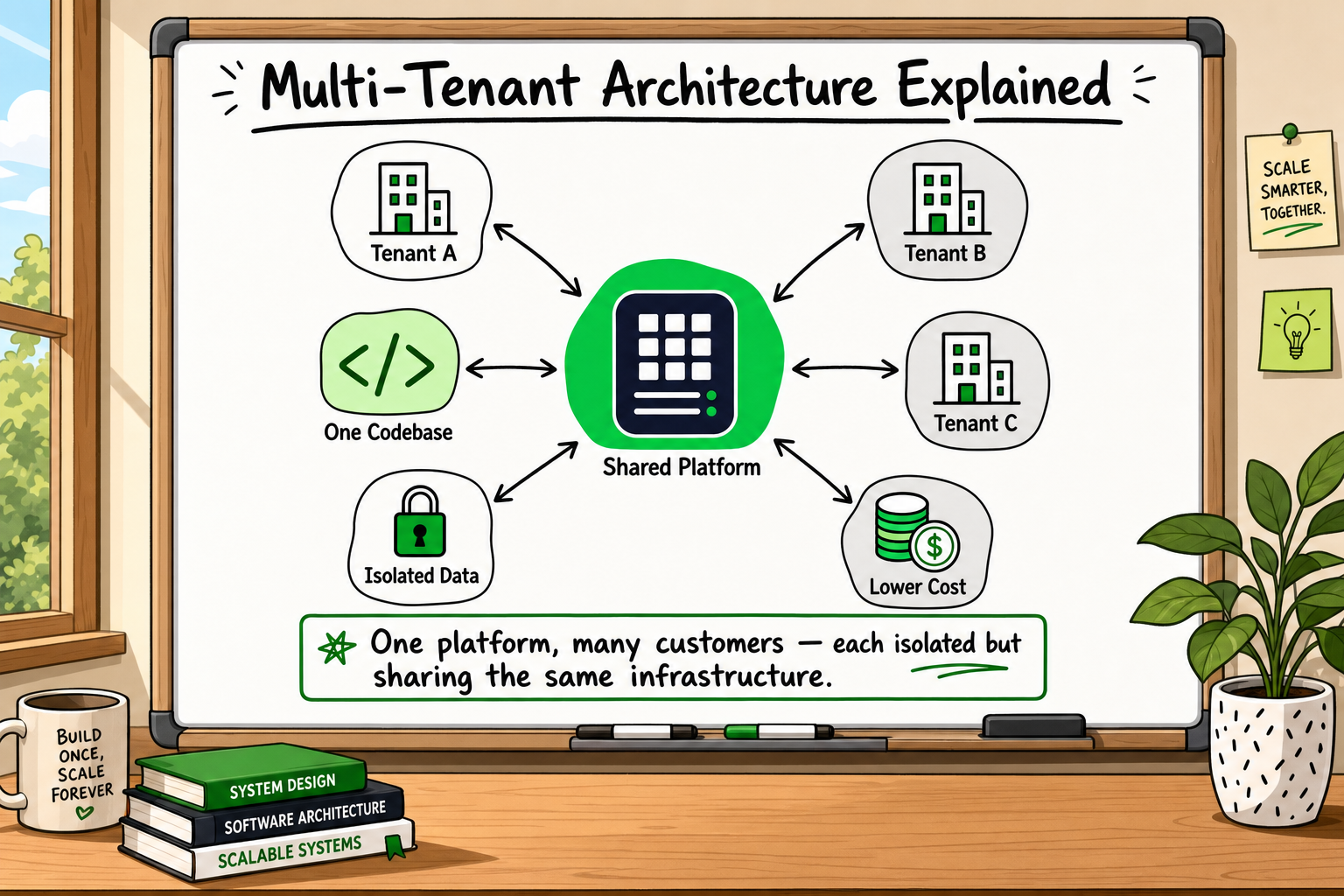
If you are scoping a SaaS product, you will hear the term multi-tenant architecture early and often. Your technical partner will use it. Investors will ask about it. And if you nod along without fully understanding it, you risk making an expensive architectural decision based on incomplete information.
This article explains what multi-tenant architecture actually means, how it compares to the alternatives, what it costs you in complexity, and when it is — and is not — the right call for your product.
No jargon. No code samples. Just the mental model you need to have an informed conversation with any engineer or agency you work with.
What multi-tenant architecture actually means
At its core, multi-tenant architecture is a design pattern where a single software system — one codebase, one set of servers, one database infrastructure — serves multiple customers simultaneously. Each customer (called a tenant) has their own data, their own configuration, and their own experience, but they are all running on the same underlying application.
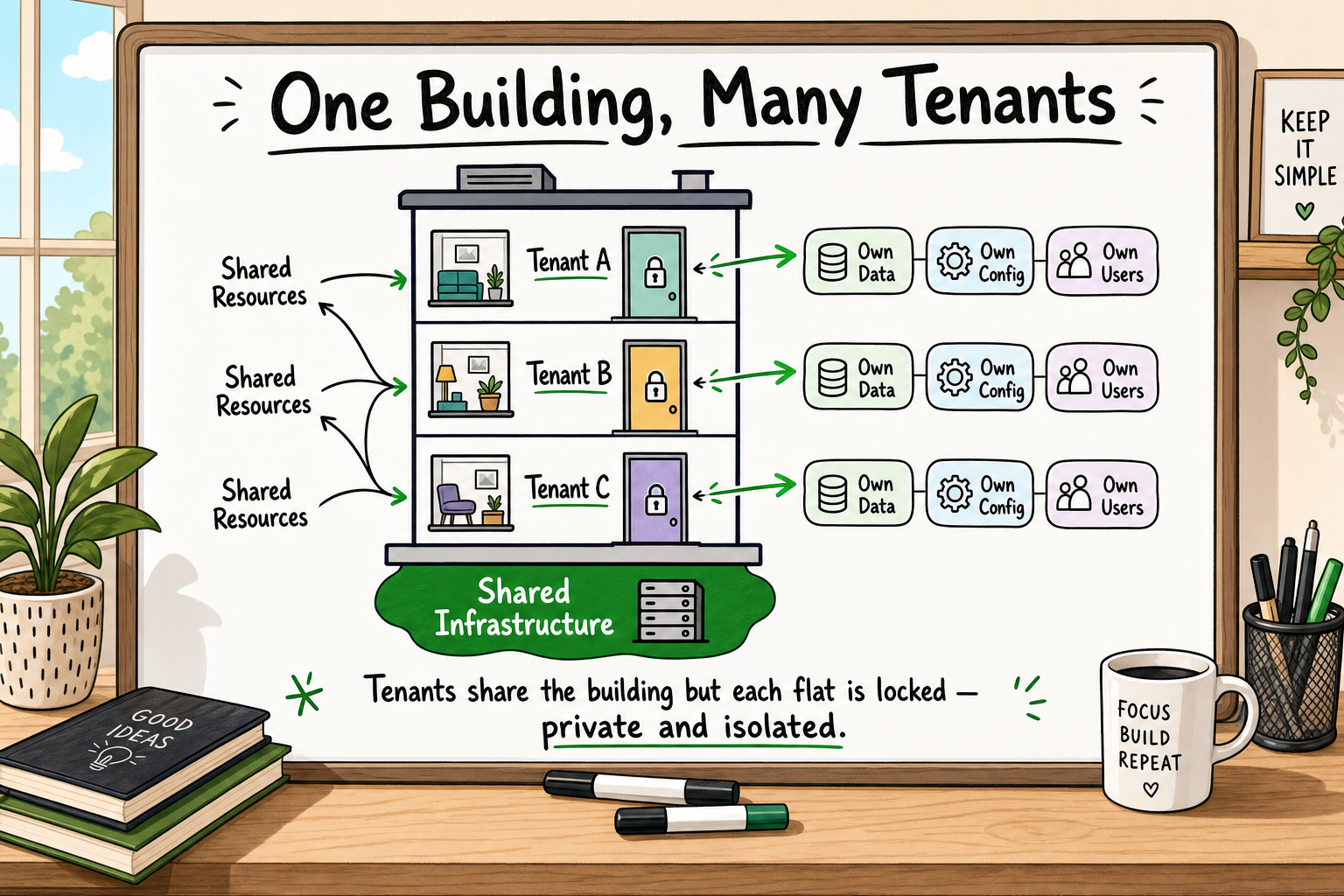
The most useful analogy is an apartment building.
The apartment building analogy
Imagine a single building with fifty flats. Each tenant has their own locked door, their own furniture, their own belongings. No one can walk into another tenant's flat. And yet the building shares one roof, one set of lifts, one boiler room, one maintenance team.
This is exactly what multi-tenancy does for software. The "building" is your application. The "flats" are your customers. The "locked doors" are data isolation controls. The shared infrastructure — servers, deployment pipelines, monitoring tools — is the boiler room.
The result: lower infrastructure costs per customer, centralised updates, and a single place to maintain the application — while each customer experiences the product as if it were built exclusively for them.
How tenants share resources without sharing data
The critical phrase in that description is logically isolated. Tenants share physical infrastructure, but their data is partitioned so that Tenant A can never read, write, or affect the data belonging to Tenant B. Achieving this reliably is the central engineering challenge of any multi-tenant system — and the source of most of the trade-offs discussed later in this article.
The three core components: application layer, database layer, and identity
Every multi-tenant system has three layers that work together:
- Application layer — the code that runs your product logic. It must always know which tenant is making a request before it does anything else.
- Database layer — where tenant data lives. The way you separate data here is the biggest architectural decision you will make (covered in detail below).
- Identity and access layer — authentication (who are you?) and authorisation (what are you allowed to see?). This is where most security failures in multi-tenant systems originate.
Single-tenant vs multi-tenant: what changes and what it costs you
Before you can decide whether multi-tenancy is right for your product, you need to understand what you are comparing it against.
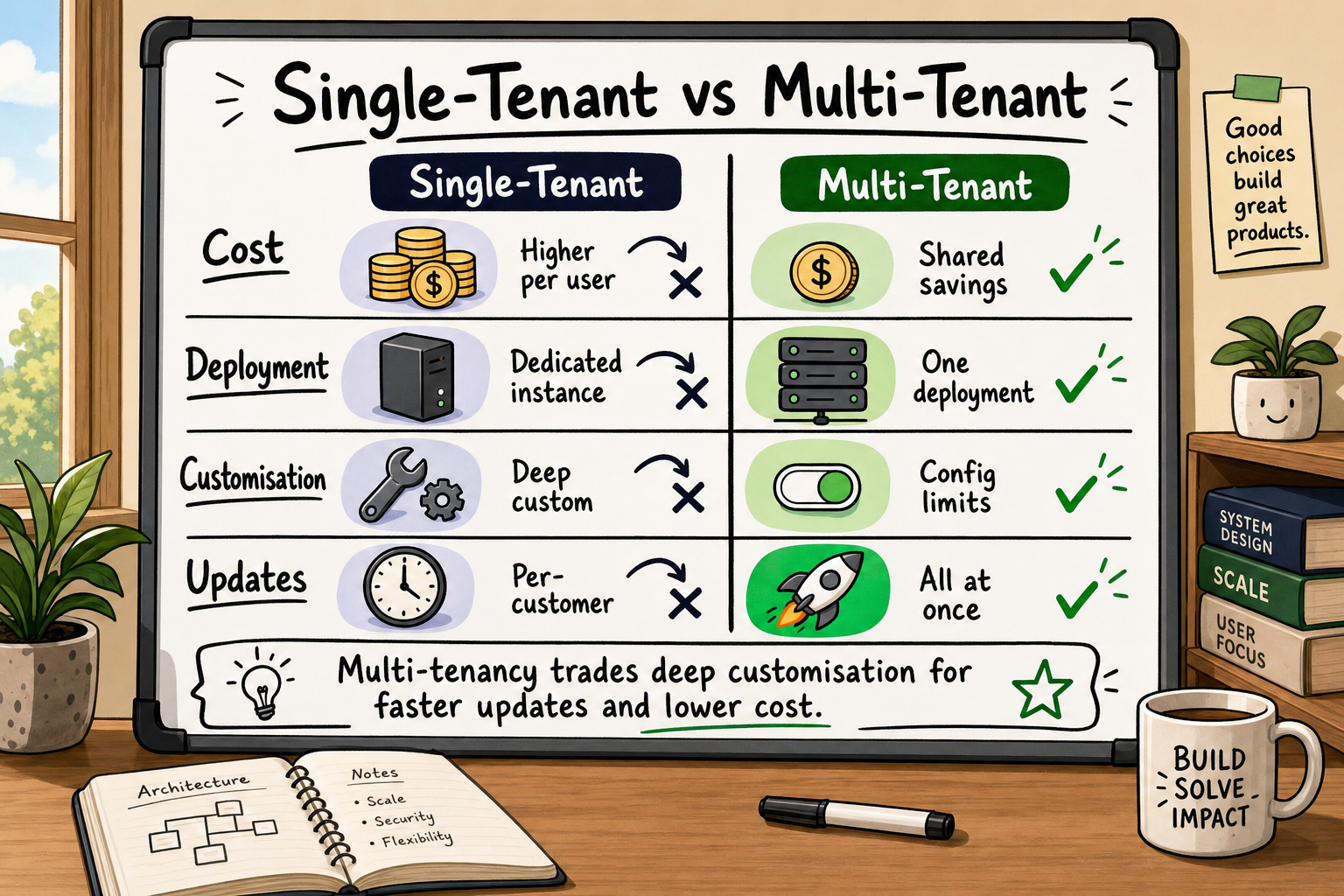
In a single-tenant system, each customer gets their own dedicated instance of the application — their own servers, their own database, their own deployment. Think of it as every customer having their own detached house rather than a flat in a shared building.
Infrastructure and hosting costs
Single-tenant deployments are significantly more expensive to run at scale. If you have 500 customers, you are managing 500 separate environments. Patching, monitoring, updating, and backing up each one multiplies your operational overhead linearly.
With multi-tenancy, you deploy once and serve all 500 customers from the same infrastructure. Hosting costs scale sub-linearly — adding a new tenant rarely requires provisioning new servers until you hit genuine capacity limits.
For most SaaS businesses, this cost difference is a primary reason to choose multi-tenancy from the start.
Customisation and configuration limits
Single-tenant architecture gives each customer maximum flexibility. You can modify the codebase, the database schema, or the infrastructure specifically for that customer without affecting anyone else.
Multi-tenancy forces you to bake customisation into the product itself — through configuration options, feature flags, and tenant-specific settings — rather than through bespoke code changes. This is a discipline that pays off, because it pushes you to build a product that is genuinely configurable rather than relying on one-off hacks.
For most SaaS products, this is actually the right outcome. The exceptions are enterprise contracts that require deep, client-specific integrations — which is one reason large enterprise software often uses a hybrid model.
Deployment and update complexity
With single-tenancy, you can deploy an update for one customer at a time, which reduces risk but multiplies effort. With multi-tenancy, a single deployment updates every tenant simultaneously — faster, but requiring more rigorous testing before release.
When we built the FieldFolio B2B wholesale marketplace, which serves 40,000+ retailers across Australia and New Zealand, a multi-tenant model allowed a single deployment to serve thousands of supplier-retailer relationships without provisioning a separate environment per client. Updates shipped to every retailer instantly. Bugs, when they occurred, were fixed once and resolved everywhere Portfolio.
The three main data isolation models — and how to choose
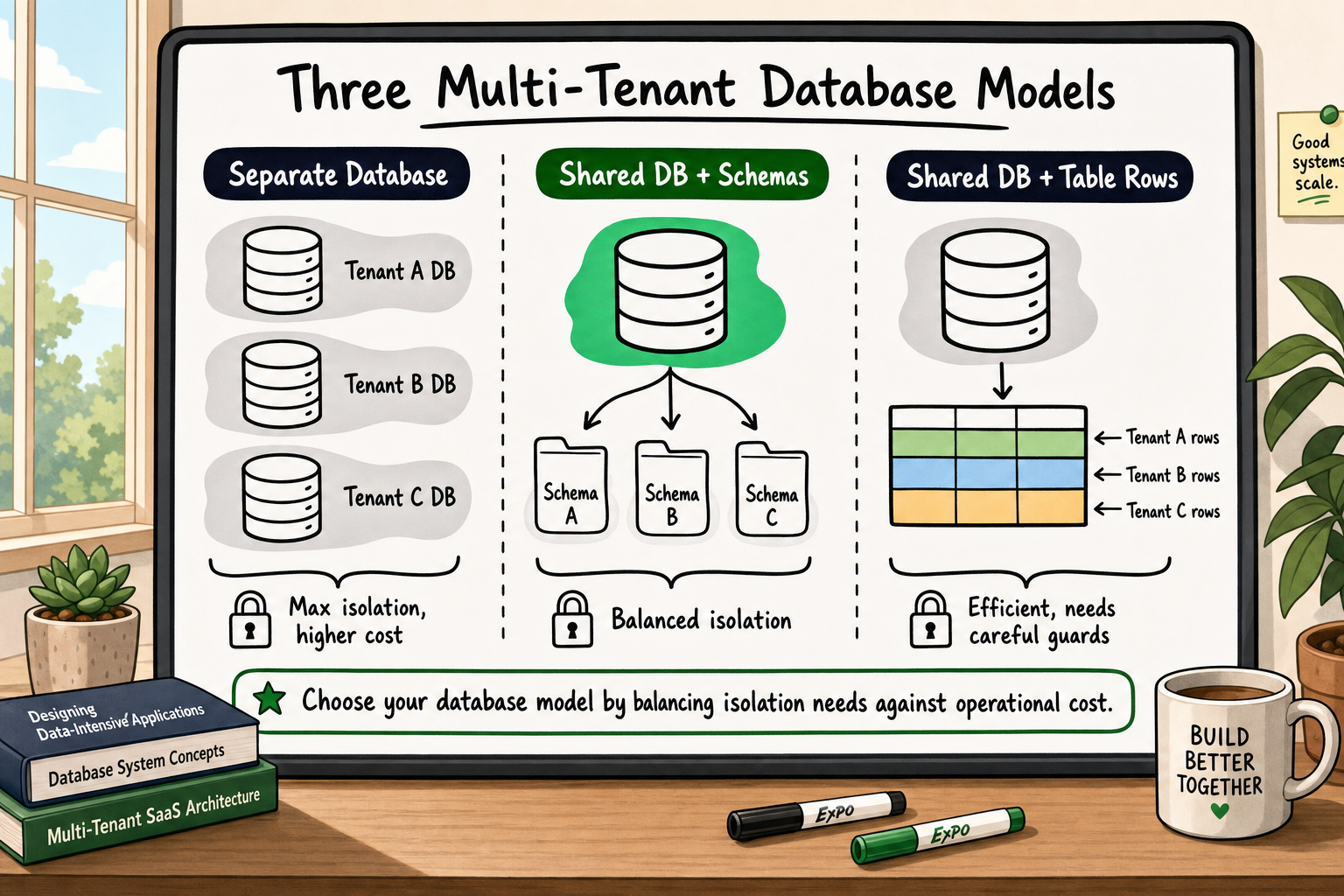
This is where most founders' eyes glaze over — but it is the most consequential technical decision in a multi-tenant system. You have three main options.
Separate database per tenant
Each tenant gets their own database instance. Data is physically separated, not just logically.
Advantages: Maximum isolation. Simplest to reason about security. Easy to move a single tenant to a dedicated server if they grow. Simplest to comply with data residency regulations.
Disadvantages: Expensive at scale. Managing hundreds of database instances creates significant operational complexity. Querying across tenants (for analytics or aggregated reporting) becomes difficult.
Best for: Products with a small number of high-value enterprise customers, healthcare or fintech products with strict data residency requirements, or situations where tenants have contractual rights to export or delete their data independently.
Shared database, separate schema
All tenants live in the same database instance, but each has their own schema — a separate namespace within the database. This is a middle-ground approach.
Advantages: Lower infrastructure cost than separate databases. Still provides meaningful logical separation. Easier to query cross-tenant aggregates than full database separation.
Disadvantages: Schema migrations (changes to your data structure) must be applied across every schema, which becomes complex at scale. Still more operational overhead than a shared schema.
Best for: Products with moderate tenant counts (tens to low hundreds), moderate compliance requirements, and a need for per-tenant data export or schema customisation.
When we built the Multiverse restaurant management system — a multi-tenant platform covering POS, inventory, online orders, and back-office operations — a shared-database, separate-schema approach kept each restaurant's data logically isolated while sharing application servers and deployment pipelines. The team could ship updates once and have them reflected across every restaurant's instance, while each operator's data remained completely invisible to others.
Shared database, shared tables with row-level security
All tenants share the same tables. Every row has a tenant_id column. The database or application enforces rules ensuring a query from Tenant A can only return rows where tenant_id matches Tenant A's identifier. This pattern is called row-level security (RLS).
Advantages: Lowest infrastructure cost. Simplest to scale to thousands of tenants. Cross-tenant analytics are straightforward. Easiest to manage schema migrations.
Disadvantages: Highest risk if access control is implemented incorrectly — a bug in your query logic could expose data from the wrong tenant. Requires rigorous testing and database-level enforcement (not just application-level) to be safe.
Best for: Products targeting a large number of small-to-medium tenants, early-stage SaaS MVPs optimising for cost, and situations where compliance requirements do not mandate physical data separation.
For context on choosing: the majority of successful SaaS products — from project management tools to marketing platforms — use the shared-table model with row-level security. It is the pragmatic default unless your compliance or contractual requirements demand otherwise.
| Model | Isolation level | Cost | Migration complexity | Best tenant count | |---|---|---|---|---| | Separate database | Physical | High | Low | < 100 | | Separate schema | Logical (strong) | Medium | Medium | 10–500 | | Shared tables + RLS | Logical (enforced) | Low | Low | Unlimited |
Security considerations founders often underestimate
The most common concern non-technical founders raise about multi-tenancy is: "What stops my customers' data from leaking to another customer?" It is the right question, and the honest answer is: the quality of your access control layer.
The cross-tenant data leakage risk
Data leakage between tenants is not an inherent flaw in multi-tenant architecture — it is a consequence of flawed implementation. Specifically, it is almost always caused by broken access control: a query that forgets to filter by tenant_id, an API endpoint that does not verify the requester's tenant before returning data, or a caching layer that serves one tenant's response to another.
The OWASP Top Ten lists broken access control as the number-one vulnerability in web applications [Source: owasp.org/www-project-top-ten]. In a multi-tenant system, the consequences of broken access control are more severe than in a single-tenant system because a single bug can expose data from all tenants, not just one.
The mitigation is not a different architecture — it is disciplined engineering: database-level enforcement of row-level security (not just application-level), comprehensive test coverage of access control paths, and regular penetration testing.
Authentication and authorisation layers
Authentication confirms who a user is. Authorisation determines what they can access. In a multi-tenant system, you need both — and you need a third layer: tenant verification, which confirms that the authenticated user actually belongs to the tenant they are claiming to act on behalf of.
Missing that third layer is one of the most common architectural oversights in hastily built multi-tenant systems.
Compliance implications: GDPR, HIPAA, and SOC 2
If your product handles personal data from EU residents, you must comply with GDPR regardless of architecture model. If you are building in healthcare adjacent to US patients' records, HIPAA applies. Neither regulation mandates a specific database isolation model — but both require you to demonstrate that data is protected and that you can honour deletion and export requests on a per-tenant basis.
For HIPAA-adjacent products, a separate database per tenant is often the practical choice simply because it makes data deletion and audit trails far simpler to implement and demonstrate. For GDPR compliance, the shared-table model with row-level security can work well if your deletion and export logic is rigorous How to Evaluate a Software Development Partner: 9 Criteria.
When multi-tenant architecture is the right call — and when it is not
Signs multi-tenancy fits your product
You should design for multi-tenancy from day one if:
- Your product will be sold to multiple business customers (B2B SaaS)
- You expect to onboard customers self-serve, without manual provisioning per account
- Your pricing model is subscription-based with many customers at similar plan tiers
- You want to ship updates to all customers simultaneously rather than managing separate deployments
- Infrastructure cost per customer needs to decrease as you grow, not stay flat
Signs you should start simpler
Multi-tenancy adds engineering complexity upfront. It may not be the right starting point if:
- You are building an internal tool for a single organisation
- Your MVP has one or two clients, and you are still validating the business model
- You are building a consumer application where individual users — not organisations — are the unit of access
- Your compliance requirements genuinely demand physical separation per client, making the cost of a shared model negligible against the compliance cost
The cost of retrofitting multi-tenancy later
This is perhaps the most important practical point for founders: if your product will eventually need multi-tenancy, design it in from the start.
Across 50+ delivered projects, retrofitting multi-tenancy into a system not designed for it typically costs three to five times the effort of building it correctly from the outset [VERIFY]. The reasons are structural: every data model must be revised to carry tenant_id, every query must be audited, the entire authentication and authorisation layer must be rebuilt, and cached data must be invalidated and re-architected. In a live product with paying customers, doing this safely — without data loss or downtime — is a significant engineering undertaking.
Technical debt that starts as "we'll add multi-tenancy later" almost always becomes a painful, expensive migration that slows down every other feature you want to ship What Is a Product Backlog? Quality, Grooming & Velocity.
If there is any plausible path to your product serving multiple business customers, make the decision during initial scoping — not six months after launch.
Frequently asked questions about multi-tenant architecture
What is multi-tenant architecture in simple terms?
Multi-tenant architecture is a design where one software system serves many customers simultaneously. Each customer's data is kept separate and private, but the underlying infrastructure — servers, code, and database — is shared. It is like an apartment building: one building, many separate flats.
What is the difference between a tenant and a user?
A tenant is typically an organisation or business account that subscribes to your SaaS product. A user is an individual person who logs in within that organisation. One tenant (for example, a company called Acme Ltd) may have dozens of users — employees, managers, admins — all operating within that single tenant's data boundary.
Is multi-tenancy safe for sensitive data?
Yes, when implemented correctly. Safety depends on the rigour of your access control and data partitioning, not on the architecture model alone. The primary risk is broken access control — a bug that returns data from the wrong tenant. Database-level row-level security, comprehensive testing, and regular penetration testing are the standard mitigations. For HIPAA-adjacent or highly regulated data, a separate database per tenant provides the strongest isolation.
Should my MVP use multi-tenant architecture?
If your MVP is a B2B SaaS product intended to serve multiple business customers, yes — design for multi-tenancy from the start. Retrofitting it later is expensive and disruptive. If your MVP is a single-client project, an internal tool, or a consumer product, multi-tenancy may not apply yet. The decision depends on who your tenants will be, not on how large you are today.
Which database model is best for multi-tenant SaaS?
There is no universal answer. Shared tables with row-level security are the cost-efficient default for most SaaS products targeting many small-to-medium customers. Shared database with separate schemas suits moderate tenant counts with stronger isolation requirements. Separate databases per tenant are appropriate for enterprise products with strict data residency or compliance needs. The right choice depends on your compliance requirements, expected tenant count, and infrastructure budget.
How Decyb Technology LLP approaches multi-tenant product architecture
For non-technical SaaS founders, understanding multi-tenancy conceptually is the first step. The harder part is making the right architectural decisions for your specific product — and documenting them in a way that survives your first engineering hire, your Series A due diligence, or a future handoff to a new CTO.
This is the gap our team works in.
Documented architecture decisions from day one
Every engagement we take on begins with an architecture decision document: a plain-English record of what we chose, why we chose it, what alternatives we considered, and what the trade-offs are. For multi-tenant products specifically, this document covers the isolation model, the access control design, the compliance implications, and the cost-versus-complexity rationale.
The goal is that if you hand this document to an investor, a new technical co-founder, or an acquirer in three years, they can understand every major decision without needing to reverse-engineer the codebase.
From FieldFolio to Multiverse: real multi-tenant systems we have shipped
The principles in this article are not theoretical for our team. FieldFolio, the B2B wholesale marketplace we built for 40,000+ retailers across Australia and New Zealand, is a production multi-tenant system handling supplier catalogues, retailer onboarding, and order management at scale. Multiverse, the restaurant management platform we built on React, Node.js, and Express, uses a multi-tenant architecture to power POS, inventory, online orders, and back-office reporting across multiple restaurant operators from a single deployment.
Both systems have been running in production with consistent five-star delivery ratings from clients [INTERNAL LINK: Portfolio].
What working with Decyb looks like in practice
We work with founders who need a senior technical partner — not a vendor who takes a brief and disappears. Our engagements are structured around fixed-price scopes with documented decision-making, not time-and-materials arrangements that leave you managing the work yourself.
If you are at the stage of scoping a SaaS product and are not yet sure whether multi-tenancy is the right call, the most useful next step is a direct conversation. Our free 24-hour technology strategy call is a working session with a senior partner — no cost, no obligation — where we map your product requirements to the right architectural approach before any code is written.
Book your free strategy call — get a plan in 24 hours Contact
All project timelines and delivery estimates are indicative and subject to scope confirmation. Third-party service costs (hosting, domains, SaaS tools) are billed separately at cost. Decyb Technology LLP is registered in India; engagements are subject to terms of service available at decyb.com/terms.