
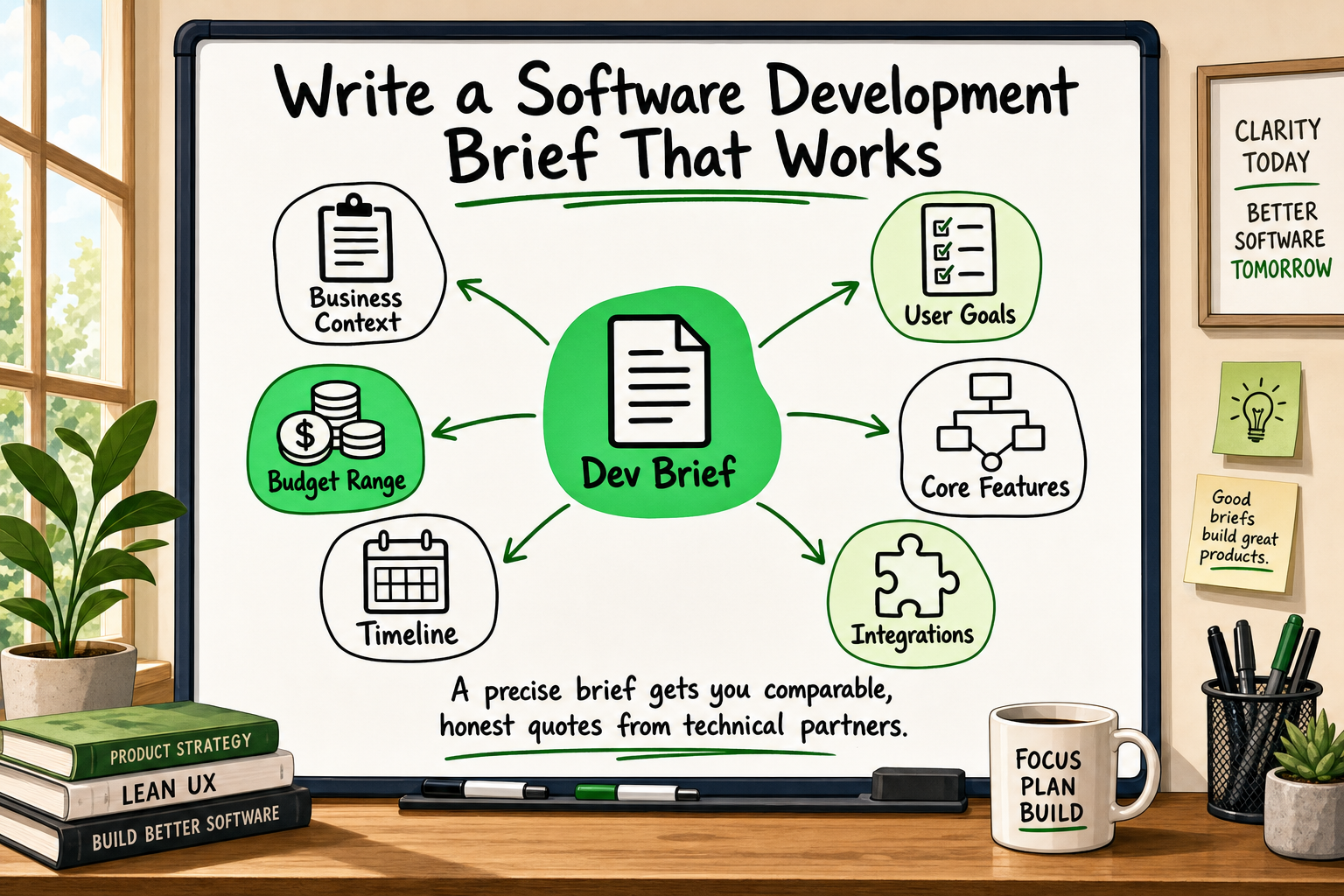
A software development brief is the single document that determines whether the quotes you receive are useful or worthless. Get it right and you will be comparing honest, apples-to-apples proposals from technical partners who genuinely understand your project. Get it wrong and you will spend weeks chasing vendors, receive estimates ranging from £8,000 to £80,000 for the same product, and still not know which one to trust.
This guide is written for non-technical founders and product leads who are actively evaluating development partners. It covers every section your brief must contain, how to describe features without writing code, why budget transparency works in your favour, and how to use your brief as a filter when comparing responses.
Fixed-Price Software Contract: Is It Right for You?
Why Most Software Briefs Produce Useless Quotes
The gap between what founders write and what developers read
Most founders approach a brief as a summary of what they want built. Most developers read it looking for what has not been defined — because undefined scope is where projects go over budget.
When a brief says "a user dashboard with analytics," a developer hears ten different things: Who are the users? What data powers the analytics? What time range? What format? Does it export? Is it real-time? Who can see it?
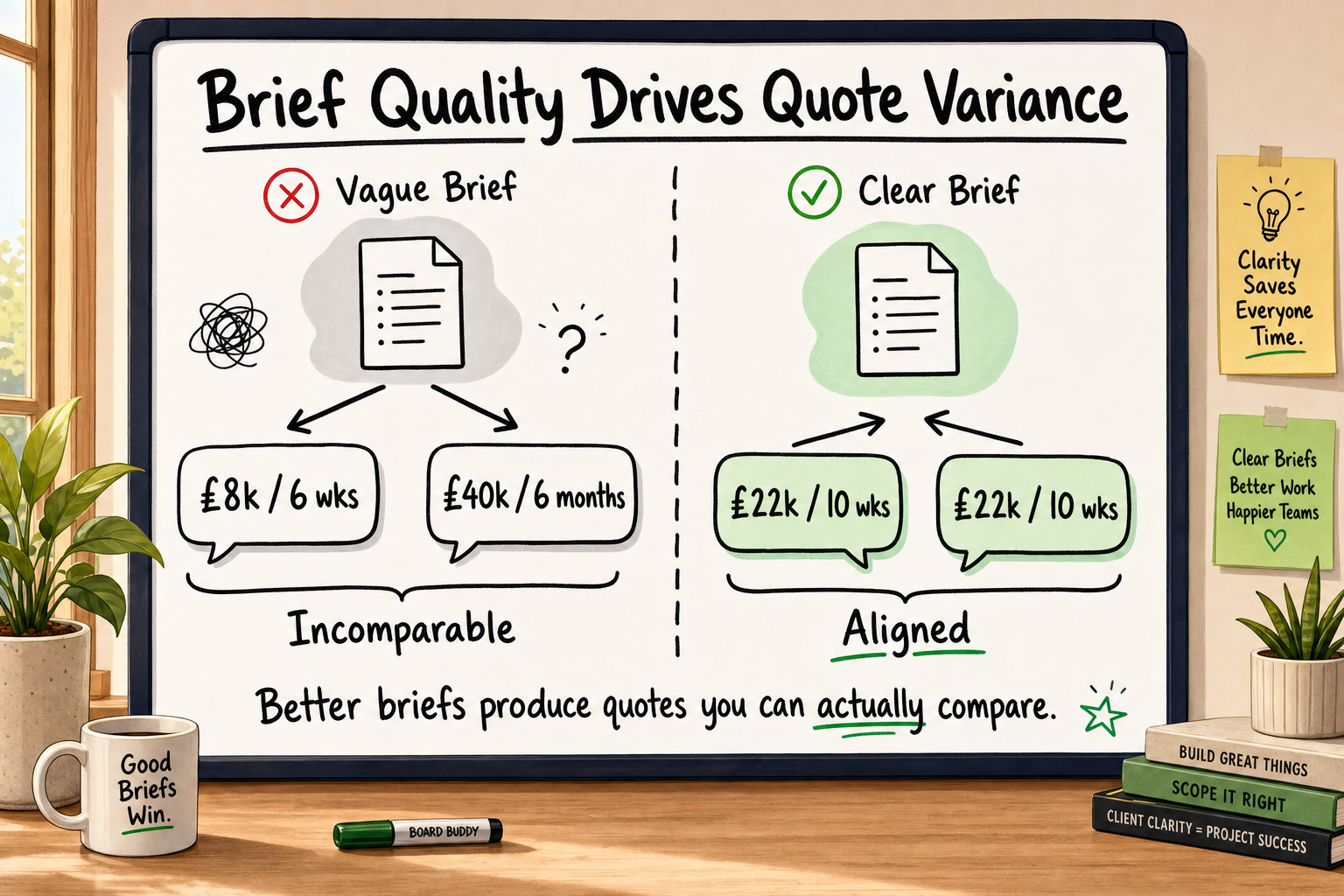
Each unanswered question becomes an assumption. Different agencies make different assumptions. That is why you receive quotes of £15,000 and £75,000 for what you believe is the same product.
How vague scope creates quote variance of 5× or more
Across our team's experience on more than 50 completed projects, incomplete briefs are the single most consistent cause of mid-project budget overruns and scope disputes. The problem is rarely the technology or the team — it is the gap between what was communicated and what was understood before the first line of code was written. [VERIFY]
The good news is that closing this gap does not require technical knowledge. It requires a structured document that answers the questions every developer will ask before they can price a project honestly.
The Six Sections Every Software Development Brief Must Contain
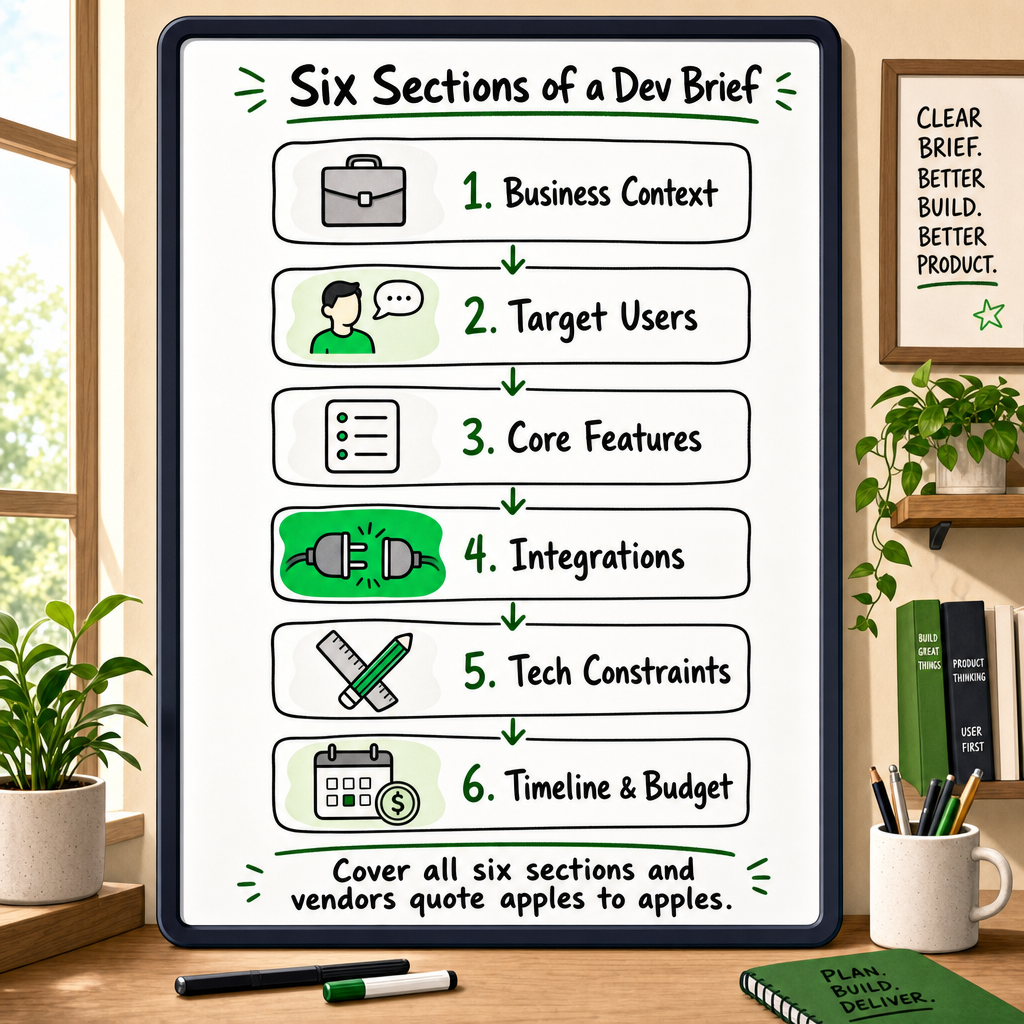
A well-structured brief covers six areas. Each one removes a category of ambiguity that would otherwise inflate or distort the quotes you receive.
1. Business context and the problem you are solving
Start with why the product needs to exist, not what it does. Describe your business model, your target customers, and the specific problem that currently goes unsolved. Include any relevant market context: Are you replacing a manual process? Competing with an existing SaaS tool? Building on top of an existing platform?
A developer who understands your business goal will make better architectural decisions than one who only knows the feature list. This section also helps agencies self-select — a team that has never built for your market may flag that early rather than discovering it mid-project.
2. User roles and the jobs they need to do
List every type of person who will use the product and describe what they need to accomplish. These are your user roles. For each role, write two or three of their core jobs — the outcomes they are trying to achieve, not the features they will click.
Example:
- Retailer (buyer): Browse the supplier catalogue and place wholesale orders without calling a sales rep.
- Supplier (seller): Publish and update a product catalogue and receive order notifications.
- Platform admin: Onboard new suppliers, manage disputes, and run basic reporting.
This structure maps directly to the features your product needs and gives developers a framework for estimating complexity per role.
3. Core features versus nice-to-haves (scope boundary)
This is the most important section for quote accuracy. Divide your feature list into two columns: must-have for launch and phase two or later. Be ruthless. Everything in the must-have column will be priced. Everything in the phase-two column will not — but listing it tells the agency to design the architecture to accommodate it later.
What Is an MVP? The Definition Startups Actually Need
A useful test: if this feature were missing on day one, would the product be unable to generate revenue or serve its core users? If the answer is no, it is a phase-two feature.
4. Technical constraints and existing systems
List every system your new product must connect to, import data from, or share authentication with. This includes:
- Third-party APIs (payment gateways, CRMs, shipping providers)
- Existing databases or legacy systems
- Single sign-on or identity providers
- Hosting or infrastructure requirements (e.g., must run on AWS, must be GDPR-compliant, must store data in a specific region)
Integration work is one of the most commonly underestimated cost drivers in software projects. A brief that names every integration upfront allows agencies to price the actual work rather than a best guess.
5. Success metrics and acceptance criteria
Describe what "done" looks like for the project, and what "working" looks like for each major feature. These are your acceptance criteria. They do not need to be written in formal testing language — plain English is fine.
Example: "A retailer can browse the catalogue, add items to a cart, and complete a wholesale order without any manual input from a supplier. The order confirmation email arrives within 60 seconds."
Acceptance criteria give you a contractual reference point if a feature is later disputed. They also signal to agencies that you are a structured client, which tends to attract more experienced teams.
6. Timeline, budget range, and engagement model
State your target launch date or the milestone you are working towards (e.g., investor demo, go-to-market date, end of runway). Then state your budget range — not a fixed figure, but a range. The section below explains why this is always in your interest.
Also specify the engagement model you prefer: fixed-price project, time-and-materials retainer, or a hybrid. If you do not have a preference, say so — a good agency will recommend the right model for your scope.
How to Describe Features Without Writing Technical Specifications
Writing user stories that developers can estimate
The most practical format for describing features in a brief is the user story:
"As a [user role], I want to [do something] so that [outcome or reason]."
This format forces you to connect every feature to a user goal, which is exactly what a developer needs to estimate correctly. It also prevents you from specifying how something should be built, which is the agency's job.
Example:
- ❌ "Build a dashboard with charts and a date picker and export to CSV."
- ✅ "As an admin, I want to see daily order volume filtered by date range and product category so that I can monitor sales performance without exporting raw data manually."
The second version tells a developer the data model required, the filtering logic needed, the rendering approach implied, and the user's actual goal. That is an estimable feature. The first is not.
Using acceptance criteria to define 'done'
For each user story, add one or two sentences describing the conditions that must be true for the feature to be considered complete. This becomes your acceptance checklist during testing.
You do not need to cover edge cases — just the primary success path. Agencies will flag gaps during their technical review.
What to leave out of the brief
Do not specify the technology stack unless you have a genuine constraint (e.g., your team already maintains a Node.js codebase). Do not describe database schemas, API endpoints, or infrastructure diagrams. Do not include design mockups as requirements — include them as context. Prescribing technology choices without a technical background typically produces an architecture that serves the brief rather than the business goal.
What Is a Product Backlog? Quality, Grooming & Velocity
The Budget and Timeline Section: Why Transparency Pays Off
Why withholding your budget backfires
Founders routinely omit budget from briefs because they fear anchoring the agency's pricing. The logic is understandable but counterproductive.
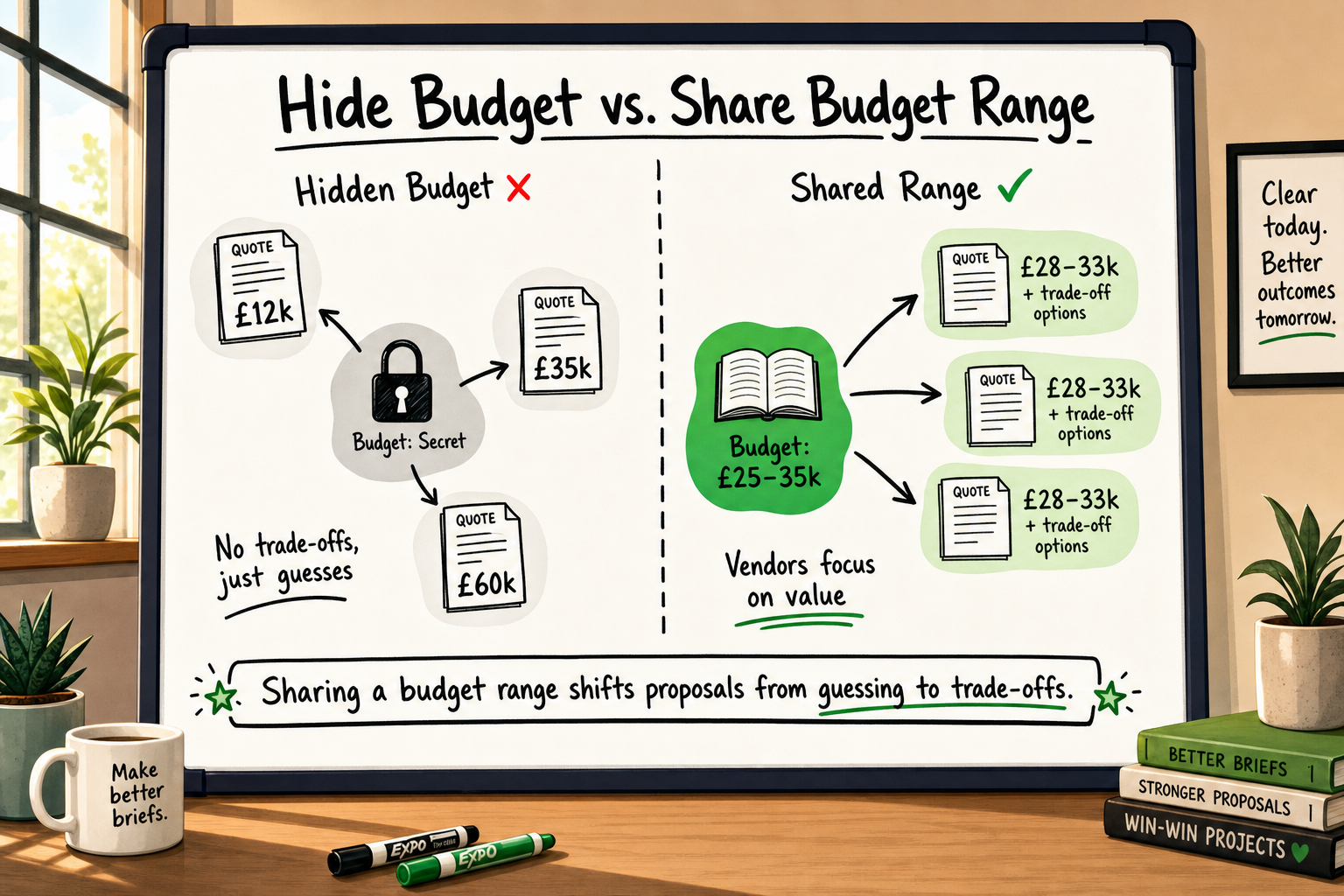
When a budget is hidden, agencies face two options: price for their ideal margin (which may be far above your actual range) or price low to win the project and recoup through change requests later. Neither outcome serves you. The quotes you receive will be incomparable because each agency has made a different assumption about what you can afford.
How to frame a budget range without anchoring too low
Share a range, not a figure. "We have a budget of £40,000–£60,000 for the initial build" tells an agency to propose what is achievable within that envelope rather than what they would charge if money were no object.
A good agency will respond with a scoped proposal that fits the range — or tell you honestly that the scope you have described requires more budget and explain why. That is a more valuable response than a quote that looks affordable but collapses under the weight of scope reality six weeks in.
Setting realistic timelines based on scope, not wishful thinking
State your target date, but also state the constraints behind it: a funding announcement, a conference, a regulatory deadline. Context helps an agency understand whether the timeline is a hard constraint or a preference.
If your scope and your timeline are incompatible, a good agency will tell you before the contract is signed. If they do not, they are hoping you will not notice until the deadline arrives.
How to Use Your Brief to Compare Quotes Fairly
What a thorough response looks like versus a templated pitch
Send the same brief to every agency you are considering. Then compare how they respond, not just what they charge.
A thorough response will:
- Reference specific sections of your brief by name
- Ask clarifying questions about ambiguous requirements
- Propose a phased scope if the budget is tight
- Explain the technology choices they are recommending and why
- Identify integration risks or unknowns you did not mention
A templated response will lead with company credentials, describe their general process, and attach a price without engaging with your specific project. Agencies that do not read briefs carefully do not manage projects carefully either.
Questions to ask every agency after they respond
- Which feature in our brief carries the most delivery risk, and how will you handle it?
- What is your process when we need to add scope after the contract is signed?
- Who on your team will we speak to day-to-day, and what are their qualifications?
- Can you show us a case study of a project with a similar integration or user role structure?
The answers reveal process discipline, communication norms, and whether the agency is comfortable with accountability.
How to Evaluate a Software Development Partner: 9 Criteria
Red flags in quote documents that signal future problems
- No breakdown of cost by feature or module — you cannot audit what you cannot see
- Timeline that matches yours exactly without any questions — a sign the agency is telling you what you want to hear
- Vague payment milestones not tied to deliverables
- No mention of testing, deployment, or post-launch support
Common Mistakes That Inflate or Undermine Your Quotes
Over-specifying the solution instead of the problem
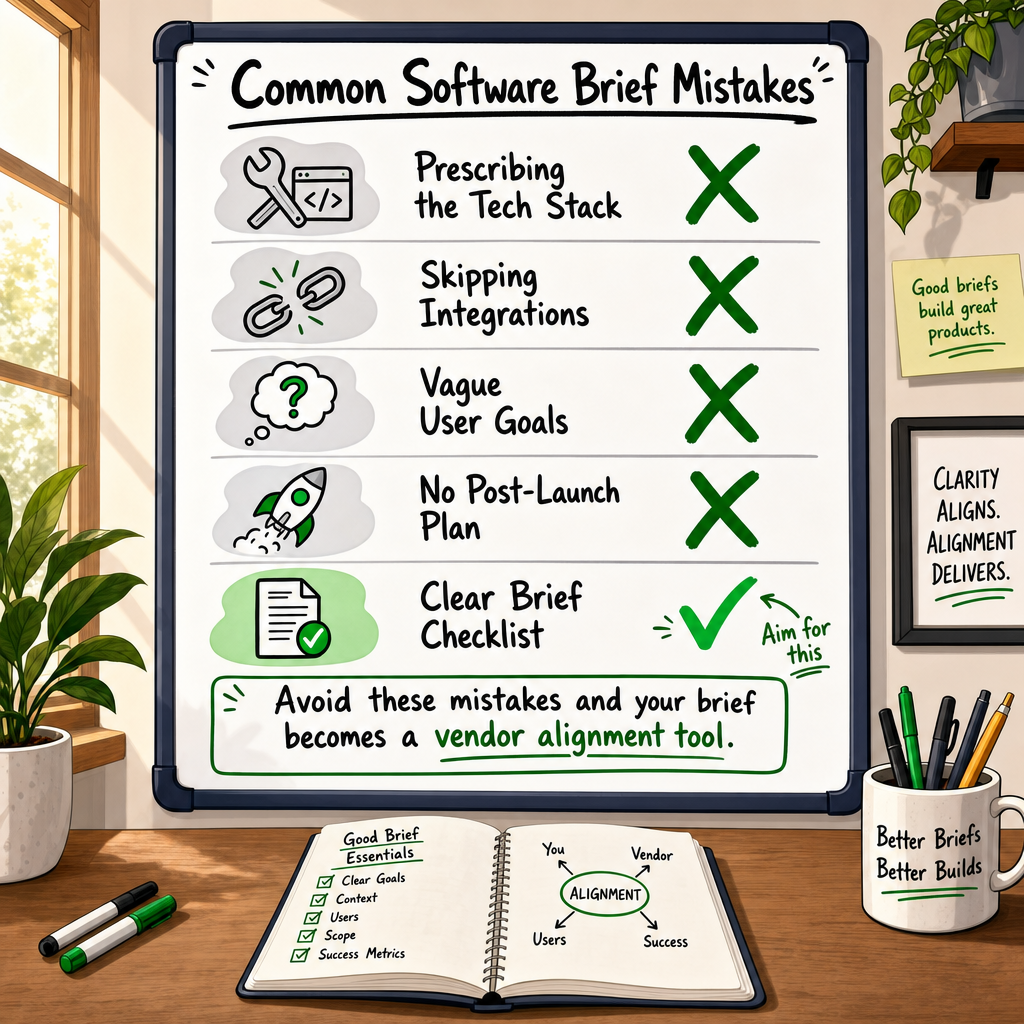
Founders who have done some research sometimes arrive with a detailed technical architecture: microservices, specific cloud providers, particular frameworks. Unless you have strong technical reasons for these choices, they constrain the agency's ability to recommend the approach that best fits your budget and timeline.
Describe the problem and the constraints. Let the agency describe the solution. Then ask them to justify it.
What Is Clean Architecture in Software? Founder's Guide
Skipping the integration and data migration section
In our project intake process, the most expensive surprises consistently come from undocumented third-party API dependencies. A payment gateway with unexpected rate limits, a CRM that requires a custom connector, a legacy database with no documented schema — these are the items that turn a three-month project into a five-month one.
List every external system in your brief, even if you are unsure how the integration will work. "We use Xero for accounting and will need order data to sync automatically" is enough for an agency to flag the integration as a risk item and price it accordingly.
Omitting post-launch expectations
Many briefs treat launch as the finish line. But for most products, launch is the beginning of the most consequential period — user acquisition, bug discovery, performance under real load, and feature iteration based on actual usage.
Your brief should include a section on what you expect after launch: bug-fix SLA, ongoing feature development, hosting and infrastructure management, or handoff to an in-house team. This single addition will reveal which agencies are building a long-term partnership and which are building a one-time deliverable.
Software Product Handoff to a New CTO: Full Guide
How Decyb Technology LLP Approaches the Scoping and Briefing Process
If you have worked through this guide, you now understand what a strong brief looks like — and probably have a clear sense of how much of what you currently have falls short. That gap is exactly where Decyb Technology LLP starts with every new engagement.
We work with non-technical founders, healthcare and fintech product leads, and eCommerce operators who need a technical partner that owns delivery rather than requiring constant management. Our intake process is built around the same six-section structure this guide describes — not because it is a convenient template, but because after 12+ years and more than 50 projects across SaaS, fintech, healthcare, and eCommerce, it is the structure that consistently produces accurate scopes and honest fixed-price proposals.
From brief to fixed-price scope in 24 hours
When you book our free strategy call, a senior partner — not a sales representative — reviews your brief before the session. During the call, we walk through every section, identify the integration risks and scope gaps that would inflate your costs, and produce a written scope document within 24 hours. That document becomes the basis for a fixed-price contract with clear milestones tied to deliverables.
Projects like FieldFolio — a B2B wholesale marketplace serving 40,000+ retailers across Australia and New Zealand — began with exactly this process. The architecture decision document produced during scoping covered multi-tenant design, retailer onboarding flow, supplier catalogue sync, and order management before a single line of code was written. That upfront clarity is what allowed the project to be delivered on schedule.
What our discovery process produces that protects both sides
Every scoped engagement produces a documented architecture decision record that explains what was built, why each major choice was made, and how the system is designed to scale. This document is designed to be handed to a future CTO, an investor conducting technical due diligence, or a new development team without any knowledge transfer sessions required.
Our consistent ★ 5.0 delivery record across international client platforms — covering everything from server-side tracking implementations to multi-tenant restaurant management systems — reflects a process that prioritises transparency and documentation over speed-to-contract.
If you are at the stage where you are evaluating technical partners, our guide to [INTERNAL LINK: How to Verify a Software Agency's Case Studies] gives you the questions to ask any agency — including us — to verify that what they show in a portfolio reflects genuine depth of delivery.
Book your free strategy call — get a plan in 24 hours. Bring whatever brief you have, even if it is a single page of notes. We will tell you honestly what it needs, what the build will cost, and whether we are the right team for it. [INTERNAL LINK: Contact]
Frequently Asked Questions
How long should a software development brief be?
Length should match project complexity. A focused MVP brief is typically two to three pages. A multi-tenant platform with integrations may need eight to ten pages. Prioritise clarity over length — a brief that answers the six core questions in four tight pages will produce better quotes than a twenty-page document full of vague requirements. A good agency will ask clarifying questions rather than requiring a perfect document before they respond.
Should I share my budget in a software development brief?
Yes — share a range, not a fixed figure. When budget is hidden, agencies either price for their own margin or price low to win and recover through change requests. A stated range invites honest trade-off conversations: the agency can tell you what is achievable within your envelope, or tell you directly that the scope requires more. Both outcomes are more useful than incomparable quotes based on different assumptions.
What is the difference between a software brief and an RFP?
A brief is a concise business and product description used to start a conversation with potential technical partners. An RFP (Request for Proposal) is a more formal procurement document that includes mandatory response formats, scoring criteria, and evaluation rubrics. Most startups and scale-ups need a well-structured brief, not a formal RFP — the overhead of a full RFP process rarely matches the stage or speed requirements of a growing product company.
Do I need to specify a technology stack in my brief?
Not unless you have a genuine constraint — for example, your existing team maintains a specific codebase that the new product must integrate with. Otherwise, describe what the product must do and any integration requirements, and let the agency recommend the stack. Then ask them to justify the choice in terms of your specific goals, timelines, and future hiring plans.
How do I prevent scope creep after the project starts?
Two mechanisms protect you: first, acceptance criteria in the brief that define what "done" means for each feature; second, a documented change-request process agreed before the contract is signed. Any work outside the original scope should go through a formal change request with a written cost and timeline impact before it is approved. Fixed-price contracts with clear milestone definitions reinforce this discipline on both sides.
All project timelines and delivery estimates are indicative and subject to scope confirmation. Third-party service costs (hosting, domains, SaaS tools) are billed separately at cost. Decyb Technology LLP is registered in India; engagements are subject to terms of service available at decyb.com/terms.