
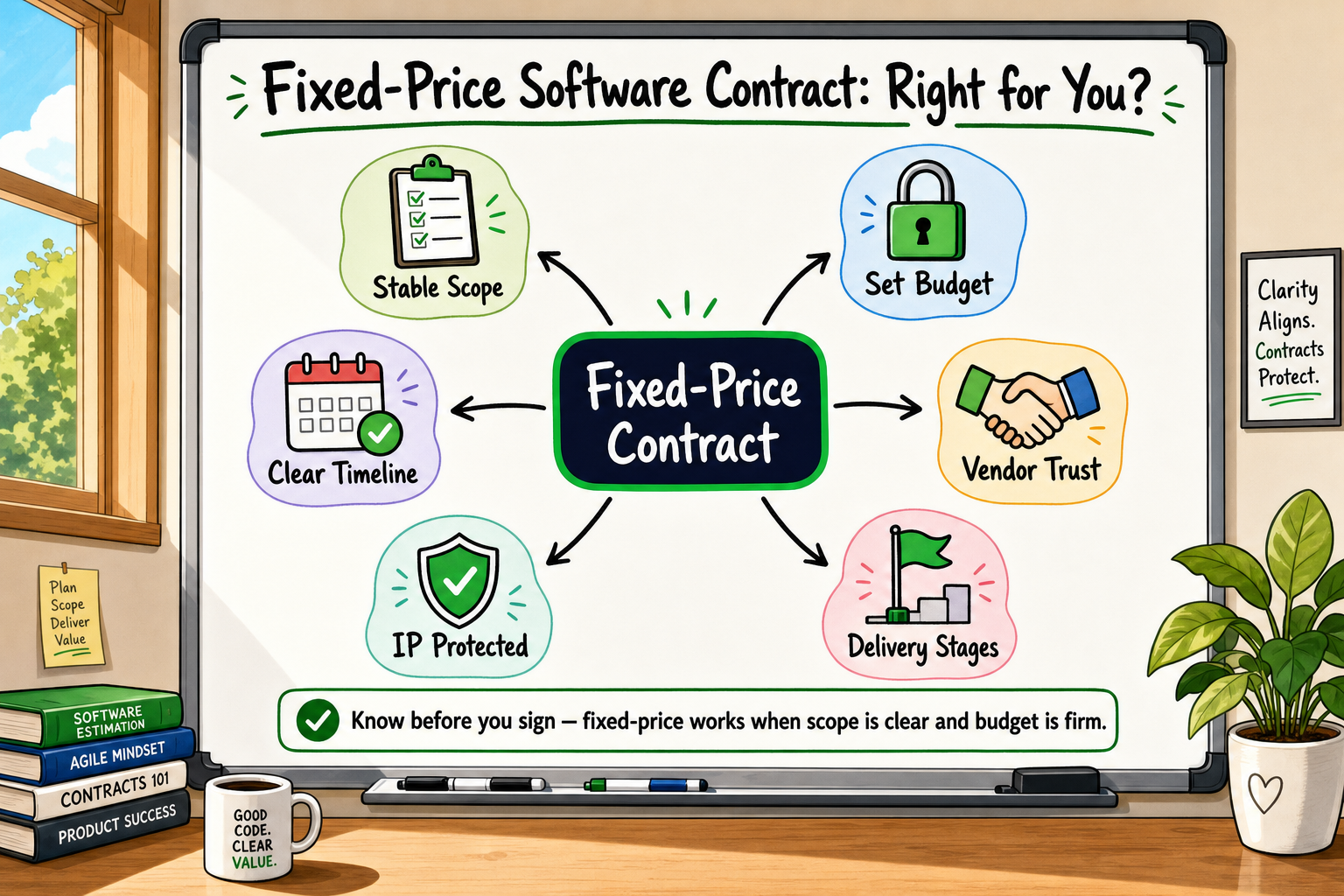
A fixed-price software contract sounds like the safest deal in the room. One number, one deliverable, no surprises. But founders who have signed one without the right groundwork often tell a different story — scope disputes, hidden change-request fees, or a product that technically shipped but barely resembled the original vision. This guide gives you a framework to evaluate whether fixed-price fits your project before you sit down with a vendor, so you walk in informed rather than hopeful.
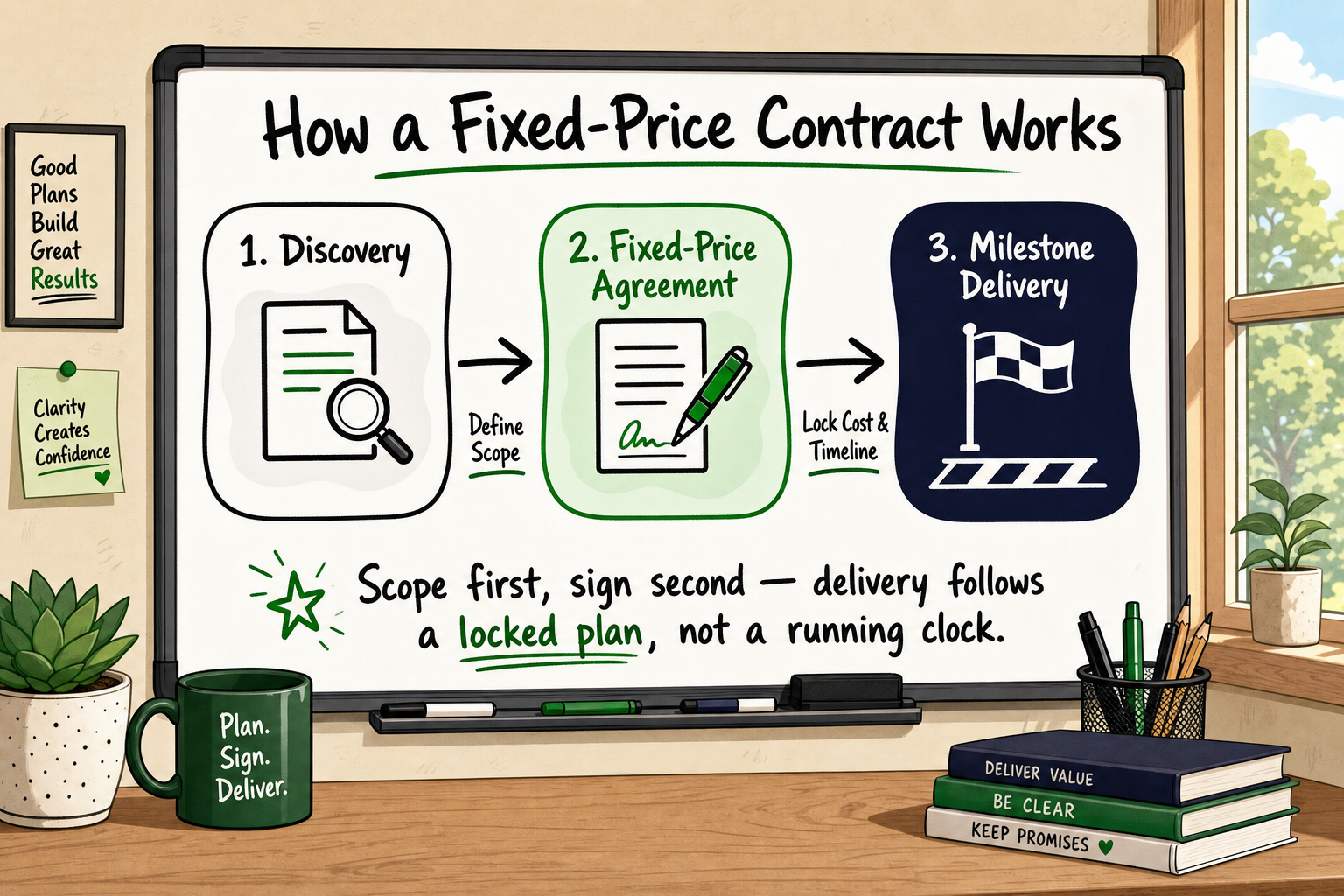
What a Fixed-Price Software Contract Actually Means
A fixed-price software contract is an agreement where the vendor commits to delivering a defined scope of work for a single agreed fee. The budget does not change as hours accumulate — unlike time-and-materials billing where you pay for every hour logged.
The critical word in that definition is defined. The price is not plucked from a rate card or a gut feel. It is derived from a scope document — typically produced during a discovery phase — that specifies what will be built, what "done" looks like for each feature, and what the acceptance criteria are. Without that document, a fixed price is really just a guess with a contractual wrapper around it.
How the Pricing Is Determined
A vendor estimates the time each feature will take, applies a buffer for integration complexity and testing, and quotes a total. That buffer is not padding — it is the risk premium the vendor is absorbing on your behalf. When the scope is vague, the buffer grows to cover uncertainty. When the scope is precise, it shrinks, and the quote becomes more competitive.
What Is and Is Not Locked at Signing
The scope is locked. The solution evolves within that scope as the team learns more during build. This is a subtle but important distinction. A fixed-price contract does not mean the vendor codes in a vacuum and hands you a binary deliverable on day 60. Milestone reviews, sprint demos, and staged sign-offs are normal — and any reputable contract will include them.
The Discovery Phase and Why It Comes First
Discovery is the pre-contract phase where the vendor maps your requirements into user stories, defines the data model, and produces an architecture outline. It usually runs one to four weeks depending on complexity. Skipping discovery and asking for a fixed price based on a pitch deck is the single most common reason fixed-price engagements go wrong. The discovery output is the contract's foundation — treat it accordingly.
What Is a Product Backlog? Quality, Grooming & Velocity
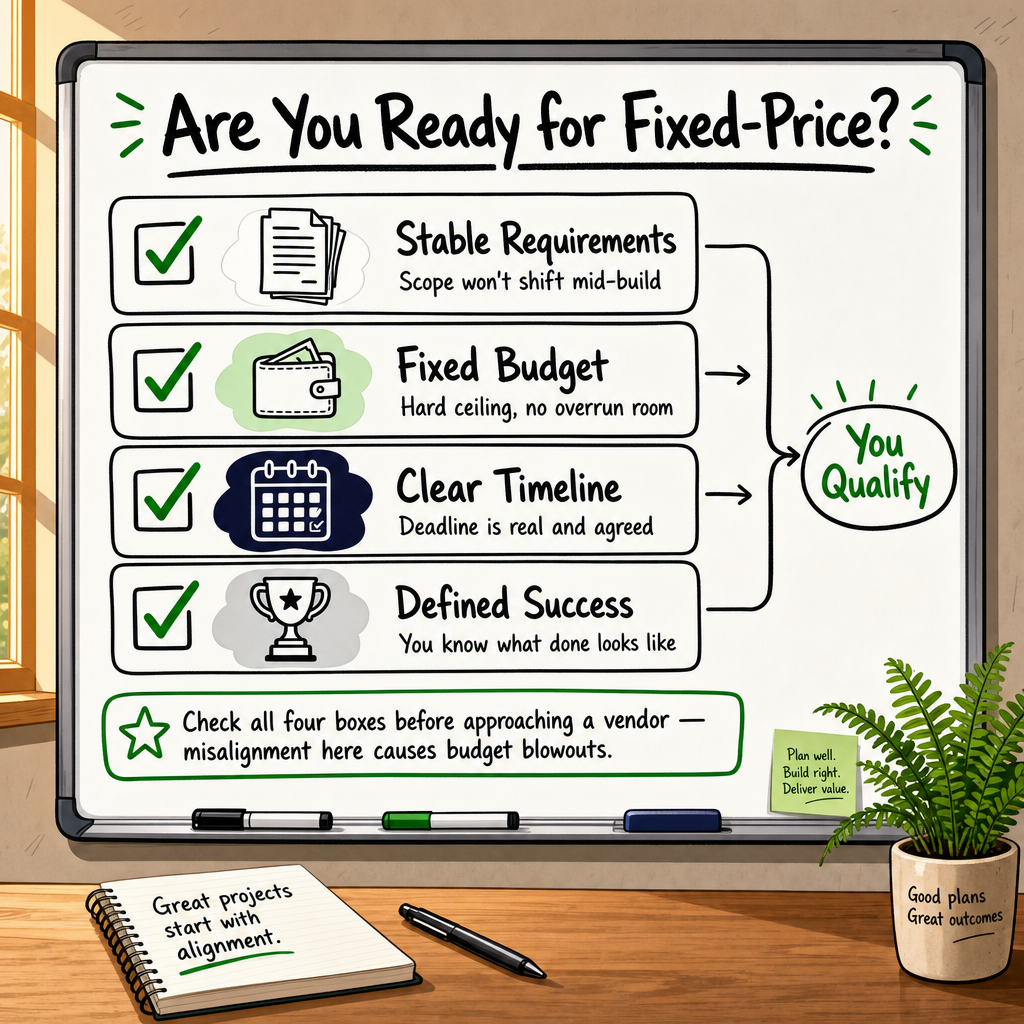
Four Conditions That Make Fixed-Price the Right Choice
Before requesting a fixed-price quote, run your project through these four conditions. The more boxes you tick, the better suited fixed-price is for your situation.
Your Requirements Are Documented and Stable
You have user stories, wireframes, or a detailed product brief. You know what the product must do and who it is for. You are not still pivoting on core features. If you cannot write a sentence that starts with "As a [user], I want to [action] so that [outcome]", your requirements are not yet ready for fixed-price pricing.
You Have a Fixed Budget or a Funding Milestone
Fixed-price is particularly valuable when your runway is the constraint. If you have raised a seed round and need to deliver an MVP by a specific date with a specific budget, a fixed-price contract converts that constraint into a contractual commitment from your vendor. It protects your runway and forces the vendor to solve problems within budget rather than passing overruns to you.
You Need Accountability Without Managing a Team Day to Day
You are not looking to project-manage a group of freelancers. You want a vendor who owns delivery, flags blockers early, and reports against milestones. Fixed-price contracts create that accountability structure because the vendor's margin depends on efficient delivery — not on hours billed.
You Are Building a Defined MVP or a Bounded Product Module
An MVP with a clear feature set, a standalone integration module, or a defined back-office system are ideal candidates. The scope boundary is clean. There is a natural start and end. When FieldFolio's B2B wholesale marketplace was scoped — covering retailer onboarding, supplier catalogue sync, and order management for 40,000+ retailers across Australia and New Zealand — the well-documented requirements allowed the team to price the engagement accurately from discovery and deliver without mid-project renegotiation.
What Is Clean Architecture in Software? Founder's Guide
Three Situations Where Fixed-Price Will Work Against You
Trust in a vendor often comes from their willingness to tell you when their model is not the right fit. Here are three situations where a fixed-price contract is likely to create friction rather than remove it.
Exploratory R&D with No Validated Requirements
If you are still testing whether a core technical approach is feasible — building a novel algorithm, prototyping hardware integrations, or evaluating competing architectures — requirements will shift as you learn. A fixed-price contract in this context locks you into a path before you have enough information to define it well. Time-and-materials or a short discovery retainer is a better fit until the approach is validated.
Products Built on Rapidly Shifting Market Assumptions
If your go-to-market strategy is still evolving and you expect the product definition to change in response to user feedback every few weeks, a fixed scope will feel like a cage within weeks of signing. The contract either becomes irrelevant as you redefine the product, or it creates a legal dispute every time the roadmap shifts. Consider a phased approach: fix the first phase, then re-evaluate.
Highly Novel Integrations with No Technical Precedent
Integrating with a legacy enterprise system that has no public API documentation, building on a technology with no established community, or connecting to a regulatory data source with unpredictable response behaviour are all situations where the vendor cannot reliably estimate effort. Any fixed price in these scenarios will include a very large uncertainty buffer — which you will pay for — or it will be understated and lead to disputes. A time-and-materials arrangement with a budget ceiling is often a better structure.
How to Evaluate a Software Development Partner: 9 Criteria
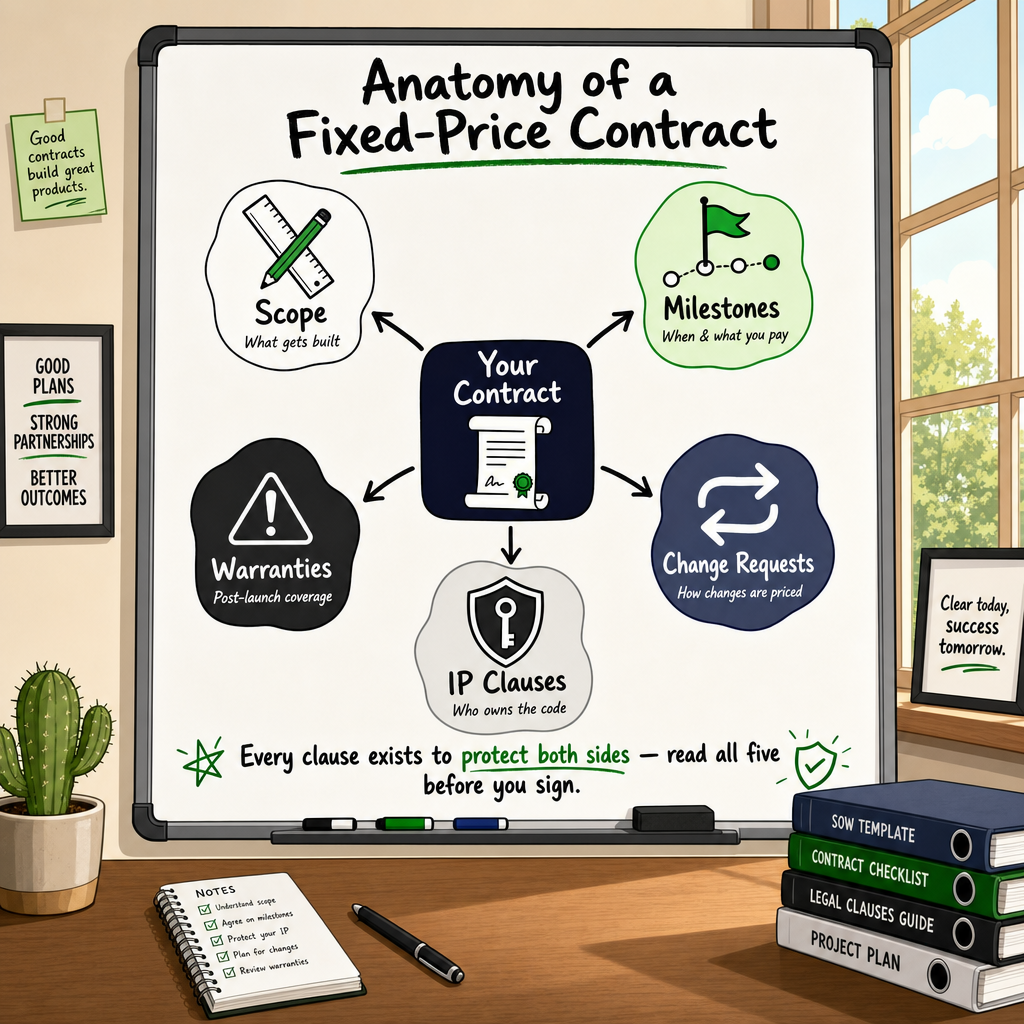
The Anatomy of a Defensible Fixed-Price Contract
Even if your project is a good fit for fixed-price, a poorly structured contract can still leave you exposed. These are the clauses that matter.
Scope Definition and Acceptance Criteria
The scope document should be appended to the contract, not summarised in it. Every feature should have acceptance criteria — the specific, testable conditions under which it is considered complete. "User can log in" is not an acceptance criterion. "User can log in with email and password, receive a session token valid for 24 hours, and see a 401 response if credentials are incorrect" is.
Milestone-Based Payment Schedule
Never pay 100% upfront or 100% on final delivery. A typical structure ties payments to tested milestones: a deposit at signing, a payment at design approval, another at staging deployment, and the final payment at production sign-off. This aligns the vendor's cash flow with delivery progress and gives you genuine leverage at each stage.
Change-Request Protocol
This clause is not the vendor trying to charge you for everything. It is the mechanism that keeps both parties honest. A change request should trigger a written scope addendum with a revised timeline and price, signed before work begins. This prevents scope creep from silently eroding quality and ensures both parties agree on what is changing and what it costs.
Intellectual Property and Code Ownership Clauses
Confirm that all intellectual property — code, designs, documentation, data models — transfers to you on final payment. Verify there are no licence encumbrances on third-party libraries that would restrict commercial use. Baseline security standards from frameworks like the OWASP Top Ten [Source: OWASP Top Ten] should be referenced as delivery requirements, not optional extras.
Warranty and Post-Launch Support Terms
A reputable vendor will include a warranty period — typically 30 to 90 days — during which they fix bugs that emerge from delivered work at no additional cost. Confirm what is covered (defects in delivered scope) versus what is not (new feature requests, third-party service outages).
How to Scope Your Project So Fixed-Price Actually Works
The most common reason a fixed-price project fails is not a bad vendor — it is an under-specified brief. Here is how to prepare before you request a quote.
Write User Stories, Not Feature Lists
"Admin dashboard" is a feature. "As an admin, I want to view a table of all active orders filtered by date range, so that I can monitor fulfilment performance without opening individual records" is a user story. User stories define the value of a feature, which makes it possible to scope, estimate, and test accurately.
Define Done: Acceptance Criteria for Every Story
For each user story, write two to four conditions that must be true for it to be accepted. These become the test cases the QA process runs against. They also become the basis for dispute resolution if there is ever a disagreement about whether something is complete.
Agree on the Tech Stack Before Pricing Begins
If you have preferences or constraints — your team will maintain the codebase, your infrastructure is already on AWS, your investors require a particular database for compliance reasons — state these before discovery begins. A vendor who quotes based on their preferred stack and then learns about your constraints mid-build will face unexpected effort, and so will your budget.
Run a Paid Discovery Sprint Before Committing to a Full Build
Paid discovery — typically a one-to-four-week engagement to produce the scope document, architecture outline, and backlog — is the highest-value investment you can make before signing a full contract. It surfaces ambiguity before it becomes a dispute. It produces the document on which the fixed price is actually based. And it gives you a working relationship with the vendor to evaluate before committing to a longer engagement. Our team consistently finds that thorough discovery and sprint-level backlog grooming significantly reduces mid-project change requests across completed engagements.
Time-and-Materials vs Fixed-Price: A Plain-English Comparison
Neither model is universally better. The right choice depends on your project's certainty level, your budget constraints, and how much ongoing direction you want to provide.
| Dimension | Fixed-Price | Time-and-Materials | |---|---|---| | Cost predictability | High — total spend is agreed upfront | Low — final cost depends on hours logged | | Flexibility | Low — scope changes require formal addendums | High — direction can shift sprint to sprint | | Risk distribution | Vendor absorbs overrun risk for in-scope work | Buyer absorbs overrun risk | | Best fit | Defined MVP, bounded modules, constrained budgets | R&D, evolving products, ongoing iterative work |
For a fixed-price software development engagement, the buyer trades flexibility for cost certainty. For time-and-materials, the buyer retains flexibility but assumes the financial risk of scope growth. Most mature engagements blend both: a fixed-price phase for the initial build, then a time-and-materials retainer for post-launch iteration.
For founders evaluating MVP fixed price development, the fixed-price model typically wins when the runway is finite, the requirements are documented, and delivery accountability matters more than week-to-week flexibility.
Frequently Asked Questions
Can scope change after signing a fixed-price contract?
Yes — through a formal change-request process. When a genuine change is needed, the vendor produces a written addendum defining the new or modified scope, the additional cost, and any timeline impact. Both parties sign before work begins. This does not void the original contract; it extends it. A well-structured change-request protocol is a sign of a professional engagement, not a loophole.
Is fixed-price or time-and-materials better for an MVP?
Fixed-price is generally better for a well-scoped MVP. It forces clarity upfront — which is valuable for a founder making product decisions — and it protects your runway by capping the financial commitment. Time-and-materials suits exploratory MVP work where you expect to pivot features based on early user feedback before the product stabilises.
What happens if the vendor goes over budget on a fixed-price project?
For work that falls within the agreed scope, the financial overrun is the vendor's responsibility. This is the core risk transfer that fixed-price provides. The contract must define scope precisely so there is no grey area about what is in or out. If overruns occur because of genuinely undiscovered complexity in the original scope, a reputable vendor will flag it early and negotiate rather than silently deliver less.
How do I protect myself in a fixed-price software contract?
Four protections matter most: milestone-based payment schedules so you never pay ahead of delivery; acceptance criteria on every deliverable so "complete" has an objective definition; IP assignment clauses so ownership transfers on final payment; and a clear change-request protocol so scope growth is priced and approved, never assumed.
How long does a discovery phase take before a fixed-price contract is signed?
Typically one to four weeks, depending on the complexity of the product. Discovery produces the scope document, architecture outline, and user-story backlog that form the basis of the fixed price. Rushing discovery to get to a quote faster is a false economy — vague scope documents produce unreliable prices and set up disputes during build.
How Decyb Technology LLP Approaches Fixed-Price Engagements
Decyb Technology LLP has structured fixed-price engagements across SaaS, fintech, healthcare-adjacent, and eCommerce products for more than a decade. The approach is built around the same principles this guide describes — because those principles exist to protect both parties, not just the buyer.
Discovery Before Commitment
Every fixed-price engagement starts with a paid discovery phase. The output is a scope document, a high-level architecture outline, and a prioritised backlog — the three artefacts that make the fixed price defensible. Founders who arrive with a pitch deck and ask for a quote in 48 hours are encouraged to run discovery first. The conversation about price happens after the scope is clear, not before.
This is how the FieldFolio B2B wholesale marketplace was delivered: a fully documented set of retailer onboarding, supplier catalogue sync, and order management requirements allowed the team to price the engagement accurately and ship for 40,000+ retailers across Australia and New Zealand without mid-project renegotiation. The same structured approach underpins the Multiverse multi-tenant restaurant management system — covering POS, inventory, online orders, and back-office reporting — built on React, Node.js, and Express with a clean, handover-ready architecture.
Milestone-Based Delivery and Transparent Reporting
Payments are tied to tested milestones, not calendar dates or hours logged. At each milestone, working software is demonstrated against the acceptance criteria defined in the scope document. If a milestone does not pass acceptance testing, it does not trigger a payment. This keeps the incentives aligned: the team ships tested, accepted work — not just code.
Consistent ★ 5.0 ratings across 12+ years of client engagements — including long-term retained relationships — reflect a delivery record built on this structure, not on impressive sales calls.
What Happens When Scope Genuinely Needs to Change
Scope changes happen. Markets shift, user research surfaces a better approach, a third-party dependency behaves unexpectedly. When that happens, Decyb raises a formal change request: a written addendum with the revised scope, cost, and timeline. Nothing proceeds without sign-off. Founders who have previously experienced agencies using change requests as a revenue mechanism will find this process different — changes are flagged early and priced at cost, not opportunistically.
One concern founders often raise is: "Fixed-price sounds good until scope changes — we're worried we'll get nickel-and-dimed once the project starts." The protection against that is the change-request protocol itself. When the scope document is detailed enough and the change-request process is contractually defined, there is no ambiguity about what triggers an additional charge and what does not.
Who Fixed-Price with Decyb Is Right For
This model works best for non-technical SaaS founders building a documented MVP on a seed or Series A budget; fintech and eCommerce product teams who have outgrown a freelance setup and need a senior pod that owns delivery; and technical co-founders who want a documented, defensible architecture they can hand to investors, future CTOs, or acquirers with confidence.
If you are exploring this model and want to understand whether your project is a good fit, the starting point is a free 24-hour custom technology strategy call with a senior partner — no sales deck, no obligation. You will leave with a clear view of whether fixed-price is the right structure for your project and what a discovery phase would cover.