
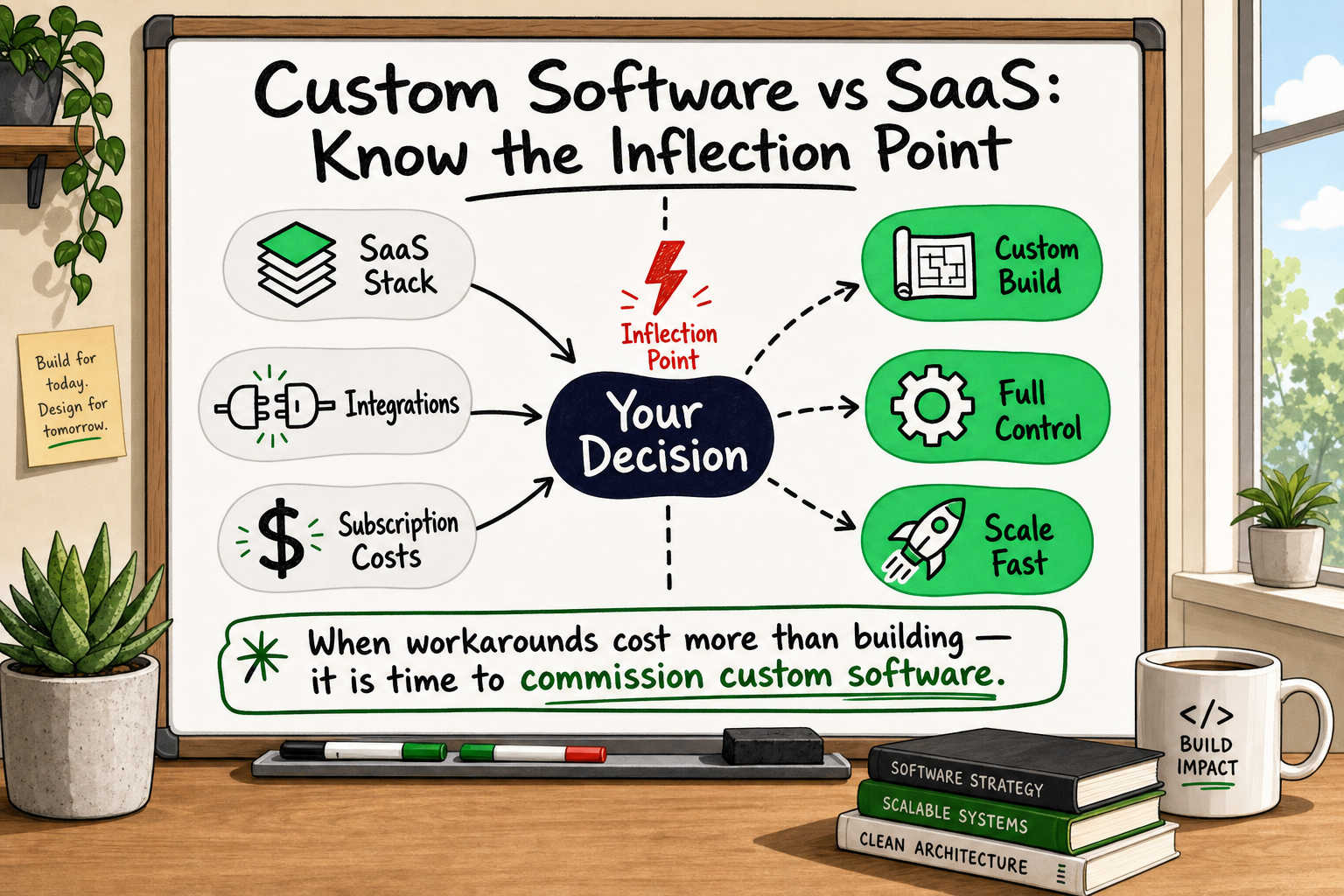
Most funded startups reach a moment where the SaaS stack that got them to product-market fit starts to feel like a ceiling. Features that should take days take weeks because three tools need to talk to each other through a fourth. Pricing jumps to the next tier every time the business grows. And somewhere in the codebase, a junior engineer is maintaining integration glue that no one fully understands.
Knowing when to commission custom software — rather than bolt another workaround onto an existing platform — is one of the highest-stakes decisions a non-technical founder will make. Get it right and the product compounds. Get it wrong in either direction and you burn runway, credibility, or both.
This guide gives you a clear, defensible framework for that decision.
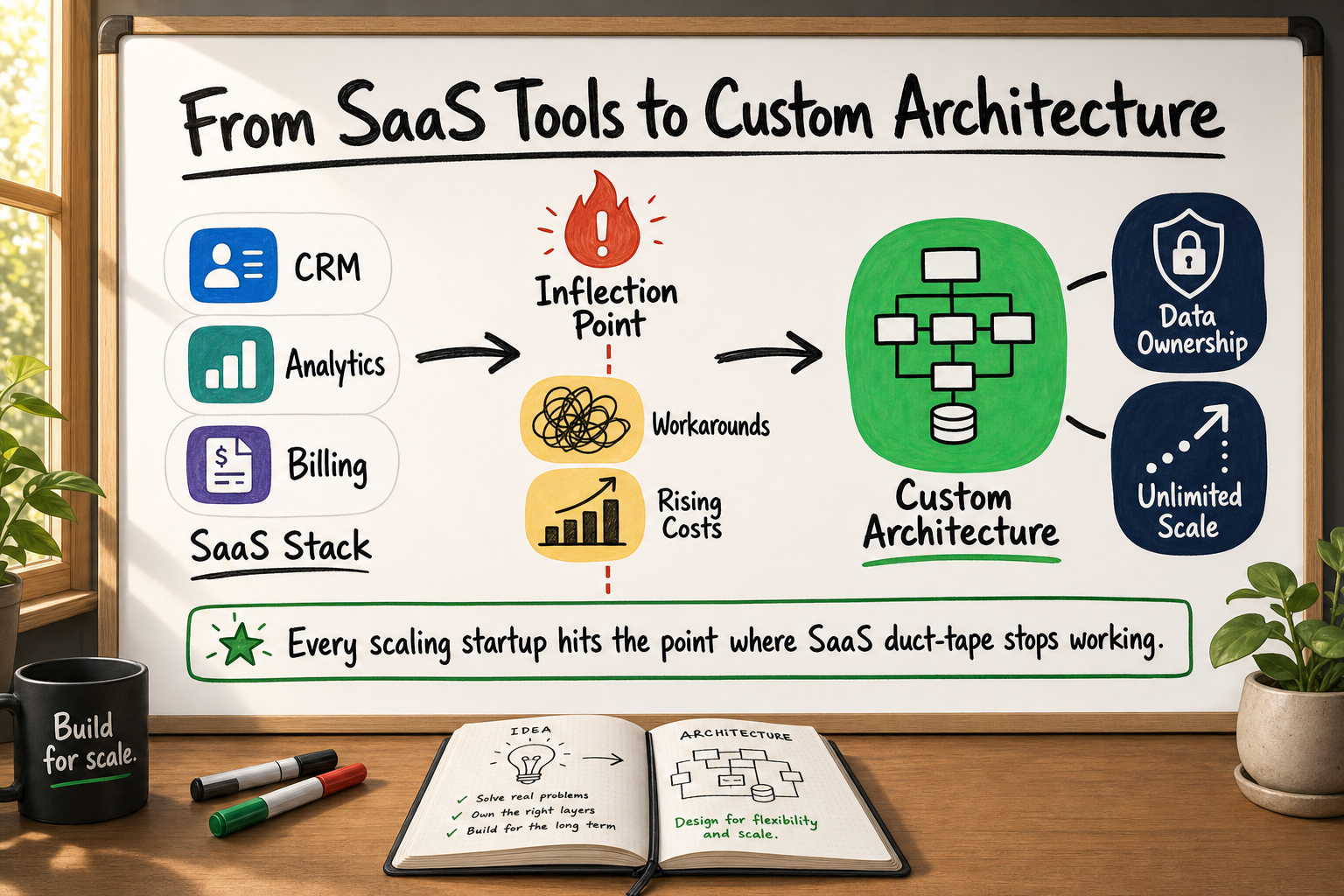
The Real Question: Build Around Your Tools or Build for Your Business?
Why most founders start with SaaS (and should)
Starting with SaaS is not a mistake — it is a sound engineering decision. Off-the-shelf tools let a small team validate demand, iterate quickly, and avoid spending runway on infrastructure problems that may never matter if the product does not find an audience. Zapier, Airtable, Shopify, HubSpot, and a dozen other platforms have allowed founders to build real businesses without writing a single line of custom code.
The build vs buy decision at the early stage almost always tips toward buy. The fixed costs of a SaaS licence are predictable. The variable costs of building and maintaining custom software — architecture decisions, engineering time, ongoing updates, security patches — are not. For a pre-revenue or pre-PMF team, those variable costs carry far too much risk. [INTERNAL LINK: Build-vs-buy decision-making]
The moment the equation changes
The equation changes when the tool stops fitting the business and the business starts bending itself to fit the tool. That might show up as a sales process that cannot be automated because the CRM does not support a custom object. It might be a marketplace that cannot model the supplier relationships the business actually has. It might be an analytics platform that tells you volume but cannot answer the specific retention question your investors are asking.
At that moment, the relevant question is no longer "can we extend this tool?" — it is "are we paying for the privilege of working around it?"
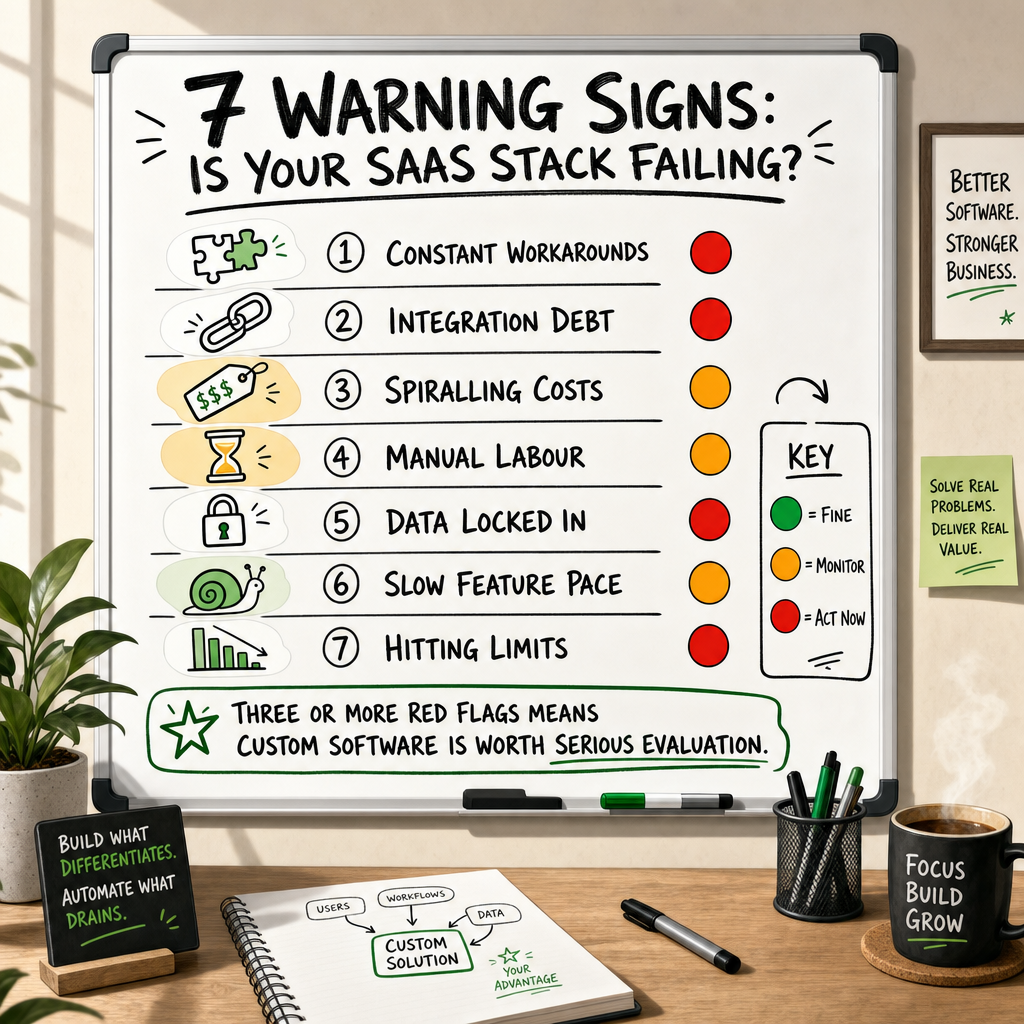
Seven Warning Signs You Have Hit the SaaS Ceiling
The following signals, taken individually, might be configuration problems. Taken together — or when even two or three appear at once — they are a reliable indicator that your SaaS tools have become a structural constraint.
1. Every new requirement needs a workaround
When the answer to every product question is "we can sort of do that with a Zap and a custom field," the platform is no longer a tool — it is a negotiation. Workarounds accumulate into technical debt that slows every future sprint and makes onboarding new engineers expensive.
2. Your pricing scales with usage, not with value
SaaS pricing tiers are designed to capture revenue as you grow, not to reflect the marginal cost of your usage. If you are paying materially more this quarter than last quarter — not because the tool delivers more value, but because you have more seats, API calls, or records — the unit economics of staying are deteriorating.
3. You cannot own or export your data cleanly
Data portability is a proxy for business risk. If migrating away from a platform would require a significant engineering project just to retrieve your own data in a usable format, you are subject to a form of lock-in that rarely appears in the total cost calculation until it is too late. What Is Multi-Tenant Architecture? Plain-English Guide
4. Third-party API limits are capping your growth
Platform API rate limits, webhook reliability issues, and restricted data models are invisible until they are not. When a business function — order processing, lead routing, analytics — is constrained by a third-party platform's API policy, that constraint is outside your control and typically cannot be negotiated away.
5. Your competitors cannot replicate your workflow — so why are you using the same tool?
If your competitive advantage lives in a unique operational process and that process is being flattened to fit a generic SaaS workflow, you are voluntarily commoditising your edge. Custom software exists precisely to encode the things that make a business distinct.
6. Compliance or security requirements exceed what the platform supports
Healthcare, fintech, and regulated industries carry compliance requirements — HIPAA adjacency, SOC 2, PCI-DSS — that generic SaaS platforms often cannot satisfy at the configuration level. When the legal and compliance team starts asking questions the vendor cannot answer, custom architecture becomes a risk-management decision, not just a product decision. [Source: OWASP Top Ten, https://owasp.org/www-project-top-ten/]
7. Integration glue code is becoming your product
This is the most dangerous signal of all. When engineers are spending the majority of their time maintaining the connections between SaaS tools rather than building the product itself, the SaaS stack has inverted — it is now the thing being maintained, and the product is secondary. That is the definition of a SaaS ceiling.
When Staying with SaaS Is the Right Answer
Building credibility on this topic requires honesty: commissioning custom software is not always the right answer, and a good technical partner will tell you so.
You are still finding product-market fit
If you do not yet have a clear, repeatable revenue model and a validated customer segment, the primary risk is not your tooling — it is your assumptions about what the product should do. Spending three to six months of runway on a custom build before those assumptions are validated is rarely defensible. SaaS tools are forgiving of pivots. Custom code is not.
The workflow gap is a configuration problem, not a capability problem
Before concluding that a SaaS tool cannot support a requirement, it is worth ruling out whether the tool could support it with proper configuration. Configuration gaps feel like capability gaps when the team does not have deep platform expertise. An honest technical audit will distinguish between the two. Fixed-Price Software Contract: Is It Right for You?
The total cost of custom build exceeds three years of SaaS fees
If the total cost of building and maintaining a custom solution — including architecture, initial development, ongoing engineering time, and hosting — is higher than three years of SaaS fees, the financial case for building is weak unless there is a strategic differentiation argument that outweighs the cost. Build that calculation explicitly before making a decision.
The Total Cost of Ownership Calculation Most Founders Skip
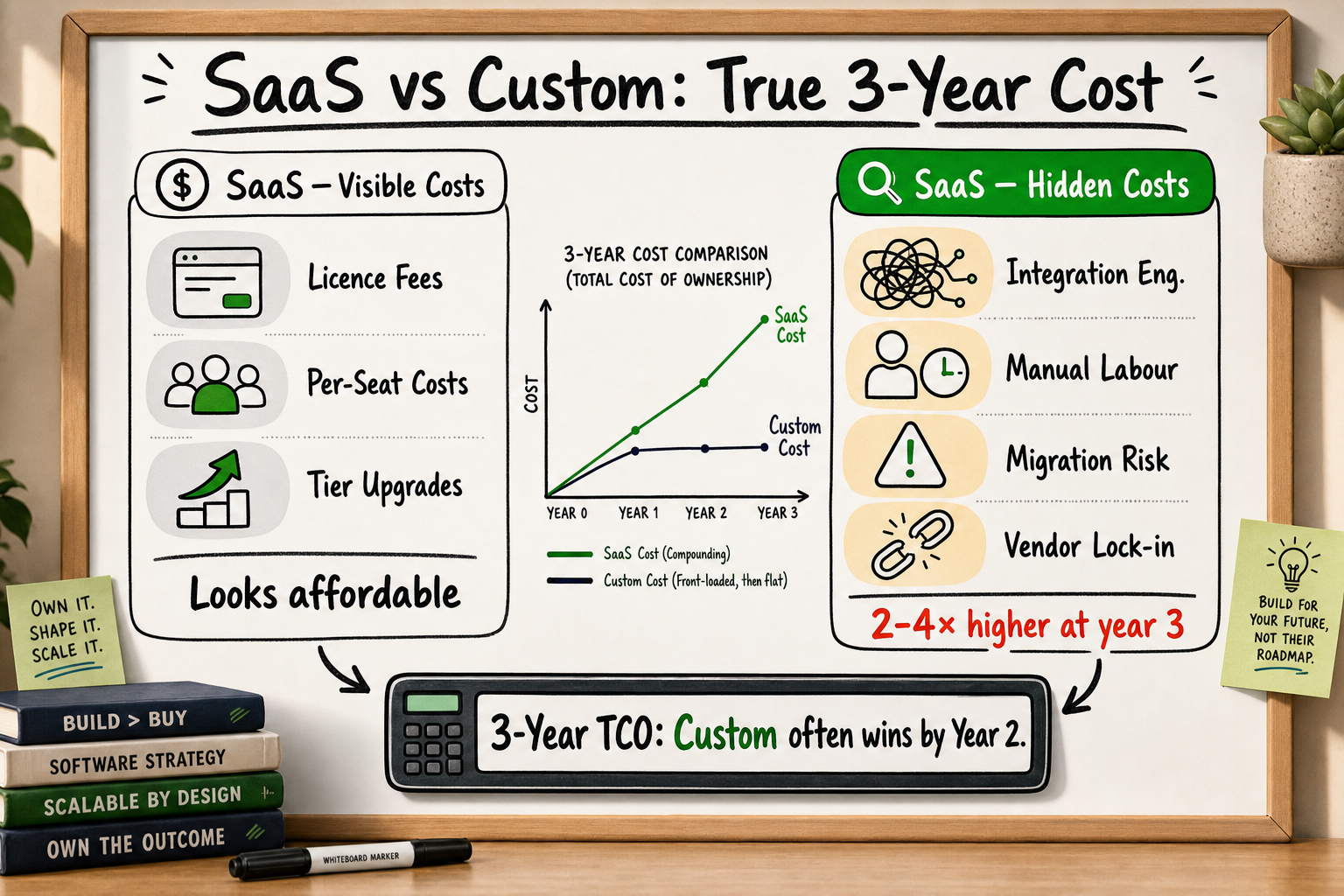
SaaS fees are visible in a monthly invoice. The costs that push founders past the inflection point rarely appear in a single line item.
Direct SaaS costs: licences, seats, and tier jumps
Start with what you are actually paying across every tool in the stack — licences, per-seat fees, API add-ons, support tiers, and the cost of the next pricing tier you will inevitably hit in six months. For many Series A teams, this number is significantly higher than the CFO's line item suggests, because usage-based charges accumulate across multiple tools. [VERIFY: average SaaS spend per employee at Series A]
Hidden costs: integration engineering, manual workarounds, and staff time
The more consequential number is the hidden cost of keeping the SaaS stack running. Across 50+ completed projects, our team found that when SaaS workarounds consumed more than 15% of engineering bandwidth, the ROI on a custom build was consistently positive within 18 months. That 15% threshold became a standard diagnostic in our client discovery process.
Manual workarounds carry a staff-time cost that compounds. A team spending two hours per day on a process that custom software could automate is spending roughly 500 hours per year — or the equivalent of three months of a full-time hire — on a problem that is solvable.
Lock-in cost: what happens when you need to migrate in 18 months?
Data migration from a mature SaaS platform is consistently underestimated. Teams that build on proprietary data models often discover at the point of migration that extraction requires significant engineering effort, data normalisation work, and potential data loss. Accounting for this cost at the decision point, rather than at the migration point, changes the calculus materially. What Is Clean Architecture in Software? Founder's Guide
How to Scope a Custom Build Without Losing Control of Cost or Timeline
The most common objection to commissioning custom software is that it is unpredictable — that scope changes will lead to cost overruns and that the founding team will end up managing a vendor as a second job. That objection is legitimate when the engagement is structured poorly. It is avoidable when it is structured well.
Start with a technology strategy session, not a feature list
The worst custom software projects begin with a features wishlist handed to an agency. The best begin with a technology strategy session where a senior partner maps the business requirements to an architecture, surfaces the decisions that will have the most downstream impact, and produces a written architecture decision document before a single line of code is written.
This document — covering data models, integration points, security posture, and scalability assumptions — is what separates an MVP built on a foundation from one built on sand.
Define the must-haves vs the nice-to-haves before any estimate
Scope creep is the primary driver of cost overruns. The antidote is a well-groomed backlog that distinguishes clearly between the features required to validate the business model (must-haves) and the features that would be nice to have in version two (deferrable). A disciplined sprint process holds that boundary through delivery. What Is a Product Backlog? Quality, Grooming & Velocity
Why a fixed-price scope protects both parties
A fixed-price engagement, properly scoped, aligns the incentives of the client and the development partner. The client knows what they will spend. The partner is accountable for delivering what was agreed. When scope changes do arise — and they will — a change control process makes the cost of each decision explicit before it is made, rather than surfacing as a surprise invoice.
Clean architecture and SOLID principles applied from day one mean the codebase is also extensible — future changes cost less because the foundation was built to accommodate them, not fight them. [Source: Martin Fowler on Microservices, https://martinfowler.com/articles/microservices.html]
Frequently Asked Questions
How do I know if my SaaS tool is the problem or my process?
The distinction usually comes down to whether the tool can do what you need with proper configuration. If a platform expert would set it up differently and that setup would solve your problem, you have a process issue. If you have exhausted configuration options and are still writing code or running manual steps to fill a structural gap the platform was never designed to address, you have a capability ceiling. A brief technical audit will tell you which situation you are in.
Is custom software too risky for an early-stage startup?
Generally, yes — before you have validated product-market fit. After PMF, with a repeatable revenue model and a clear understanding of what makes your product distinct, the risk of staying on a constraining SaaS stack often exceeds the risk of building. A fixed-price MVP scope, rather than an open-ended retainer, is the right way to manage the build-side risk.
Can no-code platforms replace custom software for scaling startups?
No-code tools are excellent for internal tools, simple workflows, and validated MVPs. They hit hard ceilings when a product requires complex data models, multi-tenant architecture, high-volume performance, or compliance controls that the platform cannot enforce. At that point, a custom build typically becomes more cost-effective over a three-year horizon than continued no-code workarounds.
What does commissioning custom software actually involve?
A well-run engagement follows a clear sequence: technology strategy session, architecture decision document, scoped and prioritised backlog, sprint-based delivery with quality gates, QA and security review, deployment, and handoff documentation. A good technical partner owns every step of that process — the founding team is consulted at key decision points but is not expected to manage the delivery.
How long does it take to build a custom web application?
A well-scoped MVP typically takes between 10 and 20 weeks, depending on complexity and integration requirements. Treat any estimate under eight weeks for a multi-feature application without a detailed scope document as a red flag. Similarly, a straightforward product that is quoted at over six months should prompt questions about delivery process and team structure. [VERIFY: industry benchmark for MVP delivery timelines]
How Decyb Technology LLP Helps Founders at the SaaS Inflection Point
For founders who have worked through the framework above and reached the conclusion that custom software is the right next move, the quality of the technical partner is the variable that determines whether that decision pays off.
Decyb Technology LLP works specifically with startups and growth-stage companies at this inflection point — the moment when SaaS tools have been taken as far as they can go and a bespoke, scalable system is needed to carry the business forward.
From business brief to architecture decision document
Every Decyb engagement begins with a technology strategy session — a structured conversation where a senior partner maps the business requirements to a defensible architecture before any estimates are made. The output is a written architecture decision document that covers data models, integration design, security posture, and scalability assumptions. This document is owned by the client and can be handed to investors, a future CTO, or an acquirer.
That is not a theoretical commitment. The FieldFolio engagement — a B2B wholesale marketplace for 40,000+ retailers across Australia and New Zealand — began with exactly this process. The architecture decision document covered multi-tenant B2B marketplace design, supplier catalogue sync, retailer onboarding flow, and order management architecture before a line of code was written. The result was a system that could handle the full complexity of the client's supplier relationships in a way no off-the-shelf marketplace platform could model.
The Multiverse restaurant management system followed the same approach: a fixed-price scope against a business-outcome brief, covering POS, inventory, online orders, and back-office reporting on a React and Node.js/Express stack — delivered on schedule.
Fixed-price delivery with no process overhead
Decyb operates as a lean senior technical pod, not a large agency. There are no account managers between the client and the people doing the work. Every decision is explained, every trade-off is documented, and the delivery process is built around sprint discipline and quality gates — not billable hours and status meetings.
For founders who have previously experienced the "process theatre" of larger agencies — layers of account management, slow approvals, and invoices that reflect overhead rather than outcomes — this is a meaningful structural difference. Decyb's internal benchmark shows 20% faster delivery compared to average agency timelines across 50+ completed projects [VERIFY: confirm benchmark currency and sample size].
Proof points from real engagements
Across 12+ years of international client engagements from 2014 to 2025, Decyb has maintained a consistent ★ 5.0 delivery record. That record includes long-term retained relationships — one client partnership spanning 10+ years across multiple technical capacities — which is a more reliable signal of delivery quality than a portfolio of one-off projects.
For founders who want to verify that track record before committing, the process for doing so is straightforward. How to Verify a Software Agency's Case Studies
If the seven warning signs in this guide describe your current situation, the right next step is a conversation, not a commitment. Decyb's free 24-hour technology strategy call is a senior-partner session with no sales overhead — you will leave with a clear view of whether custom software is the right move, what an architecture for your situation would look like, and what a fixed-price scope would involve.
Book your free strategy call — get a plan in 24 hours. Contact