
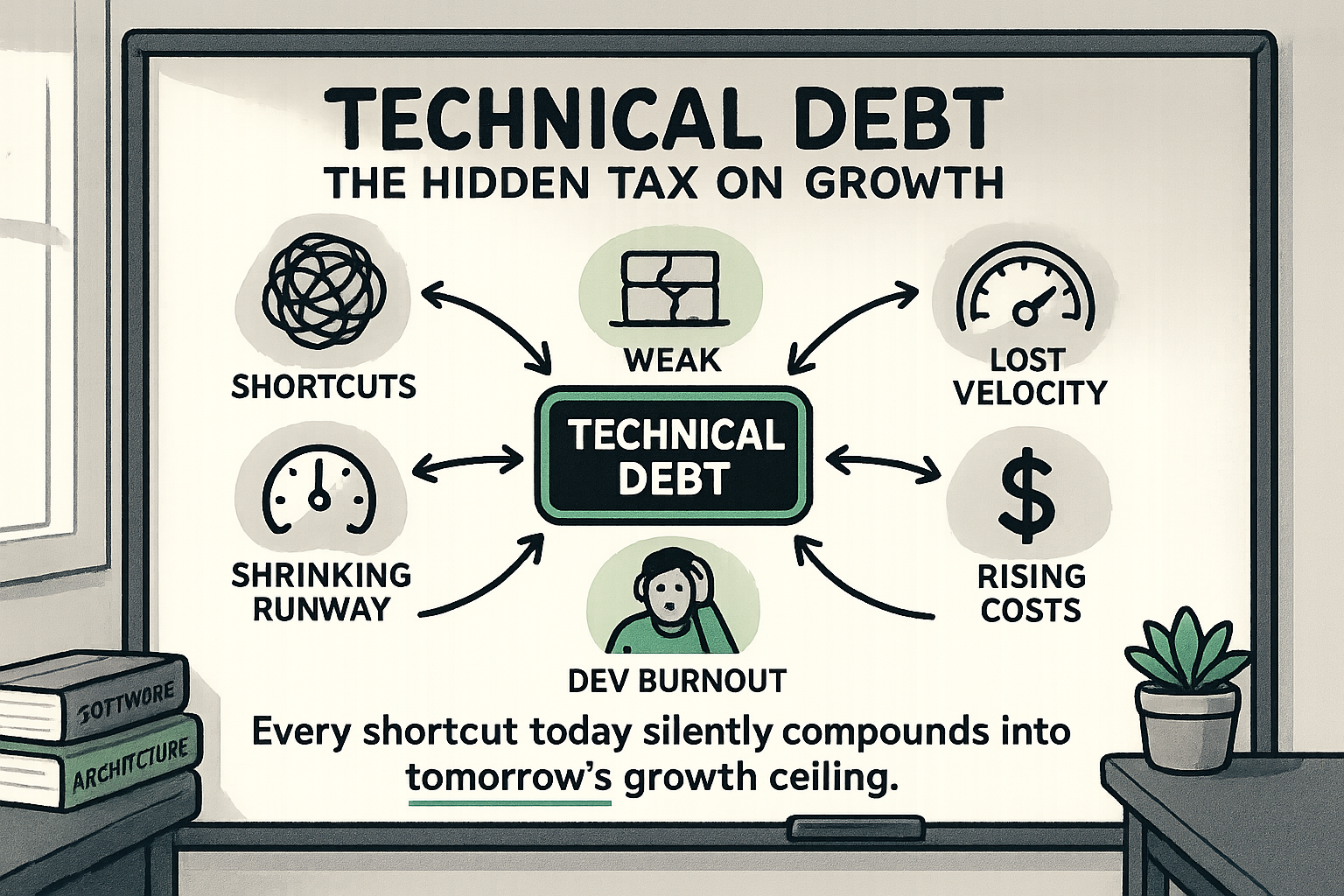
If your engineering team is getting slower every sprint — even though you keep hiring — technical debt is almost certainly a contributing factor. Technical debt is one of the most expensive problems a startup can carry, yet it rarely shows up on a balance sheet or a board deck until it becomes a crisis. This article explains what it is, how it builds up without anyone noticing, what it costs you at scale, and what you can actually do about it.
What Technical Debt Actually Means (Without the Jargon)
The term technical debt was coined by Ward Cunningham in 1992. He used a financial analogy deliberately: just as borrowing money lets you move faster now but costs you interest over time, taking shortcuts in your codebase lets you ship faster now but creates a growing maintenance burden that slows everything down later.
Martin Fowler later expanded the concept into a widely cited taxonomy [Source: martinfowler.com]. But for a non-technical founder, the simplest definition is this:
Technical debt is what happens when you choose the quick solution over the right solution — and don't make time to go back and fix it.
The Credit Card Analogy Every Founder Can Understand
Imagine you put six months of operating costs on a credit card to get through a tight period. The debt itself is not the problem — it bought you time. The problem is the interest. If you never pay it down, the interest eventually exceeds what you can earn, and the debt consumes your business.
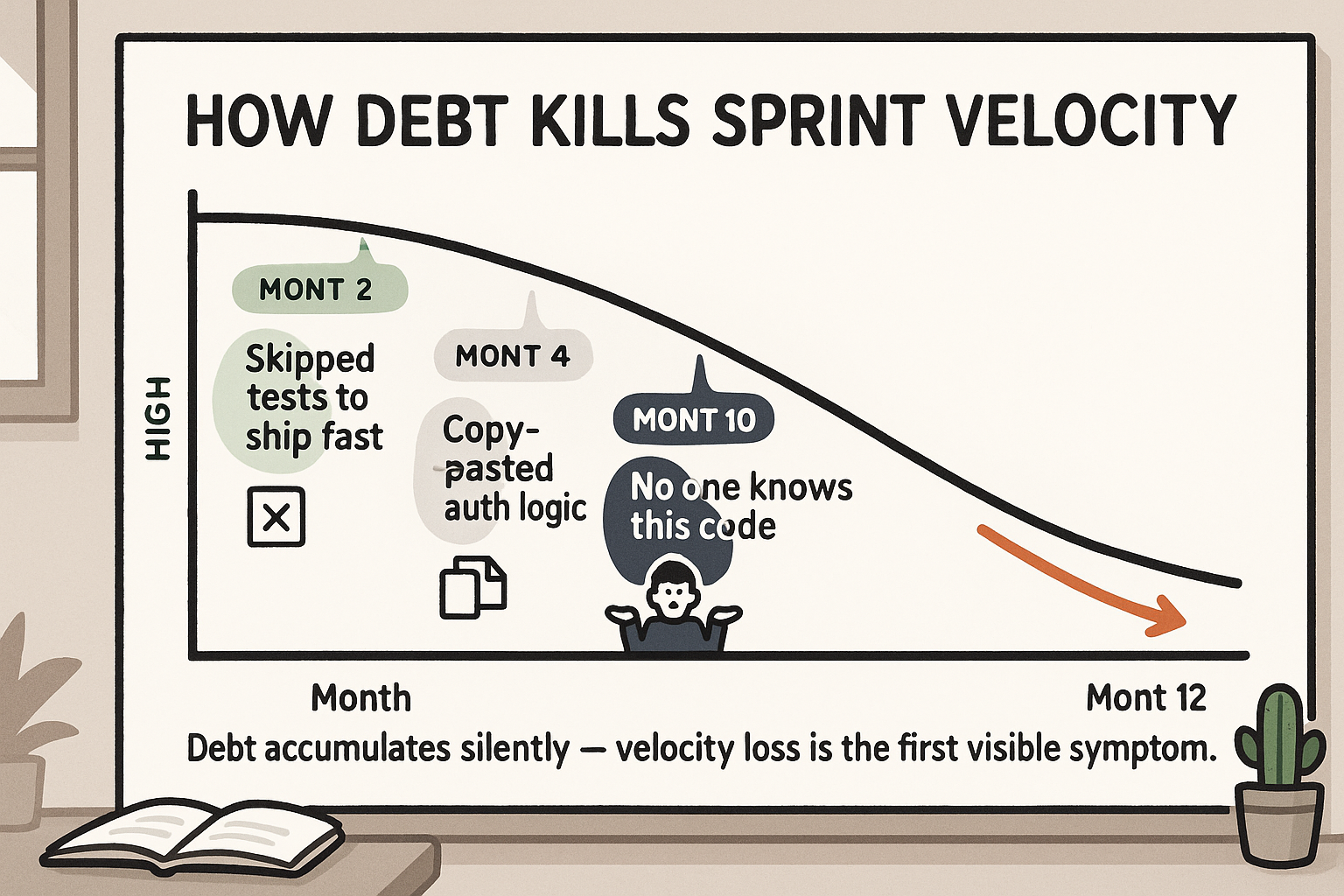
Code works the same way. A shortcut that saves three days now might add one day of extra work to every future sprint. After twelve sprints, you have lost twelve days of engineering capacity — for free, invisibly, without a single line item on your P&L.
Deliberate vs. Inadvertent Technical Debt
Not all debt is the same. Some debt is deliberate — the team knows they are taking a shortcut, they document the decision, and they plan to fix it. This is often a rational trade-off at the MVP stage.
Inadvertent debt is more dangerous. It happens when developers do not realise the long-term consequences of a decision, or when a freelancer ships code and disappears before the implications become visible. This is the debt that compounds silently.
How Technical Debt Accumulates in an Early-Stage Startup
In 16+ years of building software across SaaS, fintech, healthcare, and eCommerce, the most consistent thing I have observed is this: technical debt rarely arrives in one obvious moment. It accumulates in small decisions made under pressure, each one individually defensible, collectively catastrophic.
Shipping Under Runway Pressure
The most common debt trigger is urgency. When runway is measured in months and investors want to see a working product, "we'll clean this up later" becomes the most frequently broken promise in startup engineering. The shortcut is taken. The roadmap fills up immediately after launch. "Later" never arrives.
This is not a failure of character. It is a structural problem: the incentives at the MVP stage reward shipping above everything else, but the costs of that shipping are deferred until the moment you can least afford them — usually just before a Series A round or a major enterprise deal.
Freelancer and Agency Handoffs That Leave No Documentation
Another major accumulation point is team turnover. When a freelancer builds a feature and moves on, they take the context with them. The next developer who touches that code has to reverse-engineer what was intended, often making new assumptions on top of old ones. After two or three such handoffs, no one fully understands the system — and every change carries the risk of breaking something unexpected.
This is compounded when agencies or freelancers are incentivised by deliverables rather than by long-term maintainability. Shipping is rewarded. Documentation is not.
Copy-Paste Code and Missing Tests
Duplicated logic is one of the earliest visible signs of accumulating debt. When the same calculation or validation appears in five different places in the codebase, fixing a bug in that logic requires finding and updating all five instances. Miss one, and you have introduced an inconsistency that will surface at the worst possible moment — usually in production, usually in front of a customer.
Missing automated tests compound this further. Without a test suite, every change to the codebase is a leap of faith. Developers slow down not because they are less capable, but because they are being careful — they have no safety net.
Skipping Architecture Decisions Until They Become Emergencies
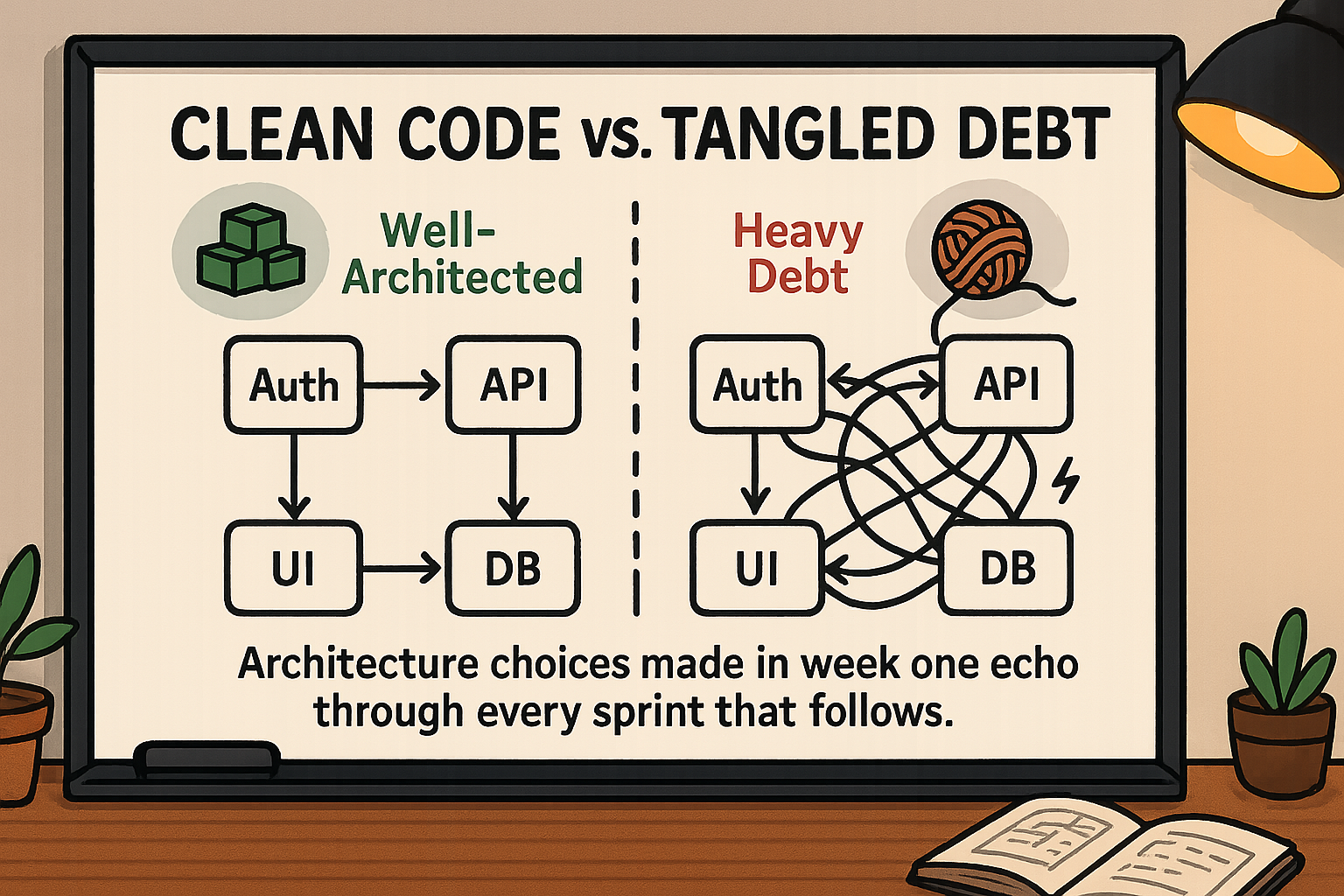
Many startups defer architecture decisions because they feel abstract at the beginning. "We'll deal with multi-tenancy when we have multiple tenants." "We'll add authentication properly when we get a security audit." These deferred decisions are not avoided — they are simply delayed until the moment of maximum inconvenience, when you have real users, real data, and real consequences for getting it wrong.
The Real Cost of Technical Debt at Scale
Technical debt has a direct, measurable impact on the commercial performance of a startup. It is not an engineering problem — it is a business problem.
When Velocity Drops Before Anyone Admits Why
The most immediate symptom is slowing sprint velocity. Tasks that used to take two days start taking five. The engineering team's estimates become less reliable. Feature requests back up. Founders get frustrated and assume the team is underperforming, when in reality the team is fighting a codebase that resists change.
Research suggests that developers spend a significant portion of their working time dealing with technical debt rather than writing new features [VERIFY: industry estimates on percentage of engineering time consumed by debt remediation]. Every hour spent navigating a tangled codebase is an hour not spent on the features your customers are waiting for.
Technical Debt in Due Diligence: What Investors and Acquirers Actually Check
If you are planning to raise a Series A or attract an acquirer, your codebase will be reviewed. Technical due diligence is now standard practice for sophisticated investors, and a codebase full of undocumented shortcuts, missing tests, and inconsistent patterns sends a clear signal: this product will be expensive to maintain and risky to scale.
This translates directly into valuation. Investors may discount your asking price, impose conditions on remediation, or walk away entirely. The shortcuts taken at the MVP stage that saved three months of engineering time can cost you millions in valuation eighteen months later.
The Compounding Effect: Why Debt Grows Faster Than Your Team
Here is the counterintuitive part: hiring more engineers does not fix technical debt — it often makes it worse in the short term. New developers have to onboard into a difficult codebase. They make decisions based on incomplete understanding. They add new patterns on top of old ones. The surface area of the problem grows.
When we built FieldFolio, a B2B wholesale marketplace now serving 40,000+ retailers across Australia and New Zealand, one of the first deliverables was an architecture decision document. Not a line of code — a document. That document meant that every engineer who joined the project, at any stage, had the same context as the team that started it. That is how you prevent compounding.
Signs Your Startup Is Carrying More Technical Debt Than It Can Afford
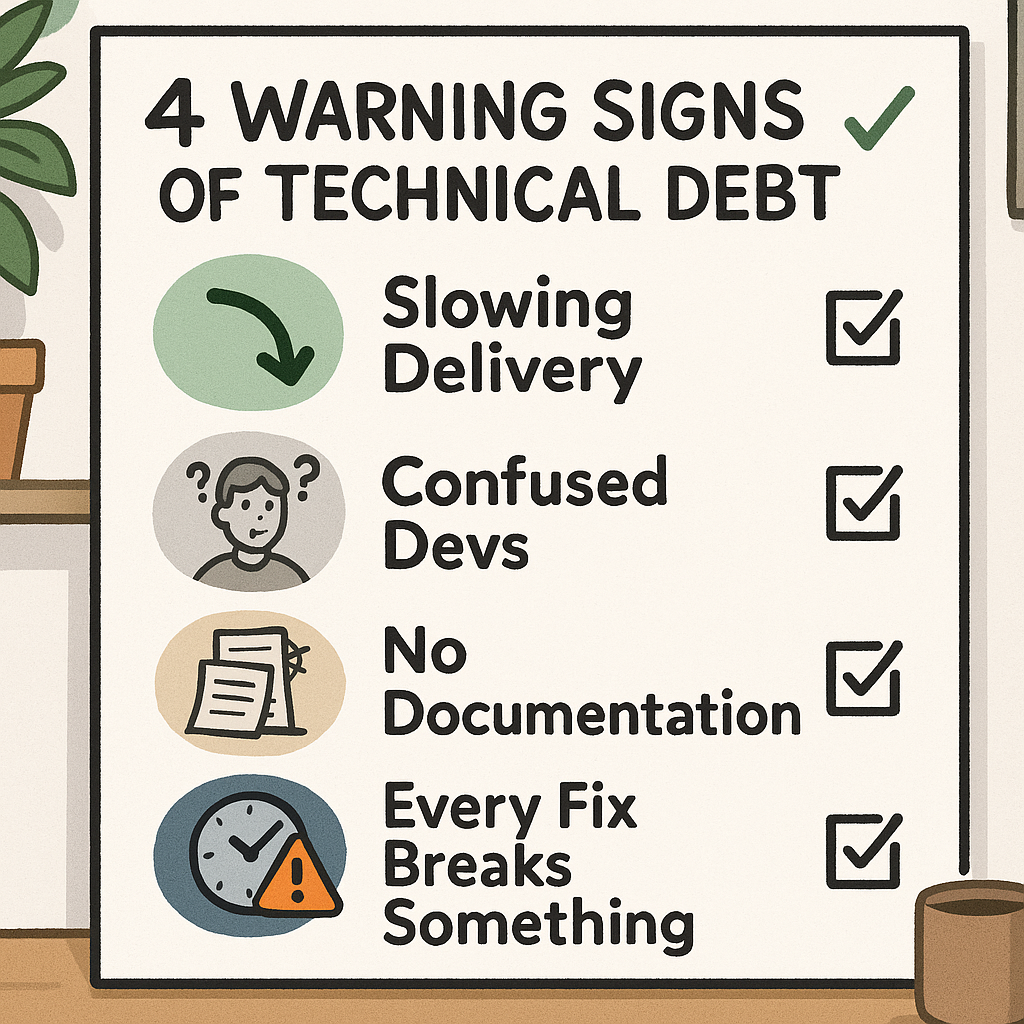
You do not need to read the codebase to spot the symptoms. These are the business-level signals that your debt load has become a problem:
Your Engineers Always Say 'It's More Complicated Than It Looks'
This phrase, repeated consistently, is a red flag. Sometimes it is true — software is genuinely complex. But when it is said about routine features, it usually means the codebase has accumulated enough hidden dependencies and undocumented assumptions that nothing is straightforward any more.
New Features Take Longer Every Sprint
If your sprint velocity is declining month over month without a clear external cause (team changes, major platform shifts), technical debt is almost certainly the reason. Plot your average story points per sprint over the last six months. If the trend is downward, the codebase is working against you.
Onboarding a New Developer Costs Weeks, Not Days
A well-structured codebase with good documentation should allow a competent developer to become productive within a week or two. If onboarding regularly takes four to six weeks — or if the new developer cannot get started without extended pairing with a senior engineer — your codebase is too opaque to scale.
Your Codebase Is Undocumented and Only One Person Understands It
This is the most dangerous form of technical debt: knowledge debt. When a single developer holds all the context for a critical system in their head, you have a single point of failure. If that person leaves — for any reason — you may be unable to maintain the product without a near-complete rewrite.
Just as we use an analytics audit checklist to identify the 12 most common GA4 configuration errors that cause 40–60% invisible data loss, a codebase audit typically surfaces a consistent set of structural problems that have been accumulating quietly over months.
Good Debt vs. Bad Debt: Not Every Shortcut Is a Crisis
It is worth being precise here, because the goal is not to eliminate all technical debt. The goal is to take on debt intentionally and to distinguish between shortcuts that are recoverable and those that are structural.
When Moving Fast Is the Right Call
At the pre-product-market-fit stage, shipping matters more than perfection. If a hardcoded value in a config file lets you test a hypothesis in two days instead of two weeks, that is often the right call. The question is not whether to take the shortcut — it is whether you know you are taking it, and whether you have a plan to address it.
How to Make a Shortcut You Can Actually Pay Back
The simplest practice is to leave a written record: a comment in the code, a ticket in your backlog, or a line in a decision log. Something that says: "We did this because of X constraint. The proper solution is Y. We will revisit this when Z condition is met." This turns an inadvertent debt into a deliberate one — and deliberate debts can be managed.
The Technical Debt Quadrant Explained
Martin Fowler describes debt across two axes: deliberate versus inadvertent, and reckless versus prudent [Source: martinfowler.com]. The most dangerous quadrant is reckless and inadvertent — shortcuts taken without awareness of the consequences. The most manageable is prudent and deliberate — shortcuts taken with full knowledge and a repayment plan. Most startup codebases contain all four types, which is why a structured audit is usually more useful than a blanket rewrite.
How to Start Paying Down Technical Debt Without Stopping Product Development
The worst response to a debt problem is a big-bang rewrite. These almost always take longer than estimated, cost more than budgeted, and produce a new codebase with different — but equally numerous — problems. The better approach is incremental remediation, built into the rhythm of normal product development.
The 20% Rule: Ring-Fencing Refactoring Time Each Sprint
Many high-performing engineering teams allocate 15–20% of each sprint's capacity to debt remediation rather than new features [VERIFY: industry adoption of the 20% rule for technical debt]. This is not dead time — it is maintenance that protects the velocity of every future sprint. Treated as a non-negotiable line item, it prevents debt from compounding while still allowing continuous product progress.
Prioritising Debt by Business Impact, Not Engineering Preference
Not all debt is equally urgent. A messy component in a rarely used admin screen is very different from a brittle data model at the core of your billing system. Prioritise remediation based on two criteria: how often the affected code is changed, and what happens to the business if it breaks. High-change, high-consequence debt should be addressed first, regardless of how aesthetically offensive the low-priority mess might be.
Documentation as a Debt-Reduction Tool
One of the fastest ways to reduce the cost of debt — even before fixing the code — is to document what you know. A well-maintained architecture decision record (ADR) does not fix a bad data model, but it reduces the risk that the next developer will make the same mistake or introduce a conflicting assumption. Documentation converts knowledge debt into manageable institutional knowledge.
When a Rewrite Is Actually the Right Answer
Occasionally, the debt load is so severe, or the architecture so fundamentally misaligned with current requirements, that a rewrite is warranted. The conditions that justify it are specific: the codebase is actively blocking growth, the cost of incremental remediation exceeds the cost of a fresh start, and the team has the time and resources to do it properly. This is rare, but when those conditions are met, it is the right call — and it should be planned and scoped as rigorously as the original build.
Frequently Asked Questions About Technical Debt
What is technical debt in simple terms? Technical debt is the accumulated cost of shortcuts taken during software development. Like financial debt, it is not inherently bad — the problem is the interest. Every shortcut not addressed adds friction to every future change, slowing your team down gradually until the interest payments consume more capacity than new work.
Can technical debt kill a startup? Indirectly, yes. Technical debt burns runway by slowing engineering velocity, raises red flags during investor or acquirer due diligence, and makes it harder to attract and retain good engineers who prefer working in clean, well-structured codebases. It rarely kills a company on its own, but it amplifies every other risk.
What is the difference between good and bad technical debt? Good debt is deliberate, documented, and time-boxed — the team knows about it and has a plan to address it. Bad debt is inadvertent, undocumented, and compounding — it was not recognised as a shortcut at the time, and it grows silently. Most startup codebases contain both, which is why an audit is more useful than an assumption.
When should a startup pay off technical debt? The best time is before you need to: before scaling paid acquisition (when your product will face real load for the first time), before a fundraising round (when your codebase will face due diligence scrutiny), and whenever a new feature consistently takes significantly longer than estimated. Waiting until it is an emergency means paying a premium.
How do you explain technical debt to a non-technical co-founder or investor? Use the maintenance cost frame: every shortcut in the codebase adds a small ongoing maintenance tax to every future feature. That tax starts small and invisible, but it compounds. After twelve to eighteen months, a high-debt codebase can consume 30–40% of engineering capacity in maintenance and rework rather than new features [VERIFY].
How Decyb Technology LLP Approaches Technical Debt From Day One
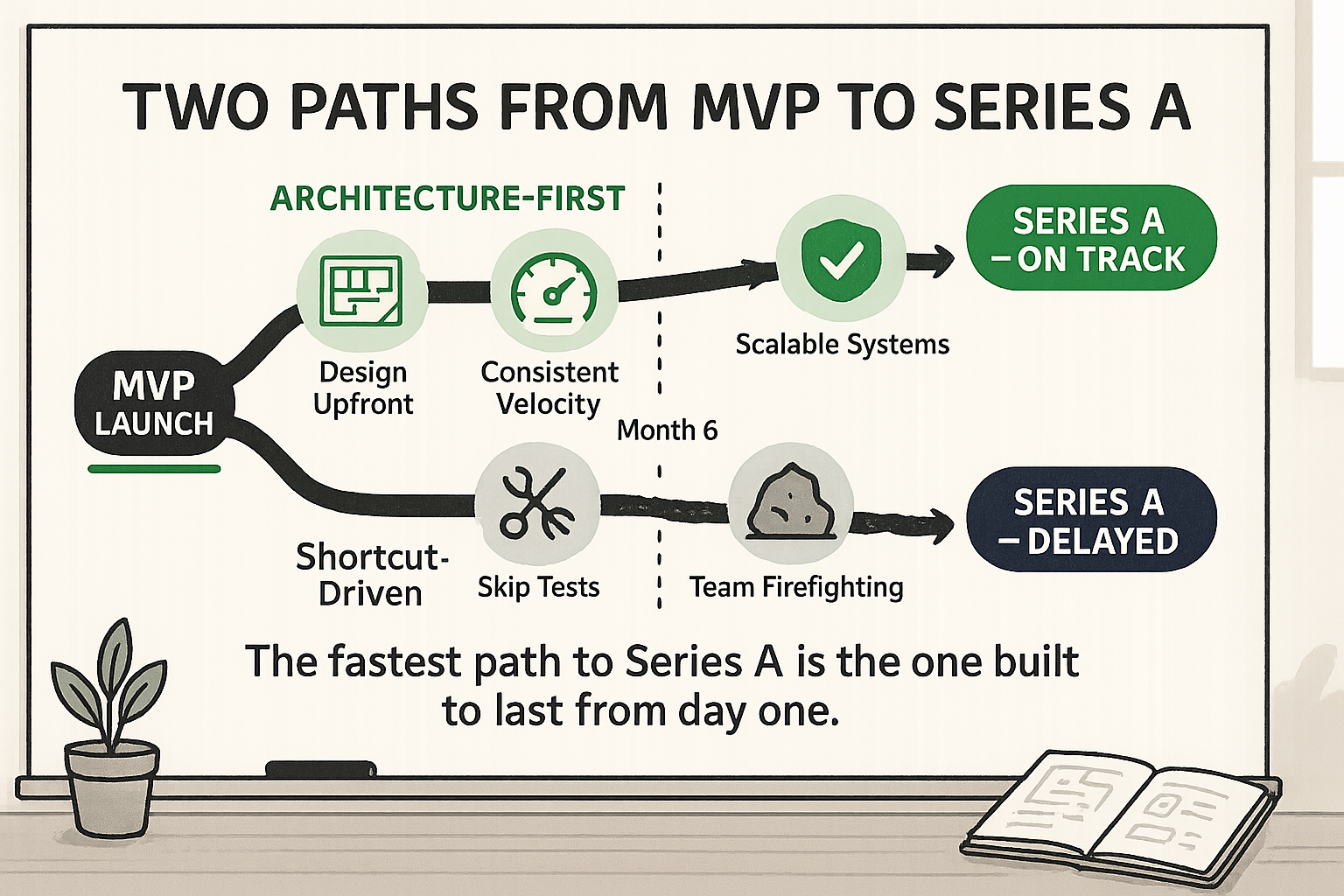
Most of the debt problems described in this article share a common root cause: decisions made under pressure, without documentation, by teams without a long-term stake in the outcome. At Decyb Technology LLP, we built our entire delivery process around preventing that pattern.
Architecture Decisions Documented Before a Line of Code Is Written
Every engagement starts with an architecture decision record — a documented set of choices about the system's structure, the trade-offs considered, and the reasoning behind each decision. This is not overhead. It is the document that lets every future developer, investor, or technical reviewer understand the codebase without needing to reverse-engineer it.
Jatinder Kumar, who leads every engagement directly, brings 16+ years of solution architecture across SaaS, fintech, healthcare, and eCommerce to these decisions. The goal is always the same: ensure that the architecture serves the business outcome, not the other way around.
What Our Fixed-Price Engagements Mean for Debt Accumulation
When a project is scoped and priced upfront, the incentives change. We are not billing by the hour, so we have no financial reason to take shortcuts that create future billable work. Our fixed-price model [INTERNAL LINK: learn more about our process] means that the right architecture is also the most commercially rational choice for both sides.
Proof: FieldFolio and Multiverse Delivered Without Structural Shortcuts
FieldFolio, a B2B wholesale marketplace built for 40,000+ retailers across Australia and New Zealand, was delivered with a documented multi-tenant architecture covering retailer onboarding, supplier catalogue sync, and order management — none of which were retrofitted after the fact. Multiverse, a multi-tenant restaurant management system covering POS, inventory, online orders, and back-office operations, was built on React and Node.js/Express with the same principle: document the architecture, then build to it.
Both systems were delivered on time, without the structural shortcuts that become tomorrow's emergencies. Our consistent ★ 5.0 delivery record across 12+ years of international client engagements reflects what happens when a team is accountable for the long-term quality of what it ships — not just the deadline.
If you are building a product now and want an honest assessment of the architectural risks you are carrying — or want to understand how to scope a build that will not become a liability six months after launch — our senior partners are available for a free 24-hour technology strategy call, no obligation.
Book your free strategy call — get a plan in 24 hours →
All project timelines and delivery estimates are indicative and subject to scope confirmation. Third-party service costs (hosting, domains, SaaS tools) are billed separately at cost. Decyb Technology LLP is registered in India; engagements are subject to terms of service available at decyb.com/terms.