
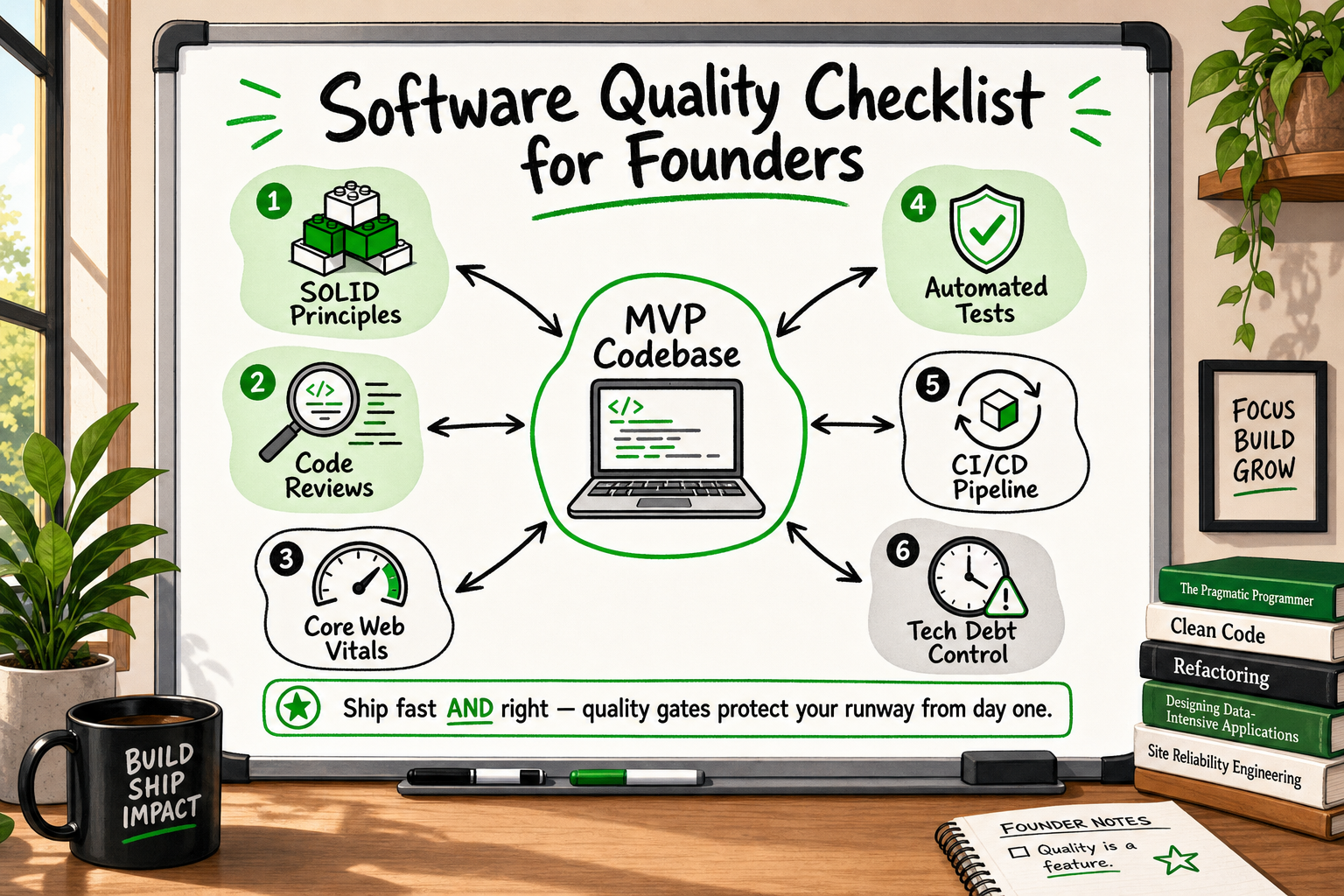
If you are a founder who has shipped — or is about to ship — a software product, the software quality checklist in this guide is one of the most important documents you will read before your next funding conversation or hiring decision.
Most early-stage founders discover quality problems at the worst possible moment: when a new developer refuses to touch the existing codebase, when a bug takes three weeks to fix because nothing is documented, or when a technical due diligence reviewer flags the architecture as a liability. The goal here is to help you catch those problems early — or avoid them entirely.
This guide covers four areas: code quality (including SOLID principles), maintainability, performance, and security. It is written for founders, not developers. You do not need to read code to use it.
Why Software Quality Is a Business Problem, Not Just a Developer Problem
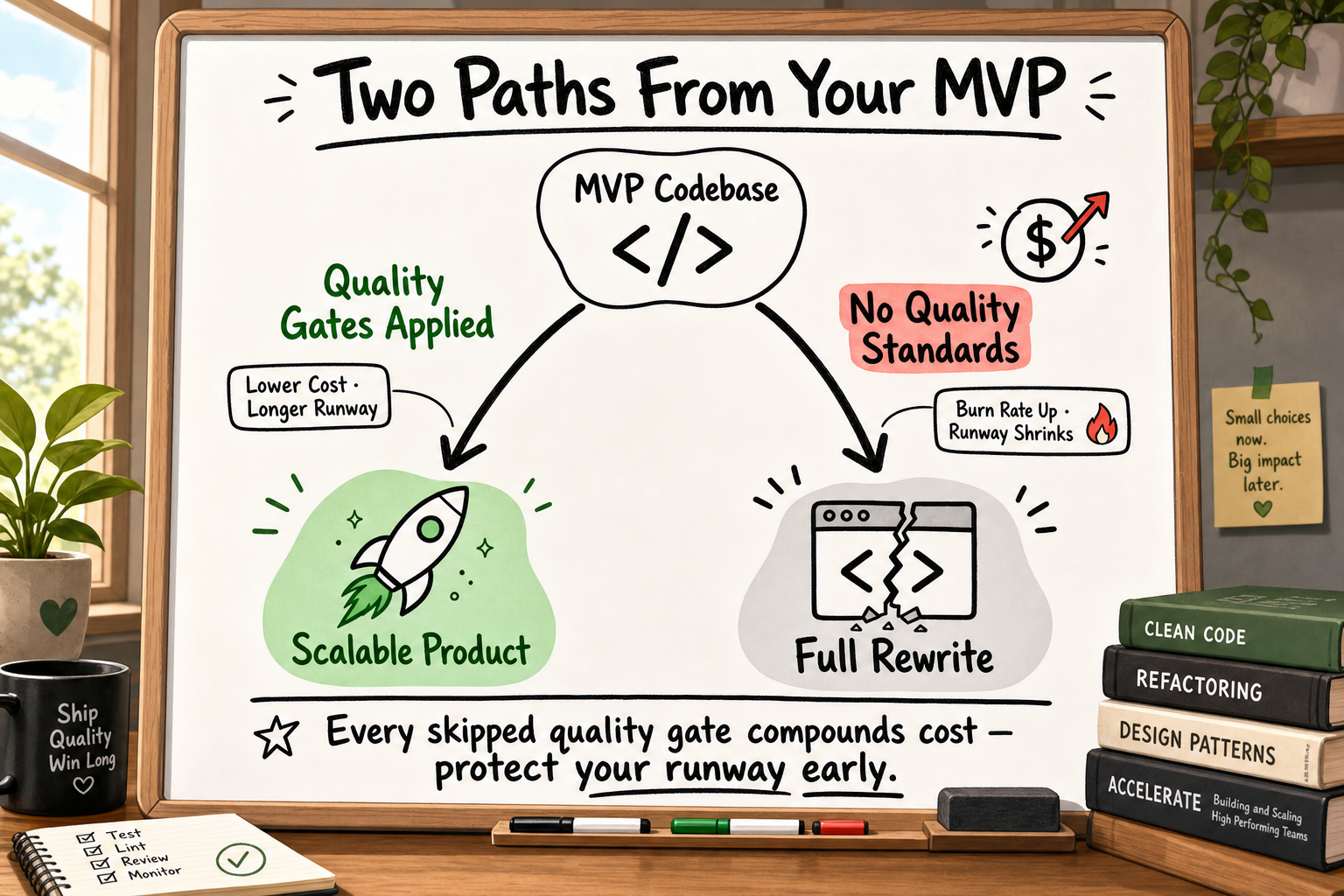
The Hidden Cost of Low-Quality Code on Your Runway
Low-quality code does not announce itself. It hides in a codebase that works well enough at launch, then becomes progressively more expensive to change. Every new feature takes longer than the last. Every bug fix introduces two new bugs. Every new developer you hire spends their first month trying to understand what the previous team was thinking.
This is technical debt — and it is not a developer problem. It is a financial problem. A codebase with high technical debt can double or triple the engineering hours needed to ship a feature that should be straightforward. At £10,000–£20,000 per engineer-month, that adds up quickly against a fixed runway.
Across client engagements I have led directly, the most consistent pattern I see is a codebase that looked perfectly functional at the MVP stage but collapsed under the weight of the second sprint of features. The reason is almost always the same: the original team shipped fast without applying any of the structural principles that allow software to grow.
Why Investors and Acquirers Are Reading Your Architecture Now
Technical due diligence is now a standard part of Series A processes and acquisition reviews. Investors and acquirers are not just looking at your MRR — they are asking a technical reviewer to assess whether the product can be scaled, maintained, and handed to a new CTO without a full rewrite.
A well-documented architecture with clear quality standards is a competitive asset. A high-debt codebase with no documentation is a deal risk that can reduce your valuation or kill a term sheet entirely.
The SOLID Principles: What They Mean for Your Product, Not Just Your Code
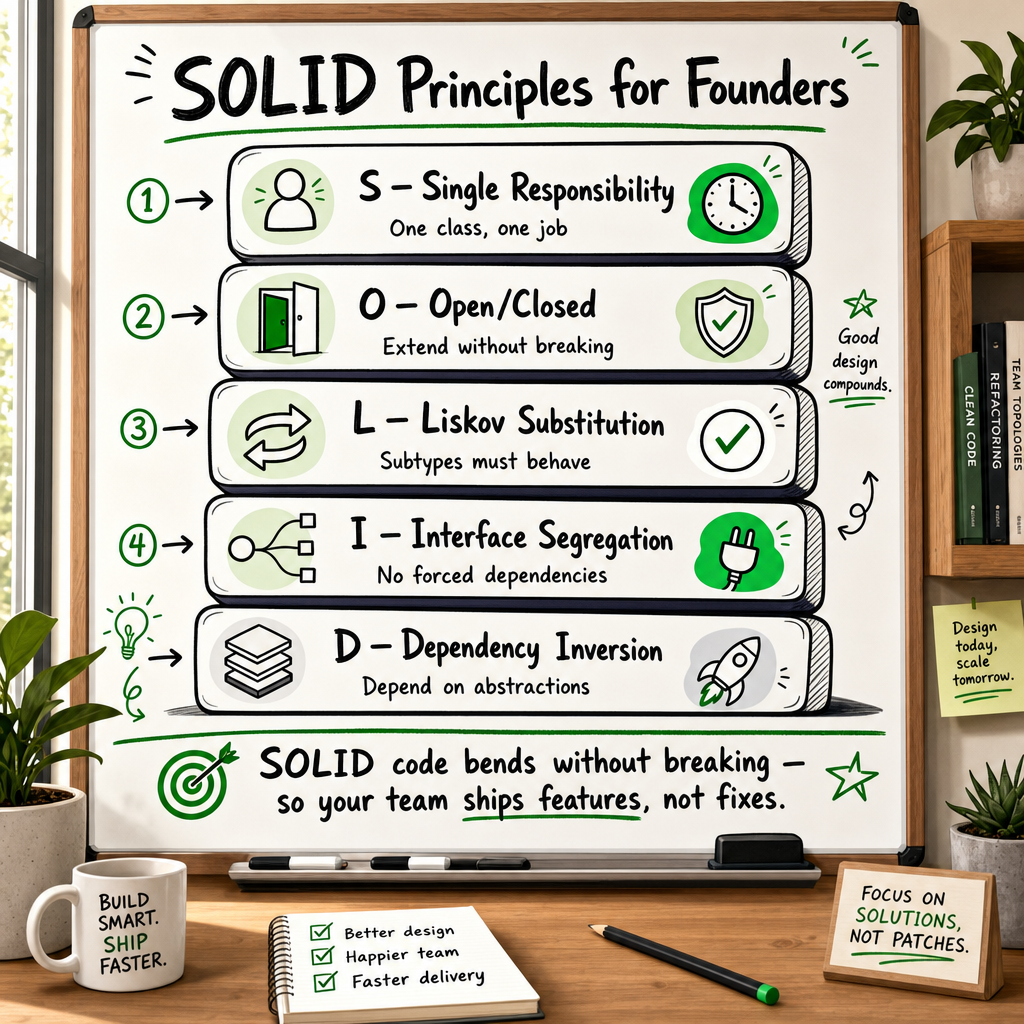
SOLID is an acronym for five software design principles that have been the foundation of maintainable object-oriented code for over two decades. They are not academic theory. They are the rules that determine whether your codebase can grow without breaking.
Here is what each one means in business terms:
Single Responsibility: One Job, One Reason to Change
Every module, class, or function should do exactly one thing. When a piece of code tries to handle authentication, send emails, and update the database at the same time, changing any one behaviour risks breaking all three. Single Responsibility means smaller, safer changes — and faster debugging when something goes wrong.
Open/Closed: Add Features Without Breaking What Works
Your code should be open to extension but closed to modification. In practice, this means you can add a new payment gateway, a new notification channel, or a new user role without rewriting the existing logic. This is the principle that determines whether adding a feature is a two-day job or a two-week risk.
Liskov Substitution: Safe to Swap Components
If you replace one component with another of the same type — say, swapping one email provider for another — the rest of the system should not need to change. This matters most when you outgrow a third-party service and need to migrate without a rebuild.
Interface Segregation: Keep Dependencies Lean
Components should not be forced to depend on interfaces they do not use. In practice, this means your application does not become a tangled web of dependencies where changing one module requires touching fifteen others.
Dependency Inversion: Decouple Your Core from Your Tools
Your core business logic should not depend directly on specific tools, databases, or third-party services. The tools should depend on the logic — not the other way around.
A practical example: when building the Multiverse multi-tenant restaurant management system on React, Node.js, and Express, the POS module was architected so that payment gateway logic was abstracted behind an interface. When a client needed to swap gateways, it was a configuration change — not a rebuild of the payment flow. That is Dependency Inversion in production.
Code Maintainability Checklist: 8 Things to Verify Before You Scale
Is Your Codebase Documented Enough to Hand Over?
Ask your development team: if they left tomorrow, could a new senior developer understand the architecture in three days? Every critical decision — why a particular database was chosen, how the authentication flow works, what the deployment process involves — should be documented in writing, not stored in someone's head.
Checklist item 1: Architecture decision records (ADRs) exist for every major technical choice.
Checklist item 2: A README file explains how to set up the local development environment from scratch in under 30 minutes.
Are Naming Conventions and Folder Structures Consistent?
Inconsistency in naming — variables, files, API endpoints — is one of the most reliable signals of a codebase that was built without standards. It means every developer made their own decisions, and the next developer has to reverse-engineer what each one meant.
Checklist item 3: Variable and function names describe what they do, not how they do it.
Checklist item 4: The folder structure follows a documented convention and is consistent across the entire project.
Does the Team Enforce a Code Review Process?
Code review is not a bureaucratic overhead — it is the primary quality gate that prevents low-quality code from reaching production. Every pull request should be reviewed by at least one other developer before it is merged.
Checklist item 5: No code is merged to the main branch without a peer review.
Checklist item 6: Review comments address logic, security, and maintainability — not just formatting.
Is Test Coverage Meaningful or Just a Vanity Metric?
A codebase with 80% test coverage sounds impressive until you discover that the 80% covers trivial utility functions and the 20% that is untested is the entire payment processing flow.
Checklist item 7: Critical business logic (payments, authentication, data processing) has dedicated unit and integration tests.
Checklist item 8: The CI pipeline runs tests automatically on every commit and blocks deployment if tests fail.
Across more than 50 completed projects, teams that enforced documented review gates shipped approximately 20% faster in the six months after launch compared to those that skipped them [VERIFY]. The reason is counterintuitive: the time spent on quality gates is recovered many times over by reducing the volume of post-launch bug fixes and rework.
Performance Checklist: The Benchmarks Your Product Must Meet
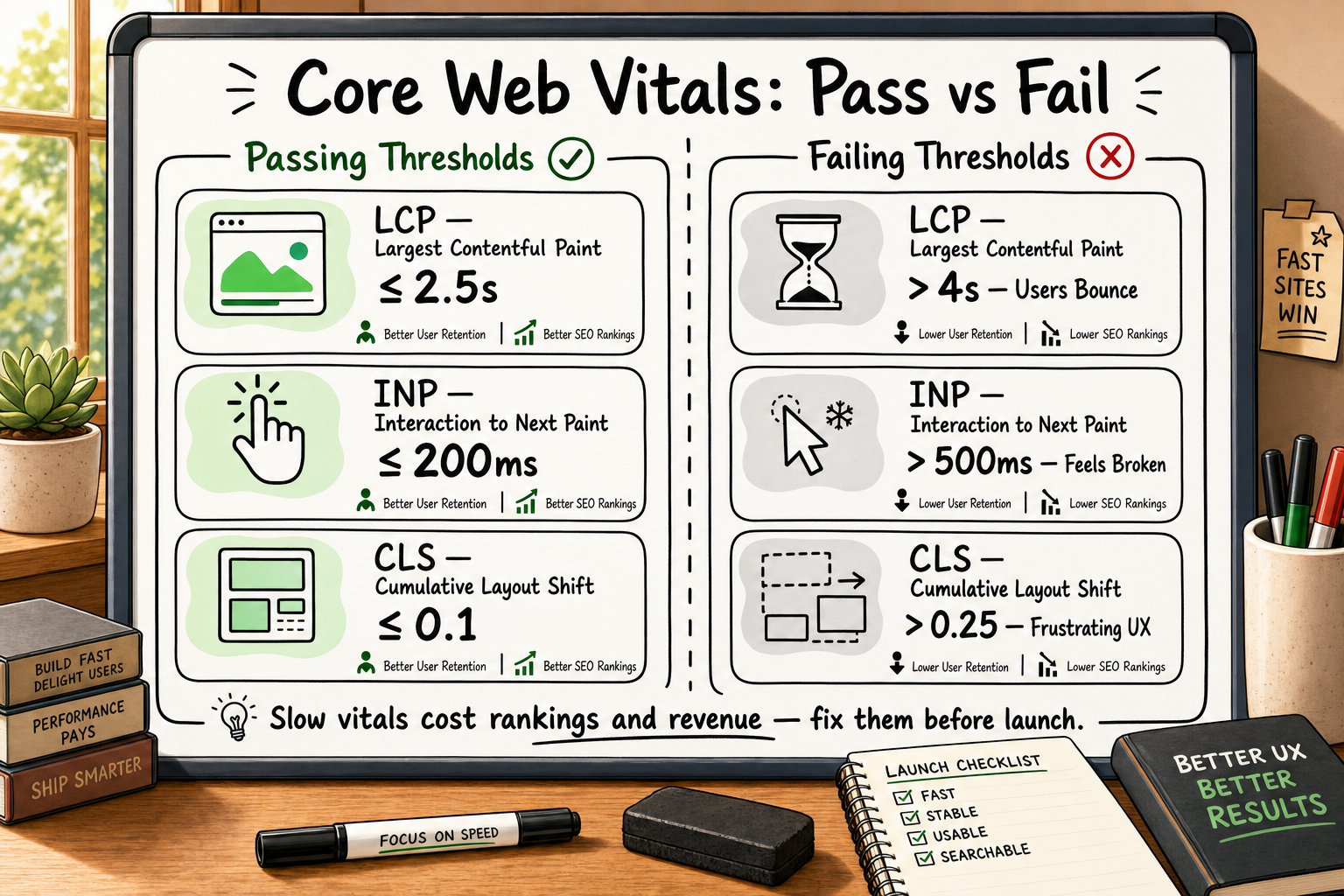
Core Web Vitals: LCP, INP, and CLS Explained Simply
Google uses Core Web Vitals as a direct ranking signal. More importantly, they measure whether your product actually feels fast to users. Here are the thresholds that matter [Source: web.dev/performance]:
- Largest Contentful Paint (LCP): The time it takes for the main content of the page to load. Target: under 2.5 seconds.
- Interaction to Next Paint (INP): How quickly the page responds to user input. Target: under 200 milliseconds.
- Cumulative Layout Shift (CLS): How much the page layout shifts while loading. Target: under 0.1.
A product that fails these thresholds loses users before they convert and loses organic traffic because Google deprioritises slow pages.
Checklist item 9: Run a Lighthouse audit on the three most critical pages (home, sign-up, core product view) and confirm all three Core Web Vitals pass.
Database Query Optimisation: The Silent Killer of Startup Apps
The most common performance problem in startup applications is not slow front-end rendering — it is unoptimised database queries. A query that runs in 50 milliseconds with 100 rows can take 30 seconds with 100,000 rows if it has no index.
When building the FieldFolio B2B wholesale marketplace for 40,000+ retailers across Australia and New Zealand, database indexing and query planning were architectural decisions made in the first sprint — not optimisations bolted on after launch. The difference is enormous.
Checklist item 10: Every database table that is queried by a user-facing endpoint has appropriate indexes on the columns used in WHERE and JOIN clauses.
Caching Strategy: When and What to Cache
Checklist item 11: Frequently read, rarely changed data (product catalogues, configuration, reference data) is served from a cache layer rather than hitting the database on every request.
Checklist item 12: Cache invalidation logic is documented and tested — stale data in a cache is its own category of production bug.
Application Security Checklist: 10 Controls Every Founder Should Confirm
Input Validation and Injection Prevention
Injection attacks — SQL injection, command injection, cross-site scripting — remain the top category of web application vulnerabilities [Source: owasp.org/www-project-top-ten/]. The fix is consistent input validation: every piece of data that enters your system from outside (user forms, API requests, file uploads) must be validated and sanitised before it touches your database or business logic.
Checklist item 13: No user-supplied input is passed directly to a database query or shell command without parameterisation.
Checklist item 14: Output rendered in the browser is escaped to prevent cross-site scripting.
Authentication, Session Management, and MFA
Checklist item 15: Passwords are hashed with a modern algorithm (bcrypt, Argon2) — never stored in plain text or as MD5 hashes.
Checklist item 16: Session tokens are rotated after login and invalidated on logout.
Checklist item 17: Multi-factor authentication is available for all admin and high-privilege accounts.
Secrets Management: No Credentials in Your Codebase
This is one of the most common mistakes in early-stage startup codebases, and one of the most dangerous. API keys, database credentials, and third-party service tokens committed to a Git repository — even a private one — are a significant security risk.
Checklist item 18: All secrets are stored in environment variables or a dedicated secrets manager (AWS Secrets Manager, HashiCorp Vault, or equivalent) — never in source code or version control.
Dependency Scanning and Third-Party Risk
Checklist item 19: The project's third-party dependencies are scanned for known vulnerabilities at least once per sprint using a tool such as npm audit, Snyk, or Dependabot.
Checklist item 20: A process exists for applying security patches to dependencies within a defined SLA (48–72 hours for critical vulnerabilities is a reasonable benchmark).
How to Use This Checklist as a Non-Technical Founder
The 5 Questions to Ask Any Development Team Before Signing
You do not need to read code to evaluate software quality. You need to ask the right questions and listen carefully to how a team answers them.
- "Can you walk me through how a pull request gets reviewed before it reaches production?" A team with no clear answer has no review process.
- "Where is the architecture documentation for this project?" If it does not exist, the knowledge is locked in someone's head.
- "What is your test coverage on the payment and authentication flows specifically?" The answer reveals whether testing is meaningful or cosmetic.
- "How do you manage secrets and environment variables?" This is a direct security check that any competent team should answer confidently.
- "If you were hit by a bus tomorrow, how long would it take a new senior developer to understand this codebase and ship a feature?" This question surfaces documentation gaps faster than any other.
Red Flags That Signal a High-Debt Codebase
From first-hand experience auditing codebases handed over from previous freelancers and agencies during client onboarding, the most common red flags I encounter are:
- No
.env.examplefile — secrets management is an afterthought - A single
utils.jsorhelpers.pyfile containing thousands of lines — Single Responsibility was never applied - Zero migration scripts — the database schema exists only on a specific machine
- No CI pipeline — deployments are manual and undocumented
- Test files that exist but have not been run in months (visible from commit history)
None of these require you to read code. They are questions you can ask and answers you can verify.
What a Quality Gate in a Sprint Looks Like
A mature development team applies quality gates at multiple points in each sprint:
- Definition of Ready: a feature is not started unless the acceptance criteria are documented
- Pull Request Review: code is not merged without peer review
- Automated Tests: the CI pipeline must pass before deployment
- Definition of Done: a feature is not marked complete until it has passed manual QA against the acceptance criteria
If a team cannot describe each of these steps, the quality of the output is unpredictable.
Frequently Asked Questions
What are the SOLID principles and why do they matter for startup software? SOLID stands for Single Responsibility, Open/Closed, Liskov Substitution, Interface Segregation, and Dependency Inversion. Each principle is a rule that keeps your codebase modular and safe to change. For a startup, they matter because they determine whether adding a new feature is a two-day job or a two-week risk — and whether a new developer can contribute without breaking existing functionality.
How can a non-technical founder evaluate code quality? You do not need to read code. Ask your team five questions: how pull requests are reviewed, where architecture documentation lives, what test coverage exists on critical flows, how secrets are managed, and how long a new developer would need to get productive. The answers — or the absence of answers — tell you everything.
What security checks should a startup run before launch? At a minimum: confirm that no secrets are stored in source code, that all user input is validated before touching the database, that passwords are hashed with bcrypt or Argon2, that session tokens are rotated after login, and that third-party dependencies have been scanned for known vulnerabilities. These five controls address the majority of real-world startup breaches.
How does technical debt affect a startup's ability to raise a Series A? Technical due diligence is now standard at Series A. A reviewer will assess whether the codebase can be scaled and maintained by a new team. Undocumented, high-debt codebases are a documented deal risk — they can reduce valuation or cause investors to request a rebuild as a condition of investment. Clean architecture and documented decisions are a genuine fundraising asset.
What performance benchmarks should a web app meet before launch? The minimum standard is passing Google's Core Web Vitals: Largest Contentful Paint under 2.5 seconds, Interaction to Next Paint under 200 milliseconds, and Cumulative Layout Shift under 0.1. These thresholds affect both SEO ranking and user retention. Run a Lighthouse audit on your three most critical pages before launch [Source: web.dev/performance].
How often should a startup conduct a code review? Every pull request should be reviewed by at least one other developer before merging — no exceptions. A broader architectural review at the end of each sprint or fortnightly catches structural drift before it becomes expensive to reverse.
How Decyb Technology LLP Builds Software That Passes Every Item on This Checklist
Every item in this checklist exists because I have seen what happens when it is missing — not in theory, but in real client codebases that were handed to me after a previous team walked away.
At Decyb, the checklist above is not a retrospective audit. It is the process from day one.
Architecture Decisions That Are Documented and Defensible
Every engagement produces an architecture decision record for each major technical choice — database selection, authentication approach, caching strategy, deployment infrastructure. These documents are written so that a future CTO, a Series A technical reviewer, or an acquirer can understand exactly why each decision was made and what trade-offs were accepted.
This is how the FieldFolio B2B wholesale marketplace was built: a documented, multi-tenant architecture serving 40,000+ retailers across Australia and New Zealand, with retailer onboarding flows, supplier catalogue sync, and order management all designed to scale independently. It is also how the Multiverse multi-tenant restaurant management system was delivered — a production-grade POS, inventory, online ordering, and back-office system built on React, Node.js, and Express with clean separation of concerns at every layer.
Security and Performance Baked In from Sprint One
Security and performance are not items added at the end of a project. They are acceptance criteria from the first sprint. Every Decyb engagement includes dependency scanning, secrets management review, input validation standards, and a Lighthouse audit on every major user-facing view before launch.
That approach is reflected in a consistent ★ 5.0 delivery record across 12+ years of client engagements, from 2014 to 2025. It is also why clients return — We have retained by a single client across 10+ years in multiple technical capacities because the code written in year one is still maintainable and extendable in year ten.
What Working with Decyb Looks Like from Day One
Every engagement starts with a free 24-hour custom technology strategy call with a senior partner. In that call, you get an honest assessment of your current codebase (if one exists), your architecture options, and the risk profile of each approach — with no obligation to proceed.
If you engage, you work directly with senior engineers — not account managers or project coordinators. Jatinder leads every engagement personally, from architecture through to post-launch. Delivery is fixed-price and scoped end-to-end, so there are no surprise invoices when scope is clear.
If you have been burned by a previous agency or freelancer — if you have inherited a codebase you are not confident in, or if you are preparing for a funding round and need to be certain your architecture is defensible — the strategy call is the right starting point.
Book your free strategy call — get a plan in 24 hours.
All project timelines and delivery estimates are indicative and subject to scope confirmation. Third-party service costs (hosting, domains, SaaS tools) are billed separately at cost. Decyb Technology LLP is registered in India; engagements are subject to terms of service available at decyb.com/terms.