
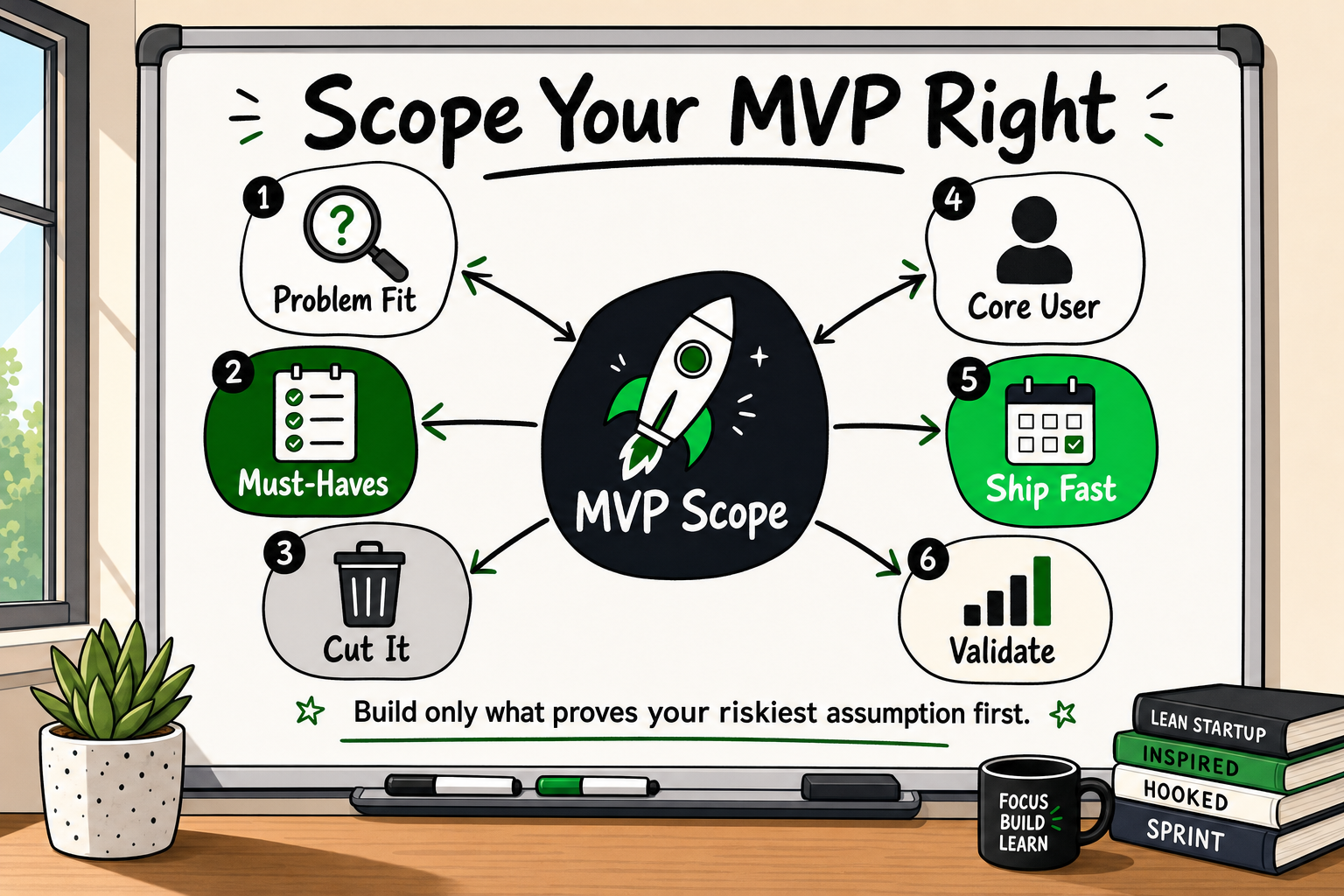
Learning how to scope an MVP properly is the most valuable hour you will spend before writing a single line of code. Get it wrong and you will burn three to six months of runway on a product that solves a problem nobody actually has — or solves the right problem with so many features that the core value gets buried. This guide gives you a practical, repeatable framework to separate what your MVP must do from everything it could do, so you ship something real, fast, and fixable.
 ## Why Most MVPs Ship Too Much (and Still Solve Nothing)
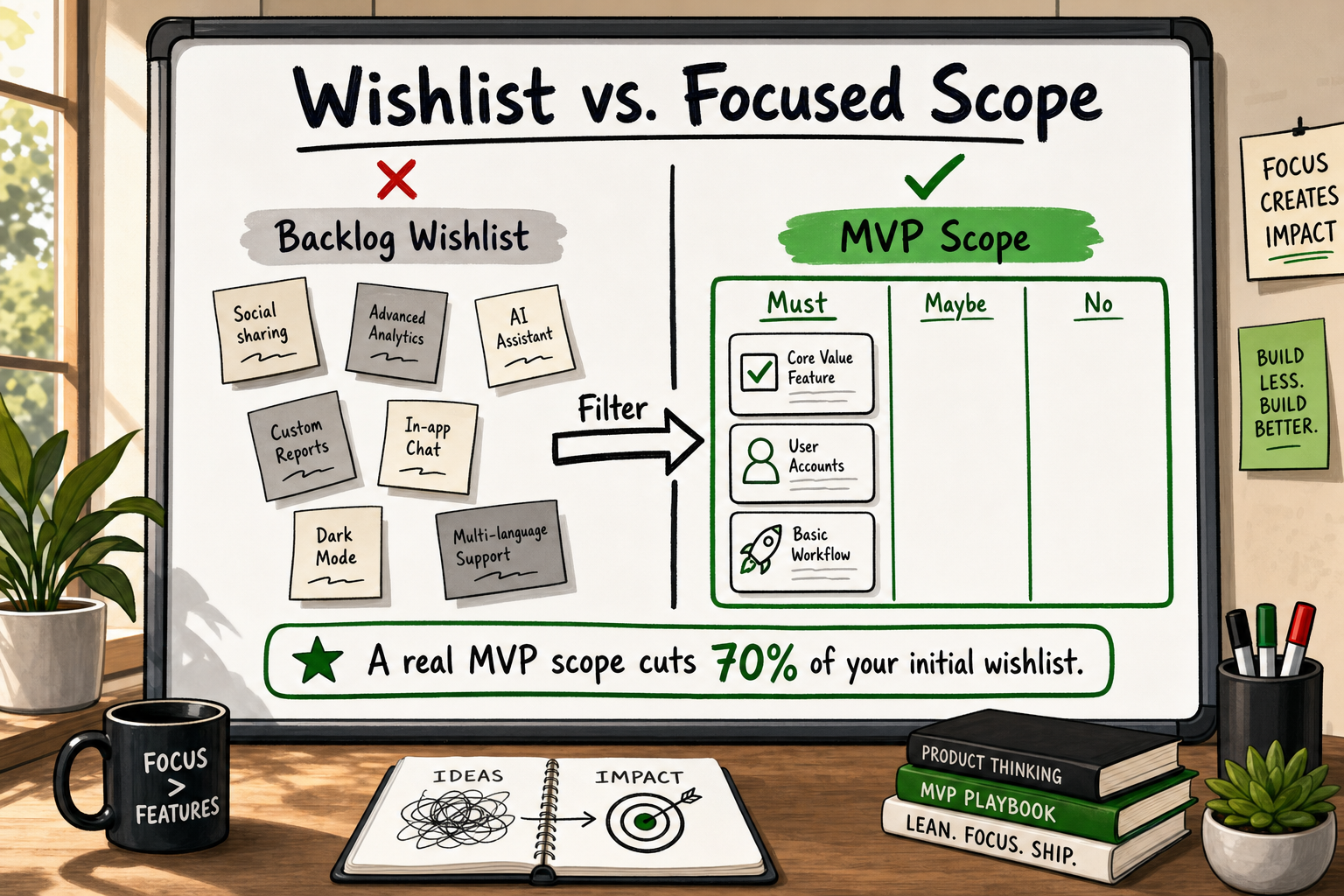
After more than 16 years of building software across SaaS, fintech, healthcare, and eCommerce, the pattern I see most often is not bad code. It is a scope defined by the founder's wishlist rather than the user's minimum need. The two things look identical on a Notion doc and feel completely different when you are three sprints in and nothing works end-to-end.
The Assumption Trap: Building for Imaginary Users
Most MVP scopes start with a deck. The deck has a persona — let's call her Sarah, 34, marketing manager, hates spreadsheets. Sarah is real enough to feel valid but fictitious enough to agree with every feature the founder already wanted to build. The product gets scoped around Sarah's imagined workflow rather than around the single thing that would make Sarah pay for it or tell a colleague about it.
The result is a product with eight features, none of which are finished well enough to demonstrate the core promise.
How Scope Creep Starts Before the First Line of Code
Scope creep is not a development problem — it is a scoping problem that shows up during development. It starts in the requirements document, when a phrase like "the user should be able to manage their account" gets written without anyone agreeing on what "manage" means. By the time a developer interprets it, it has grown from a simple profile edit to a full permissions system, audit logs, and a bulk import feature.
Every ambiguous requirement is a future scope argument waiting to happen. The antidote is specificity, applied before the project starts.
 ## What 'Minimum Viable' Actually Means in Practice
The word "minimum" gets heard as "cheap" and "viable" gets heard as "just about working." Neither is correct, and building on those definitions produces either a throwaway prototype or a half-finished product that embarrasses you in a demo.
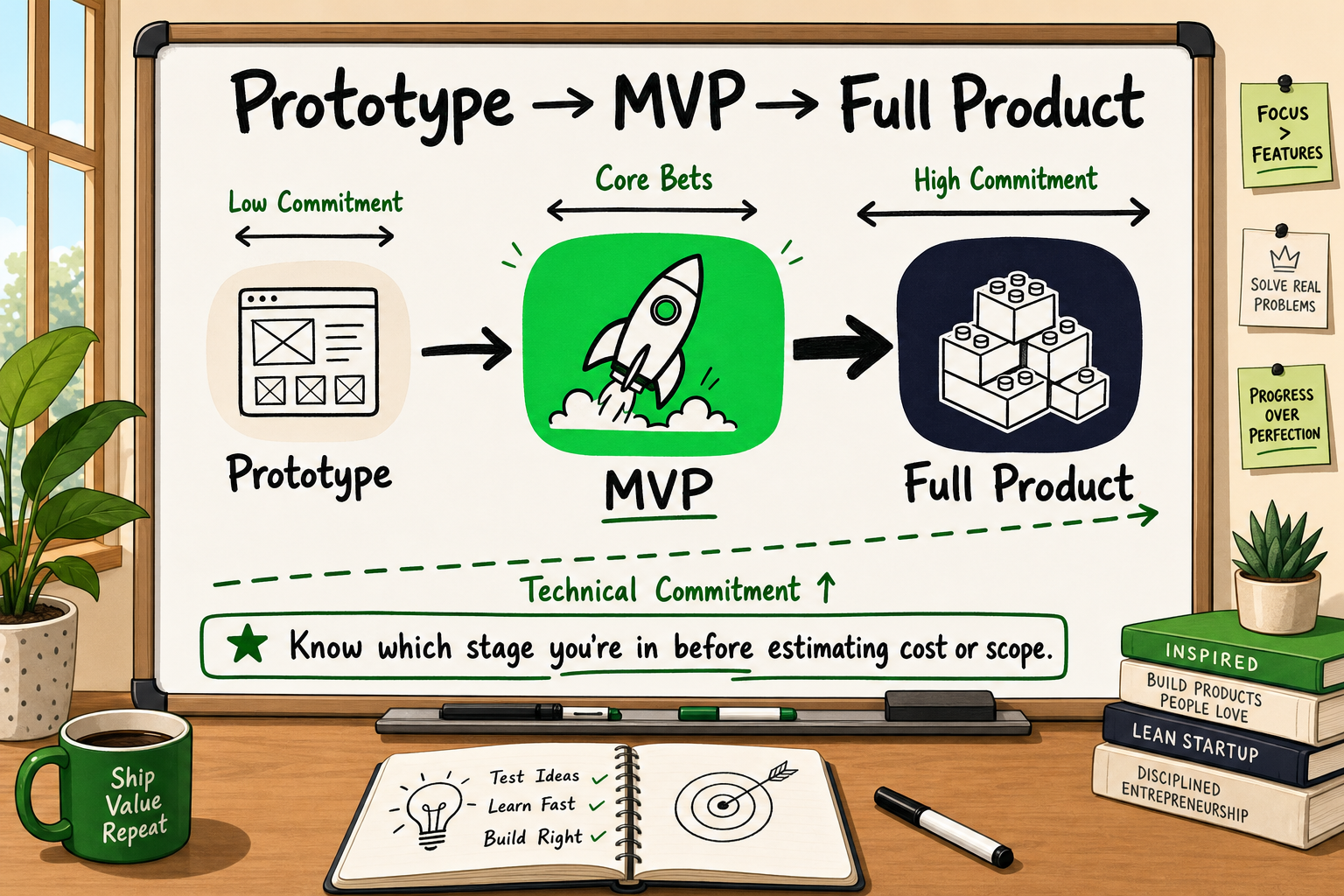
MVP vs Prototype vs Beta: The Distinctions That Matter
- Prototype: A visual or functional mock-up built to test an idea. It is not meant to survive real users or real data.
- MVP: A production-quality product that does one thing well enough for real users to get real value from it. It is built to be extended, not thrown away.
- Beta: An MVP with a controlled user group, used to gather structured feedback before a wider release.
The MVP is the stage where architectural decisions lock in. A database schema written for a prototype gets you into trouble at scale. A schema written for an MVP should still hold at 10× the initial load \[Source: Martin Fowler, Microservices — martinfowler.com\].
The One Question Every MVP Feature Must Answer
Before any feature goes on the list, it must answer this question: Does this feature directly test the riskiest assumption in our business model?
If the answer is no, or if you have to stretch to make the case, the feature belongs in V2. This single filter removes more scope arguments than any other tool I have used.
The Four-Step Scoping Framework Used on Real Projects
The following four steps are drawn from the internal scoping process we use at Decyb before any estimate is produced. The same process informed the architecture for FieldFolio, a B2B wholesale marketplace built for 40,000+ retailers across Australia and New Zealand, where getting the scope wrong would have meant building a system that could not handle multi-tenant data isolation or supplier catalogue sync at scale.
\[INTERNAL LINK: see our portfolio\]
Step 1: Define the Single Riskiest Assumption
Every business model rests on at least one assumption that, if wrong, makes the entire product irrelevant. Write it out as a single sentence: "We believe \[user type\] will \[do this behaviour\] because \[reason\]."
Examples:
- "We believe independent retailers will place wholesale orders digitally if the process takes less than three minutes."
- "We believe restaurant operators will switch from paper inventory to a digital system if it does not require staff retraining."
Your MVP's job is to prove or disprove that assumption with real data. Every feature that does not contribute to that test is not MVP scope.
Step 2: Map the Critical User Journey (Nothing Else)
Draw the shortest path a user must take to get to the value your product promises. This is not a sitemap — it is a sequence of steps. For a marketplace: browse → add to cart → place order → receive confirmation. That is it. Everything outside that path — wishlists, reviews, reorder history, supplier analytics — is a layer that comes after you have proven the core journey works.
User story mapping \[VERIFY: attribute to Jeff Patton's story mapping methodology\] is a practical tool here. Write each step on a card, arrange them horizontally, then write the supporting tasks underneath. Anything below the line of minimum viable experience is V2.
Step 3: Apply the MoSCoW Filter to Every Proposed Feature
MoSCoW stands for Must-have, Should-have, Could-have, and Won't-have (this sprint). Applied to your feature list:
CategoryDefinitionMVP ruleMust-haveWithout this the product cannot test the core assumptionIncludeShould-haveSignificantly improves the experience but is not blockingV1.1 or V2Could-haveNice addition with low effortV2Won't-haveAcknowledged and explicitly deferredBacklog only
The most common mistake is classifying too many features as Must-have. A useful test: if you removed this feature, would a user still be able to complete the critical journey and get core value? If yes, it is not a Must-have.
Step 4: Set a Hard Feature Freeze Date Before Sprint One
Every new feature request after the freeze goes into the V2 backlog — not into the current sprint. This is a discipline problem as much as a process problem. Write the freeze date into your project agreement. Make it visible. The feature audit you do next will give you the objective evidence to hold the line when stakeholders push back.
How to Run a Feature Audit: Must-Have vs Nice-to-Have
A feature audit is a structured review of every item on your proposed feature list, measured against three criteria: does it serve the critical user journey, does it test the riskiest assumption, and is there an alternative (manual process, existing tool, workaround) that could substitute for now.
Building the Feature Audit Table
Create a simple table with these columns:
FeatureServes critical journey?Tests core assumption?Viable substitute exists?VerdictUser loginYesNo (but necessary)NoMust-haveSocial login (Google/Apple)NoNoYes (email login)V2Reporting dashboardNoNoYes (manual CSV)V2Bulk importNoNoYes (manual entry at this scale)V2
In a scoping session for a multi-tenant SaaS product, this exercise moved a reporting dashboard from V1 to V2 after the audit showed it served internal curiosity rather than the core user journey. That decision saved approximately three weeks of sprint time and kept the team focused on the feature that would drive the first paying customer.
Red Flags: Features That Belong in V2, Not V1
- Admin panels built for scale: A simple CMS is fine; a full analytics suite is not.
- Third-party integrations that are not part of the critical user journey. Every integration adds build time, testing surface, and ongoing maintenance.
- Notification systems beyond the bare minimum needed to complete a transaction.
- Multiple user roles and permissions beyond the one role type your MVP is targeting.
- Reporting and export features that serve the operator, not the end user.
How to Handle Stakeholder Pressure to Add Scope
Refer every request back to the two filter questions: does it serve the critical user journey, and does it test the core assumption? If neither answer is yes, the feature goes to the V2 backlog — in writing. The backlog is not a rejection; it is a promise that the idea has been heard and will be reviewed after launch.
 ## Common Scoping Mistakes That Burn Runway
Mistake 1: Designing for the Edge Case, Not the Majority
Every product has power users who will push it to its limits — and those power users are often the loudest voices in early feedback sessions. Building for them in V1 means building complexity that 80% of your users will never see. Scope for the median user first. Edge case support is a V2 feature.
Mistake 2: Treating Integrations as Free
A CRM integration, a payment gateway, a shipping API — each of these looks like a single line item on a feature list and behaves like a three-week project in practice. Every integration has authentication flows, error handling, webhook reliability, and testing requirements. If an integration is not critical to testing your core assumption, defer it.
Mistake 3: Skipping the Technical Architecture Conversation Until It's Too Late
This is the most expensive mistake on the list. The database schema, multi-tenancy model, and API design decisions made at the MVP stage are the hardest and most expensive to undo at the Series A stage. A product built without clean architecture and SOLID principles \[Source: OWASP Top Ten — owasp.org\] will accumulate technical debt that eventually forces a partial or full rebuild — at exactly the moment when you need to be shipping features, not fixing foundations.
Have the architecture conversation before sprint one, not after the MVP launches.
When Your MVP Scope Is Ready: A Pre-Build Checklist
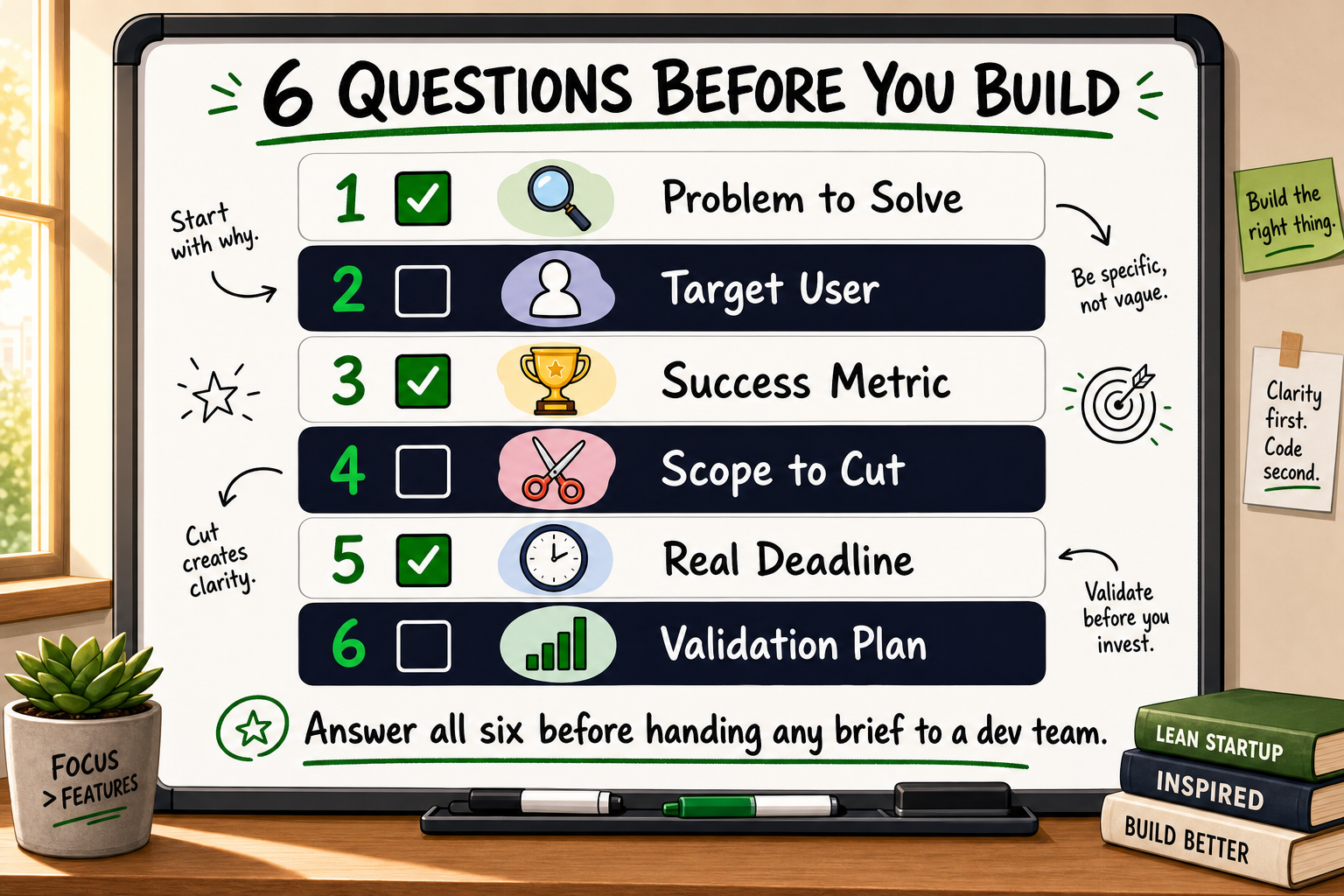
Your scope document is ready to hand to a development team when it can answer all six of these questions without ambiguity:
The Six Questions Your Scope Document Must Answer
- What is the single riskiest assumption this MVP will test? Named explicitly, not implied.
- Who is the one primary user type? Not a range of personas — one specific user with a specific job to be done.
- What is the critical user journey? Described step by step, with a clear start and end.
- What are the Must-have features? Listed with a one-sentence justification for each, tied to the critical journey.
- What are the explicit V2 items? A documented backlog, not a mental note.
- What are the technical constraints or non-negotiables? Security requirements, compliance standards, performance targets, hosting environment.
Green Light Criteria Before Sprint One
Do not start a sprint until:
- Every Must-have feature has a written acceptance criterion.
- The feature freeze date is agreed and documented.
- The architecture approach has been reviewed by a senior engineer, not just estimated.
- At least one real potential user has validated the critical user journey in a conversation or prototype test \[VERIFY: reference to lean validation methodology\].
Frequently Asked Questions
How long does it take to scope an MVP properly?A thorough scoping process typically takes one to two weeks of structured work — user journey mapping, a feature audit, and an architecture conversation. Rushing this stage is the single most expensive mistake a founder can make. The time spent here is recovered many times over during the build.
How many features should an MVP have?There is no universal number, but the right question is whether each feature directly tests your riskiest assumption. Most well-scoped MVPs cover one core user journey end-to-end, which typically means three to seven discrete features. If your list has 20 Must-haves, the filter has not been applied rigorously enough.
What is the MoSCoW method and should I use it for MVP scoping?MoSCoW stands for Must-have, Should-have, Could-have, and Won't-have (this sprint). It is a practical prioritisation filter that works well for MVP scoping when applied ruthlessly. The common mistake is treating too many items as Must-have. Used with the critical-journey test, it is one of the most effective tools available to a non-technical founder.
Should I build my MVP with no-code tools or custom software?No-code is a valid option when your core assumption can be tested without hitting platform limits — and many assumptions can be. Custom software is the right choice when your business model depends on data structures, performance requirements, or integrations that SaaS tools cannot support at the scale you are planning for. The decision should be driven by what your riskiest assumption actually needs, not by a preference for speed or familiarity.
How do I stop stakeholders from expanding MVP scope?Use a signed-off scope document and a hard feature freeze date before sprint one begins. Every new request goes into a V2 backlog in writing, which makes it a deferral rather than a rejection. The feature audit table helps because it gives you an objective framework for the conversation rather than a subjective argument about priorities.
How Decyb Technology LLP Helps Founders Scope and Build the Right MVP
The framework in this guide is not theoretical — it is the same scoping process Jatinder Kumar and the Decyb team have applied across more than 50 completed projects over 16 years, spanning SaaS, fintech, healthcare, and eCommerce. The FieldFolio B2B wholesale marketplace, built for 40,000+ retailers across Australia and New Zealand, started with exactly this kind of structured scoping conversation before a single line of code was written. So did the Multiverse multi-tenant restaurant management system, which covers POS, inventory, online orders, and back-office operations on a React and Node.js architecture.
Decyb works with non-technical founders, CTOs, and product leads who have a validated idea and need a senior technical partner to own the delivery — not a team they have to manage. Every engagement starts with a free 24-hour technology strategy call where we work through your riskiest assumption, map your critical user journey, and give you an honest read on what your MVP actually needs.
From Scope Document to Production-Ready Product
Most agencies will take your feature list and estimate it. Decyb's process starts one step earlier: we help you build the right feature list before we estimate anything. That is the difference between a project that ships on time and a project that grows by 40% in scope before the first sprint review.
Every custom web application we build — on React/Next.js and Node.js/Express — is scoped end-to-end with a fixed price, which means you know what you are getting and what it costs before work begins. Fixed-price works precisely because the scoping process is thorough enough to give both sides the confidence to commit to it.
\[INTERNAL LINK: how we build MVPs\]
Why the Architecture Conversation Happens Before Sprint One
Jatinder leads every engagement directly, which means the person who reviews your architecture is also the person who has spent 16+ years making these decisions across real production systems. The Decyb team carries a consistent ★ 5.0 delivery record across 12+ years of international client engagements — not because the work is easy, but because the scoping and architecture foundations are set correctly from the start.
If you are at the stage where you have a validated idea and need to turn it into a production-ready product without burning runway on the wrong features, the most useful next step is a direct conversation.
No cost, no obligation. Just a senior technical partner who will tell you honestly what your MVP needs — and what it does not.
All project timelines and delivery estimates are indicative and subject to scope confirmation. Third-party service costs (hosting, domains, SaaS tools) are billed separately at cost. Decyb Technology LLP is registered in India; engagements are subject to terms of service available at decyb.com/terms.