
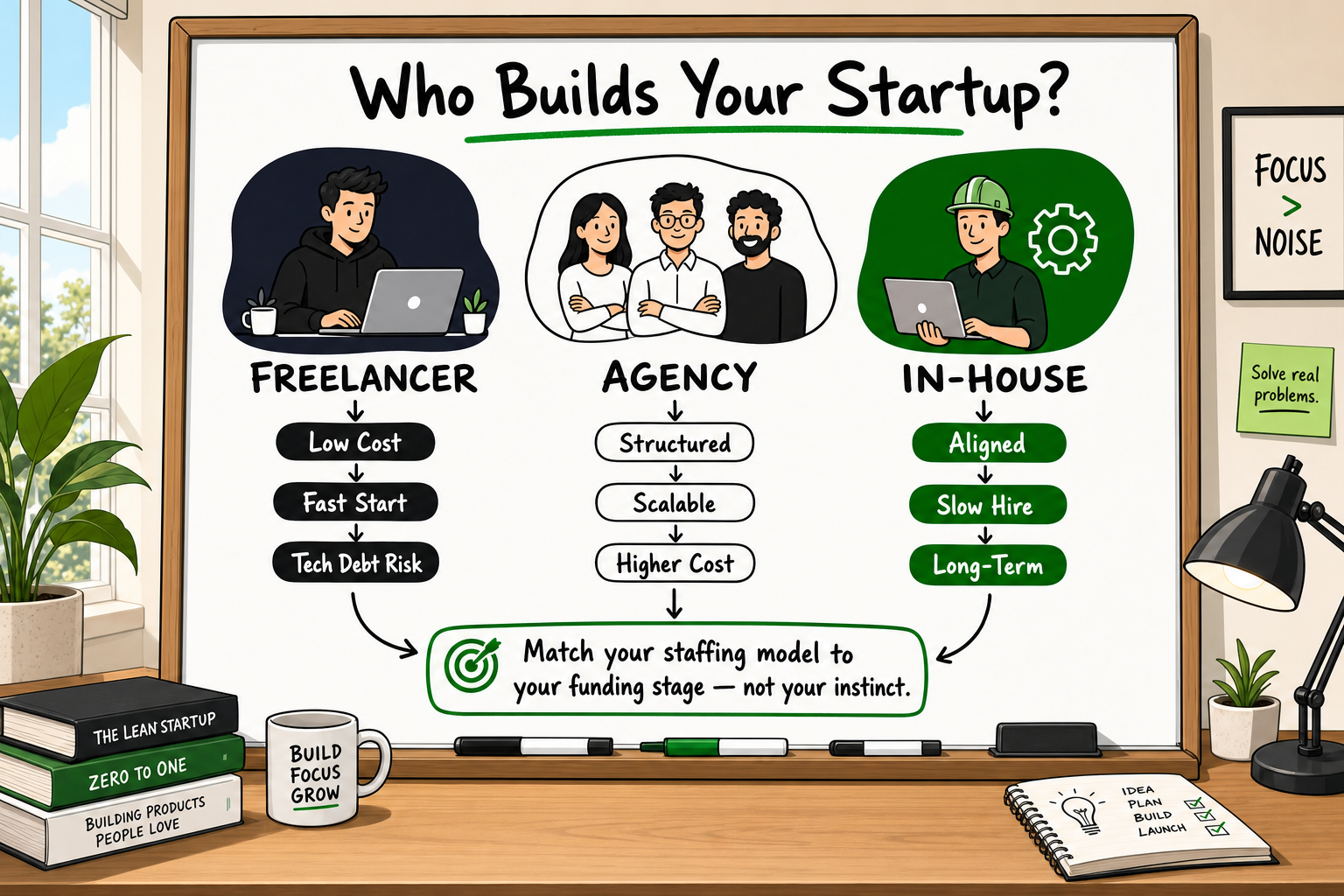
At some point in the first three months, almost every non-technical founder faces the same question: who should actually build this thing? The answer shapes your runway, your architecture, and the speed at which you can get to market. Get it right and you ship a product worth building on. Get it wrong and you spend the back half of your first year untangling a codebase that three freelancers built in three different ways.
This guide gives you a clear, honest framework for evaluating freelancers, agencies, and in-house engineers — matched to your funding stage, your product complexity, and the management bandwidth you actually have right now. There is no universally correct answer, but there is almost always a better answer for your specific situation.
Why This Decision Matters More Than Most Founders Realise
The hidden cost of getting it wrong early
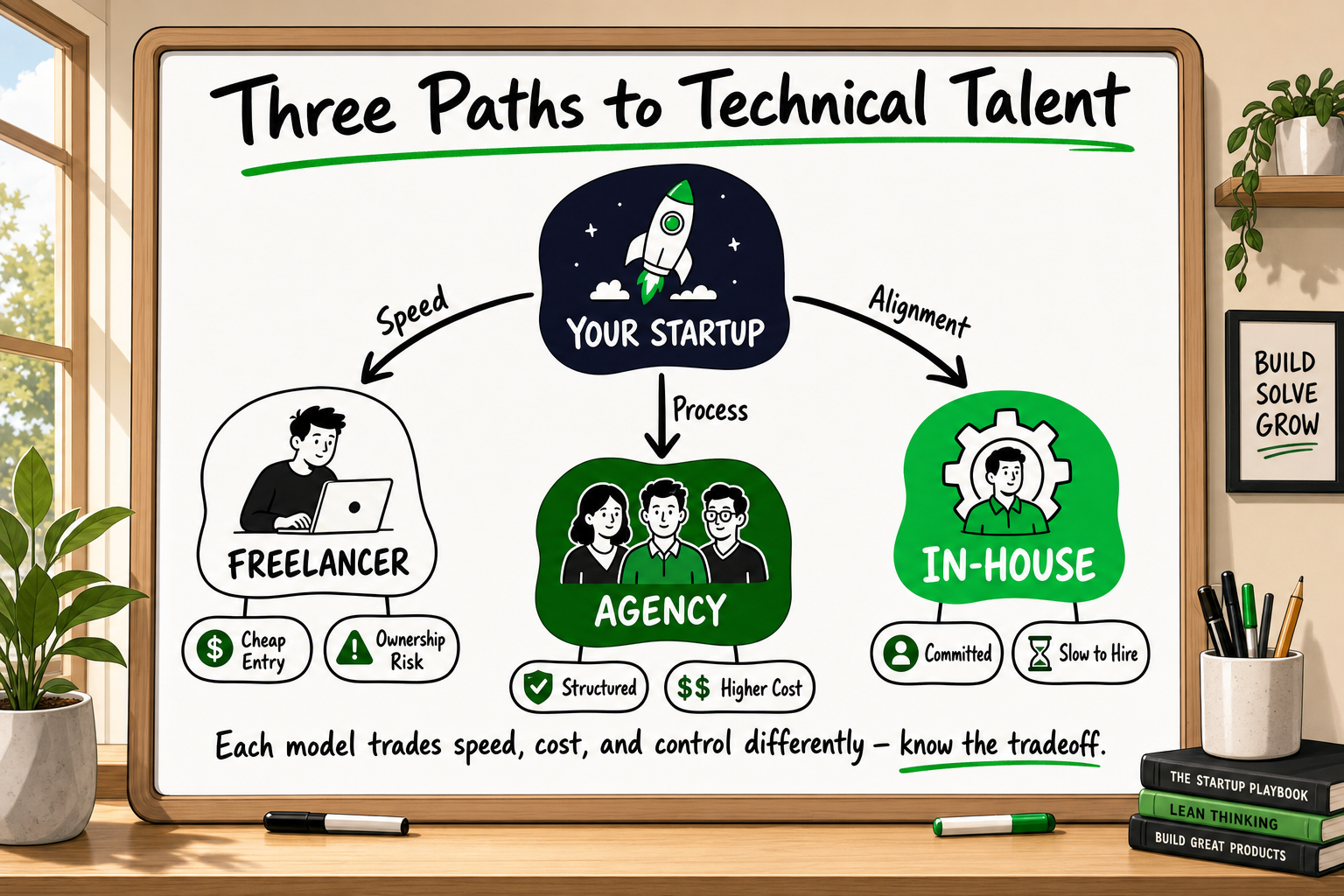
The choice between a freelancer vs agency vs in-house engineer for startups is not just a procurement decision. It is an architectural one. The people who build your first version of the product make dozens of decisions every day — about how data is structured, how authentication works, how the codebase is organised — that will either compound into a clean, extensible system or calcify into technical debt that slows every subsequent sprint.
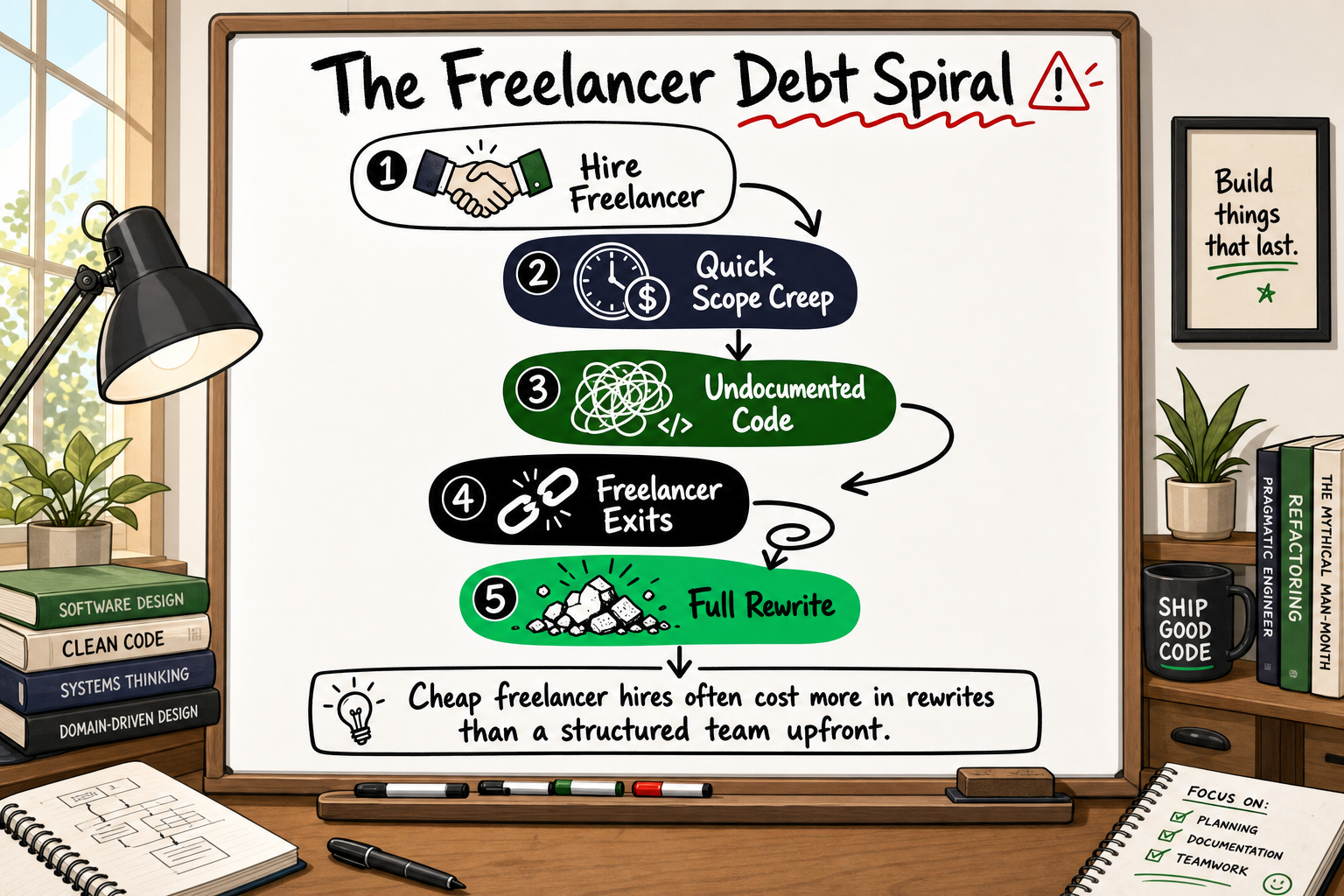
Across more than 16 years of working on early-stage products, I have seen the same pattern repeat: a founder, understandably focused on speed, makes a staffing call in week one based on whoever is available and affordable. By month four, the team has a product that works in demos but cannot be extended without breaking something. By month six, a new engineer — or a new agency — is being paid to rewrite what the first one built. That is runway burned twice on the same problem.
How your staffing model shapes your product architecture
This is the part most hiring guides skip. A freelancer working alone has no incentive to document decisions, write tests, or think about the engineer who will inherit their work. An agency with a large account management layer has incentives that are partially misaligned with shipping: they bill for hours, not outcomes. An in-house engineer hired too early costs three to six months of ramp-up time on a 12-month runway.
Each model produces a different kind of product, at a different speed, with different long-term consequences. Understanding that is the foundation for making a good decision.
Option 1: Hiring Freelancers — The Fastest Start With the Highest Variance
Where freelancers genuinely shine
Freelancers are not a bad option. They are a misapplied one. For narrow, well-defined tasks — a specific API integration, a design sprint, a one-off data migration, a short audit — a skilled freelancer is often the fastest and most cost-effective choice. You get direct access to a specialist, you pay for what you need, and you move on.
The problems begin when founders use freelancers as a substitute for a coordinated MVP development team. A single freelancer, or a loosely connected group of them, building a complex product across multiple months introduces structural risks that are not obvious until they have already compounded.
The accountability gap that kills momentum
The defining characteristic of freelance work is the absence of a single accountable owner. When a freelancer finishes a module and moves to the next client, no one is responsible for how that module interacts with the one the next freelancer is about to build. Decisions that should be made at the architecture level get made implicitly, in code, by whoever is working that week.
This is the accountability gap. It produces codebases where:
- Three different approaches to error handling exist in the same application
- There is no test coverage because each freelancer assumed someone else would write tests
- The database schema was designed for the feature in front of them, not the product roadmap ahead of them
When a new technical partner eventually inherits that codebase, the honest assessment is often that it needs significant rework before it can be safely scaled — which is exactly what the founder was trying to avoid by moving fast in the first place.
What to watch out for in a freelance engagement
- No defined handover process at the end of the engagement
- Reluctance to document decisions or write a technical specification
- Billing by the hour with no fixed scope — every change request adds cost and time
- No single point of contact who owns the overall architecture
If you do use freelancers, define the scope down to the ticket level before work begins, agree on a handover checklist, and make documentation a contract requirement.
Option 2: Hiring a Software Agency — Speed and Structure, If You Pick Well
What a good agency engagement looks like
A good software development agency for startups should solve the coordination problem that freelancers cannot. You get a team that works together, a process that structures the work, and — critically — a single entity that is accountable for delivery. The agency owns the architecture, the quality gates, and the handover. You should not need to become the de-facto project manager.
The best agency engagements feel like having a senior technical partner embedded in your company. Decisions get explained, not just executed. Architecture choices come with documented trade-offs. Sprints have clear outputs. The codebase is clean enough to hand to a future CTO without embarrassment.
The warning signs of an agency that will slow you down
Not every agency operates this way. Watch for these warning signs:
- Layer on layer of account managers between you and the engineers. If you cannot speak directly to the person writing the code, the agency is selling you process theatre rather than outcomes.
- Time-and-materials pricing with a vague scope. This structure transfers all the risk to you. Every scope question becomes a billing event.
- Impressive-looking portfolios with thin case studies. Ask to speak to the client named in the case study. If the agency hesitates, treat that as a signal.
- Slow response times during the sales process. Communication patterns before you sign are a reliable preview of communication patterns once you do.
Fixed-price vs time-and-materials: which protects you?
Fixed-price software development is not inherently safer, but it forces a discipline that benefits both sides: the agency must scope properly before work begins, and the founder understands what they are buying before they commit. The risk to watch for is a fixed price set without a thorough discovery phase — that is just a time-and-materials project with a payment structure bolted on top.
A well-structured fixed-price engagement includes a documented scope, a change-request process that is transparent rather than punitive, and milestones tied to working software rather than deliverable documents.
Option 3: Building an In-House Engineering Team — The Long Game
The real cost of an in-house hire beyond salary
Salary is the number founders look at. Total cost is what actually hits the runway. For a senior engineer hired in the UK, Australia, or the US, the loaded cost — salary, employer contributions, equipment, recruiter fees, benefits, and management time — typically runs 30–40% above the base salary figure [VERIFY]. Then add the ramp-up period.
A senior engineer joining a startup takes three to six months to reach full productivity [VERIFY]. On a 12-month runway, that is a meaningful share of your operating window spent on onboarding rather than shipping. On a 18-month runway, the maths looks better — but only if the hire works out on the first attempt. A failed senior hire, including the cost of recruiting a replacement, is one of the most expensive mistakes an early-stage company can make.
When in-house starts to make sense
When to hire in-house engineers is a question of traction, not ambition. The right conditions are:
- The product has found initial market fit and engineering is now a daily operational dependency
- The architecture is documented and stable enough to onboard a new engineer in less than two weeks
- You have the runway to absorb a 3–6 month ramp-up without it affecting go-to-market execution
- You need strategic engineering ownership — someone who can make long-term architectural decisions from inside the company
Before those conditions exist, in-house hiring is often an expensive way to buy the feeling of control rather than actual delivery velocity.
The hybrid approach: in-house lead plus external delivery pod
A model that works well at Series A is the hybrid: one or two in-house technical leads who own the product roadmap and architectural direction, working alongside an external delivery team who execute against well-defined briefs. The in-house lead provides continuity and institutional knowledge; the external team provides capacity and specialist skills without the overhead of full-time headcount.
This model requires a mature relationship with the external partner — one where trust, communication standards, and handover processes are already established.
A Funding-Stage Framework: Matching Your Setup to Your Stage
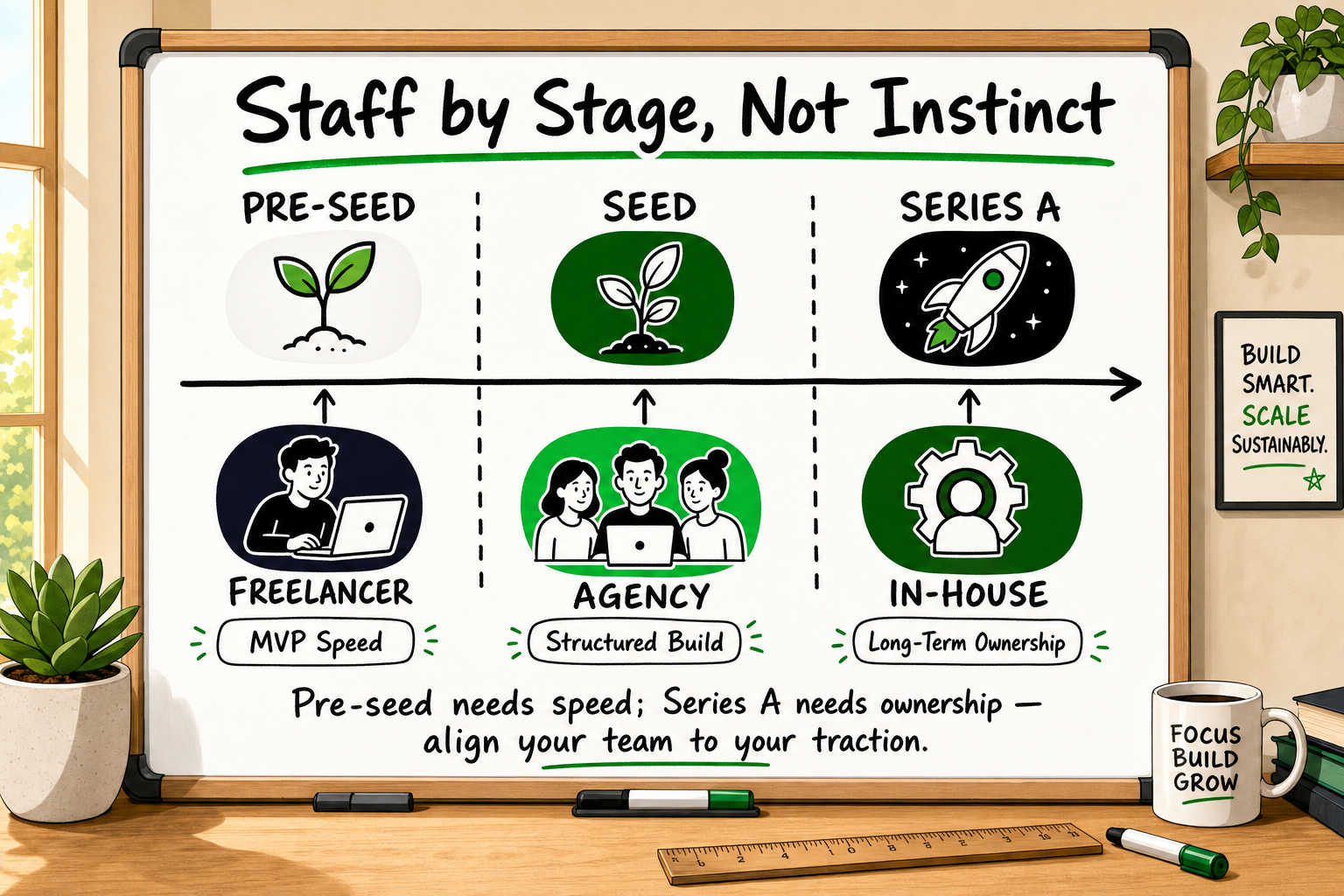
The following is not a rigid prescription. It is a starting framework based on the patterns that tend to produce good outcomes at each stage.
Pre-seed and bootstrapped: what works
At this stage, your primary constraint is capital. Your secondary constraint is clarity — you probably do not yet know exactly what you are building. The right model is the one that minimises waste while giving you enough to test your core assumptions.
What tends to work:
- A single trusted freelancer for a narrow proof-of-concept or landing page test
- A small specialist agency for an MVP if the product concept is already validated and the scope is clear
- No in-house hire — the recruiting, onboarding, and salary cost is almost never justified at this stage
Seed stage: where the decision gets harder
At seed, you have some capital and a clearer product direction, but you are still making foundational architectural decisions that will matter at Series A. This is the stage where the staffing model has the highest long-term consequence.
What tends to work:
- A senior technical partner or specialist agency who can own architecture decisions, not just execute them
- Clear documentation of every major technical decision — you will need this for investor due diligence and future CTO onboarding
- A fixed-price engagement for the core product, with a defined change-request process for scope evolution
- Avoidance of a large freelance team unless each freelancer has a defined, non-overlapping scope
Series A and beyond: when to bring engineering in-house
Post-Series A, the product has users, the architecture has been tested under real load, and engineering is a strategic function rather than a project. This is when building an in-house team starts to pay off.
What tends to work:
- Hiring one or two senior engineers to own product engineering and architectural direction
- Retaining an external partner for capacity overflow, specialist skills, and ongoing growth systems
- Investing in the tooling, documentation, and processes that make the codebase transferable
The Questions Every Founder Should Ask Before Choosing a Model
Regardless of which path you choose, these questions will give you a clearer picture before you commit.
Questions to ask a freelancer before you hire
- Can you show me a codebase you handed over to another team? What did that handover look like?
- How do you document architectural decisions as you go?
- What happens if you become unavailable mid-project?
- Are you comfortable working within a defined scope, or do you prefer open-ended engagements?
Questions to ask an agency before you sign
- Who will be the single accountable owner of delivery on your side?
- Can I speak directly to the engineers, or does everything go through an account manager?
- What does the handover process look like if we stop working together tomorrow?
- Can you share a case study where the project did not go to plan, and walk me through how you resolved it?
- How is scope change handled — is there a transparent change-request process?
Questions to ask yourself before committing to in-house
- Do I have the runway to absorb 3–6 months of ramp-up time without it affecting my shipping timeline?
- Is engineering already a daily operational dependency, or am I at a stage where it is still project-based?
- Do I have the management capacity to recruit, onboard, and retain a senior engineer right now?
- Could a well-structured external partnership give me 80% of the benefit at 40% of the cost and management overhead?
One question I ask in every discovery conversation at Decyb — and that every founder should ask any technical partner: "What does the codebase handover look like if we stop working together tomorrow?" If the answer is vague, that is a signal worth taking seriously.
Frequently Asked Questions
Is it cheaper to use a freelancer or an agency for my MVP?
Freelancers usually have a lower day rate, but total cost is the number that matters. When you factor in coordination time, the rework that follows inconsistent standards, and the absence of a single accountable owner, freelance MVPs often cost more in total than a well-scoped agency engagement. Compare total cost of delivery, not day rate.
When should a startup stop using freelancers and hire in-house?
Typically when the product has found initial traction, the architecture is documented and stable, and engineering has become a daily operational dependency. For most startups, that is post-seed or early Series A. Before that point, the recruiting and onboarding cost rarely justifies the velocity gain.
What are the biggest risks of building an MVP with freelancers?
The primary risks are: no single owner of architectural decisions, inconsistent coding standards across contractors, no test coverage, and a codebase that is difficult to hand over or extend. These combine into a technical debt problem that typically requires expensive rework before the product can scale.
Can a small software agency handle the security and performance needs of a complex product?
Yes, if the agency employs senior engineers with relevant domain experience and documents its architectural decisions. Seniority and process rigour matter far more than headcount. The benchmark for security should be frameworks like the OWASP Top Ten [Source: owasp.org], not the size of the team building against it.
What is the hybrid model and when does it make sense?
The hybrid model pairs one or two in-house technical leads with an external delivery team. The in-house lead owns product direction and institutional knowledge; the external team provides execution capacity and specialist skills. It works well at Series A, when a startup needs engineering ownership but cannot justify a full in-house bench.
How Decyb Technology LLP Approaches Early-Stage Technical Staffing
What makes a lean senior team different from a typical agency
Most of the problems this guide covers — the accountability gap, the process theatre, the codebase you cannot hand off — come from the same root cause: a misalignment between what the development partner is incentivised to do and what the founder actually needs.
Decyb was built specifically to close that gap for early-stage startups. There are no account manager layers between founders and engineers. Every engagement is led directly by a senior partner with full-stack engineering experience across SaaS, fintech, healthcare, and eCommerce. Architecture decisions are documented, explained, and tied to business outcomes — not just shipped and invoiced.
Engagements are structured on a fixed-price model with a transparent change-request process, so there are no surprises once work begins. The handover process is defined before the first sprint starts.
Proof points from real engagements
The model has been tested on genuinely complex problems:
- FieldFolio, a B2B wholesale marketplace, was designed and shipped for 40,000+ retailers across Australia and New Zealand — a multi-tenant architecture with retailer onboarding, supplier catalogue sync, and order management built to scale from day one.
- Multiverse, a multi-tenant restaurant management system, covers POS, inventory, online orders, and back-office operations on a React/Node.js/Express stack — the kind of product complexity where architecture decisions made in week one still matter in year three.
- Jatinder Kumar has been retained by a single client across 10+ years in multiple technical capacities — a ★ 5.0 long-term review that reflects what consistent, accountable delivery actually looks like over time.
These are not portfolio pieces assembled for impressiveness. They are systems in production, serving real users, built on the same architectural principles we apply to every engagement. [INTERNAL LINK: /portfolio]
Is Decyb the right fit for your stage?
Decyb works best with non-technical founders at seed stage who need a trusted technical partner to own delivery end-to-end, and with startups that have outgrown a freelance setup and need someone who can take full ownership of the architecture without requiring constant management.
If you are earlier than that — still testing an idea, not yet ready to scope a full build — the most useful thing we can offer right now is a conversation. We run a free 24-hour technology strategy call with a senior partner. No obligation, no sales process. Just an honest assessment of your options based on where you actually are.
Book your free strategy call — get a plan in 24 hours →
All project timelines and delivery estimates are indicative and subject to scope confirmation. Third-party service costs (hosting, domains, SaaS tools) are billed separately at cost. Decyb Technology LLP is registered in India; engagements are subject to terms of service available at decyb.com/terms.